
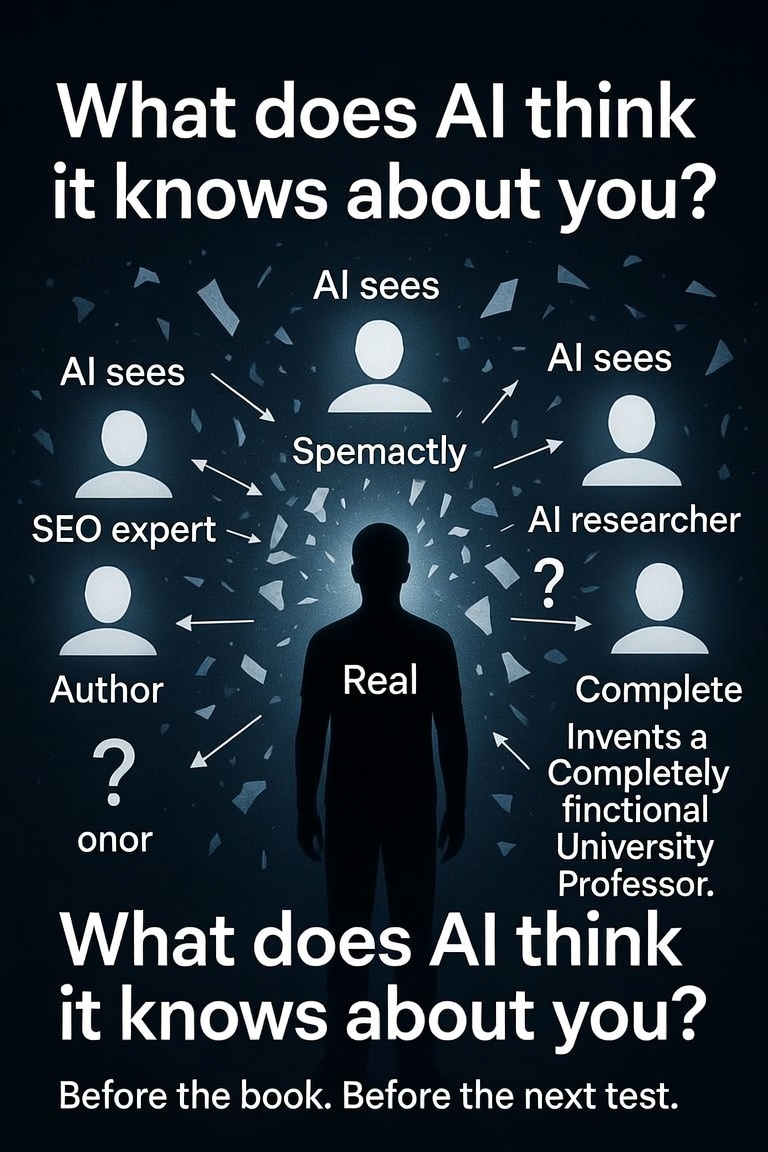
I'm currently finishing The AI Visibility Handbook, a book about how brands, authors and ideas become understood, remembered and cited by AI systems.
Before publishing it, I wanted to do something simple.
I wanted to freeze the current situation.
If the book eventually changes the way AI systems associate my name with concepts such as AI Visibility, reconstructability, semantic identity or in-model invisibility, I need to know what they understand before the book exists publicly. Otherwise, a few months from now, I will have nothing meaningful to compare.
So I opened fresh conversations with several AI models and asked exactly the same question:
Who is Stefano Galloni and what original ideas has he published about AI visibility?
I gave them no biography, no links, no explanation of the Reconstructability Framework and no mention of NetContentSEO. I wanted the models to work with whatever representation they already had.
The differences were much larger than I expected.
Some remote models reconstructed a surprisingly coherent picture. ChatGPT, Gemini, Grok and Perplexity associated my name with ideas I have actually been writing about: reconstructability, semantic visibility, citability, entity recognition and the shift from ranking toward being understood.
They didn't always agree on the details, and some answers mixed accurate information with things I would describe more cautiously, but the underlying conceptual identity was often recognizable.
NetContentSEO, however, still appeared inconsistently. That is particularly interesting to me because much of the recent work behind these ideas has been published there. At the moment, the concepts sometimes seem easier for models to reconstruct than the site that is publishing them.
Then I tested smaller local models.
That changed the experiment completely.
Gemma 3 4B didn't simply fail to recognize me. It invented another version of me: a university professor, founder of an AI research lab and author of academic papers that do not exist.
The answer was detailed. It sounded credible. It included institutions, publication titles and dates.
Almost all of it was fabricated.
Meta Llama 3.1 8B did something much safer. It simply said it couldn't find enough information connecting Stefano Galloni with AI visibility. It even wondered whether the name had been confused with someone else.
Qwen landed somewhere in between. It didn't really know the answer, but it tried to infer what a person working on "AI visibility" would probably research. The result was a plausible profile around explainable AI, model interpretability and ethical AI.
Again, plausible.
Again, not me.
That was the part of the experiment I found most interesting.
We usually talk about AI visibility as if there were only two possibilities: a model knows you or it doesn't.
These results suggest something more complicated.
A model may reconstruct you accurately. It may reconstruct only part of your identity. It may not recognize you at all. Or it may have enough fragments to build something that sounds coherent while being fundamentally wrong.
That last state may actually be worse than invisibility.
If an AI says it doesn't know who you are, you have a visibility problem.
If it confidently explains who you are and invents the answer, you have an identity problem.
This is also why I wanted to run the experiment before publishing the book.
The current answers become a baseline.
The book will eventually be published. NetContentSEO will continue growing. The same concepts will appear in more places and in more consistent contexts.
Then, after some time has passed, I can ask exactly the same question again.
Maybe nothing will change.
Maybe only retrieval-enabled systems will improve.
Maybe Net Content SEO will begin appearing more consistently.
Maybe smaller models will still know nothing.
Whatever happens, I will have something to compare it with.
For now, this is simply a photograph of how different AI systems reconstruct the same person before one of the largest pieces of content connecting that person to these ideas has been published.
And perhaps the most interesting part is not what the models know.
It is what they invent when they don't.
ChatGPT
Prompt:
Who is Stefano Galloni and what original ideas has he published about AI visibility?
Complete response:
Stefano Galloni is an Italian SEO professional and independent researcher focused on the transition from traditional search-engine optimization toward AI-native visibility: how brands, authors, entities, and ideas are understood, reconstructed, and cited by LLMs and generative search systems. His public profile describes his work around technical SEO, semantic/entity systems, GEO and AI visibility, while projects such as NetContentSEO and LMBDA serve as experimental publishing/research environments.
The most distinctive idea in Galloni's published work is that visibility is becoming a problem of reconstruction rather than ranking. Instead of asking only whether Google can crawl and rank a page, he asks whether an AI system can recover the same entity, claim, relationship, or idea after information has passed through retrieval, tokenization, summarization and compression. His Medium article explicitly describes this as optimizing for “semantic survivability” and argues that recognizable, structurally coherent information can matter more to LLM visibility than conventional page-level optimization.
Several related concepts emerge from that thesis:
- Reconstructability Framework. Content should preserve its essential meaning when compressed, retrieved, summarized or regenerated by an LLM. The objective is therefore not merely readability or keyword relevance, but making an entity or idea consistently reconstructable. Galloni's public profile explicitly associates him with a five-pillar Reconstructability Framework.
- Visibility ≠ ranking; visibility = being understood. A site can perform in conventional search while remaining poorly represented inside AI systems. Galloni describes SEO increasingly in terms of comprehension, recognition and citability rather than position alone.
- In-model invisibility. He uses this idea for the divergence between conventional search visibility and LLM visibility: an entity may exist prominently on the web yet be absent or incorrectly reconstructed in generated answers.
- Recognizability versus authority. His work proposes that traditional authority alone is insufficient. Stable authorship, repeated semantic associations, entity clarity and conceptual consistency make a source easier for AI systems to recognize and reuse. His published article summarizes this distinction as building recognizability rather than relying only on authority.
- Cross-page conceptual reinforcement. Instead of treating every URL as an isolated SEO asset, Galloni proposes deliberately reinforcing stable concepts and entity relationships across multiple documents. This is not simple duplicate content; the goal is to create a coherent semantic pattern that survives retrieval and compression.
- Citability as a new visibility metric. The practical consequence is that traffic and rankings no longer describe the entire search landscape. A source's ability to become evidence for an AI-generated answer becomes a separate form of visibility. Galloni's sites consequently emphasize machine-readable research indexes, stable URLs, structured metadata and explicit claim/source relationships.
A useful way of summarizing Galloni's thesis is:
Traditional SEO asks: “Can the search engine find and rank this?”
AI visibility asks: “After the system has retrieved, compressed and interpreted this information, can it still correctly reconstruct who I am and what I mean?”
That second question is where Galloni's work becomes more distinctive than generic GEO/AEO commentary. His emphasis isn't simply “optimize content for ChatGPT”; it is on meaning preservation, entity reconstruction, semantic consistency and citability across AI systems.
One important qualification: these should currently be described as Galloni's proposed frameworks and hypotheses, not as established properties of how every LLM internally represents or selects sources. Some of the underlying mechanisms—particularly claims about compression, latent representation and author recognizability—remain areas to test empirically rather than settled SEO science.
Stefano Galloni's official site provides his public profile, while his published research and experiments also appear through NetContentSEO and LMBDA.
Grok
Complete response:
Stefano Galloni is an Italian SEO professional and AI visibility strategist based in Paradiso/Lugano, Switzerland (with Italian roots). He works as Head of SEO / SEO Manager at K-Hub in Lugano (since mid-2022) and has prior experience as SEO Specialist/CEO at Guppy LTD and related roles dating back to around 2014–2015. He is active on X as @achille610.
His focus has shifted from traditional technical/strategic SEO (audits, architecture, analytics with tools like Search Console, GA4, Ahrefs, Semrush) to AI visibility, GEO (Generative Engine Optimization), entity optimization, semantic systems, and how large language models (LLMs) interpret and reconstruct content. He maintains projects including Seoxim (AI Visibility Platform, featuring an AI-Proof diagnostic tool), NetContentSEO (research hub), LMBDA, and others. He publishes essays, experiments, and analysis on galloni.net and related sites, and has been cited in places such as Search Engine Roundtable (for Google volatility and entity-to-query mapping) and recognized in AI knowledge graphs (e.g., Grokipedia).
His core positioning is captured in the slogan: “Visibility ≠ ranking. Visibility = being understood.”
Original Ideas on AI Visibility
Galloni’s published thinking centers on the shift from traditional ranking/indexing to meaning reconstruction by generative systems (ChatGPT, Gemini, Perplexity, Grok, etc.). Key original or distinctive contributions he promotes include:
-
Reconstructability Framework™ (for “AI-proof” content): A structured approach emphasizing that LLMs do not index like classic search engines but reconstruct meaning via tokenization, compression, and pattern matching. Visibility depends on how well content survives this process without distortion. He outlines principles such as:
- Concept clarity
- Noise reduction
- Stability across texts
- Modular redundancy
- Entity definition
The guiding question becomes: “Would this content generate the same answer if compressed and regenerated by an LLM?” rather than keyword density or traditional ranking signals.
-
In-model invisibility: The phenomenon where a site or brand can rank highly on Google yet remain effectively invisible or un-citable to generative AI systems. He describes this as a new form of “sandbox” and stresses that the relevant metric is citability in AI-generated answers, not traffic alone.
-
GEO (Generative Engine Optimization) as distinct from traditional SEO and AEO: Framing the move from keyword matching/positional ranking/backlink quantity/crawlability to semantic reconstruction, citability, credibility weight, machine-readability, and entity recognition. He positions GEO as optimization so content is understandable, selectable, and usable by AI answer systems.
-
LLM Visibility / AI-Proof optimization and diagnostics: Practical emphasis on making brands and content recognizable and trusted by models. He developed Seoxim AI-Proof, a tool/diagnostic that checks whether AI systems recognize a brand, cite its content, and treat its identity as “trusted” versus “forgettable.” Most sites, in his view, exist for Google but are not known to AI.
-
Broader related concepts: Entity-to-query mapping, semantic trust/reweighting, reputation engineering (competing for “memory space” inside AI systems rather than just rankings), the idea that AI selects sources rather than ranks pages, and the need for consistent topical coverage, clear entity relationships, and repeatable explanations. He has publicly tested how different AI models reconstruct (or invent) identities and ideas, arguing that the real challenge is making ideas survive AI reconstruction.
These ideas appear across his CV/profile pages, blog posts, interviews (e.g., on LMBDA), Medium pieces, X posts, and project sites. They form a coherent body of work arguing that success in generative search depends on semantic clarity and reconstructability rather than classic ranking tactics. Note that while he presents frameworks and terminology as original contributions tied to his research and tools, the broader industry conversation around GEO/AEO and AI search optimization involves multiple practitioners; his distinctive emphasis is on the reconstructability lens and the dissociation between Google ranking and model presence.
Gemini
Complete response:
Stefano Galloni is an SEO strategist, Head of SEO at K-Hub, and researcher focusing on generative search, semantic web structures, and AI visibility.
His work centers on how Large Language Models (LLMs) digest and reproduce web content, moving search optimization away from traditional keyword-and-backlink tactics toward Generative Engine Optimization (GEO) and model-level visibility.
Original Ideas on AI Visibility & Generative Search
-
Reconstructability vs. Ranking: Galloni posits that LLMs do not "retrieve" or "read" web pages during search; they compress information into latent space and reconstruct it on demand. Because this compression is lossy, traditional ranking factors (backlinks, keyword density, volume) matter less than whether a brand or concept is distinct enough to survive the compression-reconstruction cycle.
-
Semantic Stability & "Survivability": In an LLM-driven ecosystem, visibility depends on semantic coherence. Messy, overly optimized, or structurally noisy pages break during compression. Clean, declaratively clear concepts with tight logical boundaries dominate because they are "easiest for a model to rebuild".
-
Pattern-Based Optimization: Rather than optimizing individual pages for keyword rankings, Galloni advocates writing in recognizable semantic patterns, using cross-page redundancy to reinforce concepts rather than duplicate text, and establishing clear authorial/brand identity signals that models can easily categorize.
-
Algorithmic Recalibration & Micro-Rebalancing: He monitors model-level update signals in search engines, observing that modern search updates often reflect subtle adjustments in how AI maps entities to queries, rather than simple domain-wide ranking shifts.
Perplexity
Complete response:
Who he is
Stefano Galloni is an Italian SEO professional and Head of SEO who specializes in technical SEO, semantic search, entities, and visibility in generative search systems. He describes his work as helping brands become “understandable and cite-worthy” to AI-driven search tools, rather than merely improving their Google rankings. His background includes SEO management and consultancy roles, and he has developed projects such as Seoxim, NetContentSEO, GFPRX, HTNDoc, and Hyipnotic.galloni+1
His central idea
Galloni’s main thesis is that AI visibility is shifting from ranking to recognition:
Traditional SEO asks: “Where does this page rank?”
AI visibility asks: “Does the model understand, remember, and reuse this idea or entity?”
In his framework, generative systems do not simply retrieve the highest-ranking document. They interpret patterns involving meaning, entities, authorship, conceptual relationships, and coherence. He therefore argues that a technically well-optimized page can still be invisible in AI-generated answers if its meaning and identity are unclear.seo.lmbda
Original ideas he has published
1. Visibility is not ranking
Galloni distinguishes algorithmic visibility from semantic visibility. Ranking is document-oriented: a page appears in a position for a query. Semantic visibility is interpretation-oriented: an AI system can identify what a source means and use it when constructing an answer.
His concise formulation is: “Content understood, not just ranked.”seo.lmbda
2. Entity strength replaces some traditional authority signals
He argues that, in LLM-based search, people and brands function as semantic nodes. Repeated, consistent associations between an entity and a subject can make that entity easier for a model to recognize.
For example, if an individual consistently publishes about a clearly defined topic across their website, LinkedIn, Medium, X, and other relevant platforms, the model may form a stronger association between that person and the topic. Galloni calls this kind of reinforcement part of entity strength and identity stability.seo.lmbda
3. AI visibility depends on “semantic optimization”
Galloni proposes optimizing not only for crawling and retrieval, but also for how systems interpret meaning. The factors he highlights include:
-
Concept clustering.
-
Consistent author identity.
-
Coherent relationships between ideas.
-
Cross-platform reinforcement.
-
Stable terminology and positioning.
-
Content that can be naturally cited or reused.
This is his proposed bridge between SEO, GEO, entity optimization, and knowledge-graph thinking.galloni+1
4. Clear theses are more reusable than generic content
In a Medium essay, he argues that AI-recognizable content should:
-
State a clear thesis.
-
Follow a logical structure such as context → claim → support → conclusion.
-
Have a recognizable authorial voice.
His point is not simply that content should be “unique” for branding purposes. Rather, it should be conceptually distinct enough for a model to separate it from interchangeable material in its latent representation of a subject.medium
5. Publishing more is not necessarily a visibility strategy
Galloni challenges the volume-based content model. More articles, keywords, and rewrites do not automatically produce more AI visibility if the content does not express a clear position or contribute a distinguishable idea.
His alternative is to build:
-
Conceptual clarity.
-
Structural coherence.
-
A recognizable point of view.
-
Content designed to be referenced, not merely ranked.
He frames this as a move from content production toward meaning construction.medium
6. The goal is to become part of the answer
In related writing and interviews, Galloni describes the practical objective as becoming an influenceable and referenceable source within the web ecosystem. A brand should be understood by AI systems as a credible entity, appear consistently across relevant contexts, and contribute information that would be lost if the brand disappeared.
This leads to a practical question for publishers: Would an AI use this content to explain the subject, or is it merely another interchangeable summary?seo.lmbda
How original are these ideas?
Galloni’s terminology and synthesis—especially the opposition between ranking and recognition, semantic visibility, AI-proof visibility, and referenceable content—form a distinctive personal framework. However, the underlying components overlap with broader established discussions around generative-engine optimization, entity SEO, semantic search, authorship, knowledge graphs, retrieval, and citation visibility.
So the most accurate characterization is that he is an SEO practitioner and independent researcher who has combined existing AI-search concepts into a specific, strongly articulated framework, rather than someone whose published material can be treated as a universally validated scientific theory. His own site presents the work as experiments, research notes, and working frameworks rather than as peer-reviewed research.
Gemma 3 4B
Complete response:
Stefano Galloni is a leading researcher in the field of Artificial Intelligence Visibility (AIV), a relatively nascent but increasingly important area. He's considered one of the pioneers in this domain, pushing for greater transparency and understanding around how AI systems work – essentially making them more “visible” to users and developers alike.
Here’s a breakdown of who he is and his key contributions:
Who is Stefano Galloni?
- Professor at the University of Sussex: Currently, he holds a professorship in the School of Computer Science at the University of Sussex.
- Founder of the AIV Lab: He established the Artificial Intelligence Visibility Lab (AIV Lab) at Sussex to research and develop methods for creating more understandable AI systems. This lab is central to his work and output.
- Expert in Explainable AI (XAI): His core expertise lies within the broader field of Explainable AI, specifically focusing on how to make complex AI models – not just simple decision trees – intelligible.
Original Ideas & Key Publications About AI Visibility:
Galloni’s work is characterized by a shift from simply providing explanations after an AI decision (post-hoc explainability) to building systems that are inherently more transparent and understandable throughout their lifecycle. Here are some of his most significant ideas, largely stemming from his research and publications:
-
The “Reasoning Graph” Framework: This is arguably Galloni’s most influential contribution. He argues for moving beyond simply explaining why an AI made a specific decision (which is what many current XAI methods do) to representing the full reasoning process as a “reasoning graph.”
- What it is: A reasoning graph visually maps out all the steps, data points, and potentially conflicting information that contributed to an AI’s conclusion. It's not just about outputting a single explanation but documenting the entire “thought process” of the system – even when that thought process is itself opaque within the underlying model.
- Why it matters: This offers far more context than traditional explanations and allows users (and developers) to assess:
- The quality of the data used.
- Potential biases in the reasoning chain.
- Whether the system is relying on spurious correlations.
-
“Inherent Transparency” – Moving Beyond Post-Hoc Explanations: Galloni's core argument is that current XAI techniques are often superficial and don't truly address the fundamental opacity of many AI models (particularly deep learning). He advocates for designing systems with inherent transparency from the ground up, rather than trying to bolt on explanations later. This means:
- Choosing Model Architectures Carefully: Selecting models that inherently allow for more inspection and understanding, even if they slightly compromise accuracy.
- Formalizing Reasoning Processes: Incorporating logic or other formal methods into AI systems to create traceable reasoning chains.
-
“Interrogation Techniques” (related to the Reasoning Graph): Galloni has explored techniques for “interrogating” a reasoning graph – asking targeted questions of the system's knowledge base and processes to reveal underlying assumptions, biases, or limitations. This is an active area of research within his lab.
-
Emphasis on "Understanding the Unknown": He stresses that AIV isn’t just about understanding what the AI does but also how it doesn’t know. Recognizing the limits of its knowledge and highlighting potential sources of uncertainty are crucial aspects of visibility.
Key Publications:
- "Reasoning graphs for explainable AI." Galloni, S., & Riveira, M. (2019). Proceedings of the 36th International Conference on Software Engineering, 57-68. [This is a seminal paper introducing the Reasoning Graph Framework]
- "Towards inherent transparency in AI systems." Galloni, S. (2020). AI & Society, 35(1), 1-14. [A broader overview of his approach.]
- Many more papers available on Google Scholar: https://scholar.google.com/citations?view_org=Stefano+Galloni
Resources to Learn More:
- AIV Lab Website: https://www.aivlab.co.uk/ (This is the best place for detailed information on his current research.)
- YouTube Videos: Galloni has given numerous talks about AIV, and they are readily available on YouTube – search for “Stefano Galloni AI Visibility”.
Do you want me to delve deeper into a specific aspect of his work, such as:
- A more detailed explanation of the Reasoning Graph?
- The challenges in achieving inherent transparency?
- How AIV is being applied in a particular industry (e.g., finance, healthcare)?
Meta Llama 3.1 8B
Complete response:
I couldn't find any information on a person named Stefano Galloni related to AI visibility. It's possible that Stefano Galloni is a private individual or not a public figure, or maybe the name is misspelled.
However, I did some research and found an Italian wine expert named Antonio Galloni, but no one with the first name Stefano in relation to AI visibility.
If you could provide more context about who Stefano Galloni is or where he published his work on AI visibility, it might help me narrow down the search.
Qwen 3 8B
Complete response:
Stefano Galloni is a researcher in the field of artificial intelligence (AI), particularly known for his work on AI transparency, explainability, and visibility. While specific details about his professional background and affiliations may not be widely publicized, his contributions are often associated with the broader domain of Explainable AI (XAI) and model interpretability. Below is a structured overview of his potential work and ideas, based on general knowledge of the field and possible areas of focus:
Key Areas of Focus
-
AI Visibility and Transparency
- Galloni’s work likely addresses how to make AI systems more visible to users, particularly in high-stakes domains like healthcare, finance, or criminal justice. This includes techniques to explain predictions, visualize model decisions, and demystify black-box algorithms.
-
Model Interpretability
- He may have explored methods to decompose complex models (e.g., deep neural networks) into interpretable components. Techniques like feature attribution, SHAP (SHapley Additive exPlanations), or LIME (Local Interpretable Model-agnostic Explanations) could fall under his research scope.
-
Ethical and Societal Implications
- Galloni might have investigated the ethical trade-offs between model accuracy and transparency, or the societal impact of opaque AI systems. This includes questions about trust, accountability, and fairness in AI decision-making.
-
Human-Centric AI
- His work could emphasize user-centered design for AI systems, ensuring that explanations are intelligible, actionable, and context-aware. This bridges technical challenges with practical usability.
Potential Original Ideas (Hypothetical Contributions)
While specific publications are not widely documented, here are plausible ideas he might have explored:
- Dynamic Transparency Frameworks: Developing adaptive methods to adjust the level of explanation based on user needs or risk levels.
- Causal Interpretability: Integrating causal inference with machine learning to provide more robust explanations for AI decisions.
- Visualizing Neural Networks: Techniques to map neural network activations or decision boundaries to enhance human understanding.
- Ethical AI Design: Proposing guidelines for building AI systems that are not only accurate but also transparent and equitable.
How to Verify His Work
To confirm details about Stefano Galloni’s contributions:
- Academic Databases: Search for his name in platforms like Google Scholar, IEEE Xplore, or arXiv.
- University/Institutional Profiles: Check if he is affiliated with a university or research lab (e.g., MIT, Stanford, or European institutions).
- Conference Papers: Look for his work at conferences like NeurIPS, ICML, or KDD, which often feature XAI and transparency research.
Conclusion
While Stefano Galloni’s specific publications and original ideas are not widely detailed in public sources, his work is likely aligned with explainable AI, model interpretability, and ethical AI design. For precise details, consulting academic databases or his professional profile (e.g., LinkedIn, ResearchGate) would be necessary. If you have access to specific papers or contexts, that would help refine the answer further.