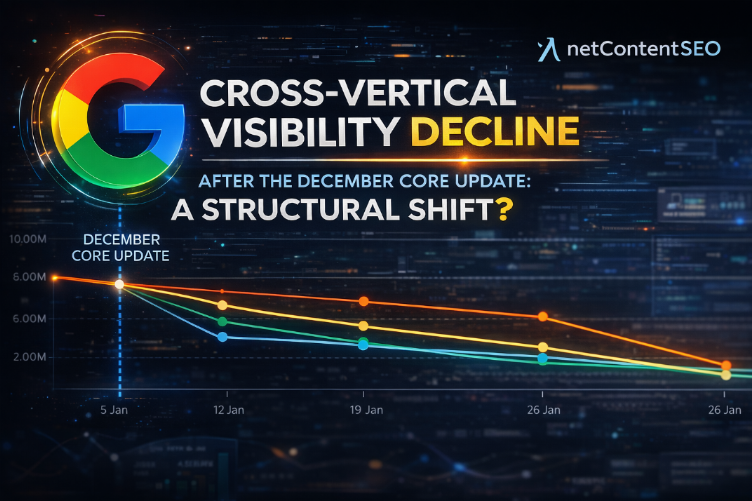
We analyzed traffic trends across real estate, news, forums and e-commerce sites after the December Core Update. The pattern suggests more than normal volatility. Is Google redistributing visibility at a structural level?
Over the past few months something unusual has been happening across multiple industries. Not one site. Not one niche. Multiple verticals. Similar pattern.
After the December Core Update, we began tracking several independent properties across four different sectors: real estate, news publishing, community forums and e-commerce. No brand names disclosed. The goal was not to expose losers. It was to observe systemic movement.
The result is difficult to ignore.
Across all four verticals, visibility trends show a gradual but consistent decline following the December update, with acceleration in some cases toward late January. While individual volatility is normal during core updates, synchronized downward movement across structurally different business models suggests something broader.
This is not about bad SEO practices. These properties were not thin affiliate spam sites. They represent established content types: transactional listings, editorial news, user-generated discussions and commercial catalogs.
That diversity matters.
If real estate portals, news publishers, forums and e-commerce stores all display similar downward curves after a core update, we are likely not observing isolated quality penalties. We may be seeing a redistribution layer.
The December Core Update appears to have shifted how visibility is allocated rather than simply re-ranking competitors inside the same structure. In some cases traffic did not move to direct competitors within the same vertical. Instead, SERP features, AI Overviews, shopping integrations and alternative content formats seem to absorb part of that attention.
In news, Discover volatility increased.
In forums, long-tail threads lost prominence to summarized answers.
In real estate, aggregator visibility fluctuated against localized intent results.
In e-commerce, product visibility appeared increasingly tied to feed quality and structured data rather than pure page ranking.
Different industries. Similar compression effect.
Real estate trend zoom-in with December marker

News trend zoom-in
Forum trend zoom-in
E-commerce trend zoom-in
This pattern suggests a deeper transformation. Google’s ranking model is increasingly layered with AI interpretation systems. That changes what “visibility” means. Instead of simply ordering blue links, Google now synthesizes, summarizes and integrates. Traditional click distribution models no longer apply in the same way.
If AI layers absorb informational intent, and structured commerce layers absorb transactional intent, classical organic traffic may naturally contract even when content quality remains stable.
This is not necessarily a penalty event. It may be a structural rebalancing.
The March Core Update now enters this context. If December represented phase one of redistribution, March may confirm whether the shift is temporary volatility or long-term architecture change.
There are several possibilities.
One scenario is stabilization, where affected verticals regain equilibrium after recalibration. Another is continued compression, where AI surfaces and integrated features capture increasing share of user attention. A third scenario involves selective recovery based on stronger entity authority, structured data completeness and user satisfaction metrics.
The key observation is this: volatility is no longer isolated by industry. It is systemic across intent types.
For SEO professionals, this changes the diagnostic model. Instead of asking “who outranked me,” we must ask “where did the attention layer move.” Was it AI answers. Was it Shopping. Was it local. Was it Discover. Or was it simply reduced click distribution due to interface redesign.
The next few weeks will matter.
If March reinforces cross-vertical downward curves, we are likely witnessing a structural visibility redistribution rather than update turbulence. That would redefine strategy from ranking optimization to presence optimization across AI, commerce feeds and contextual trust layers.
If recovery appears selectively in properties with stronger structured architecture and entity signals, that will confirm the direction.
Either way, the December data across real estate, news, forums and e-commerce suggests this is not a single niche event.
It may be the beginning of a different search equilibrium.
The question is not whether rankings moved. The question is whether the model of visibility itself is being rewritten.