
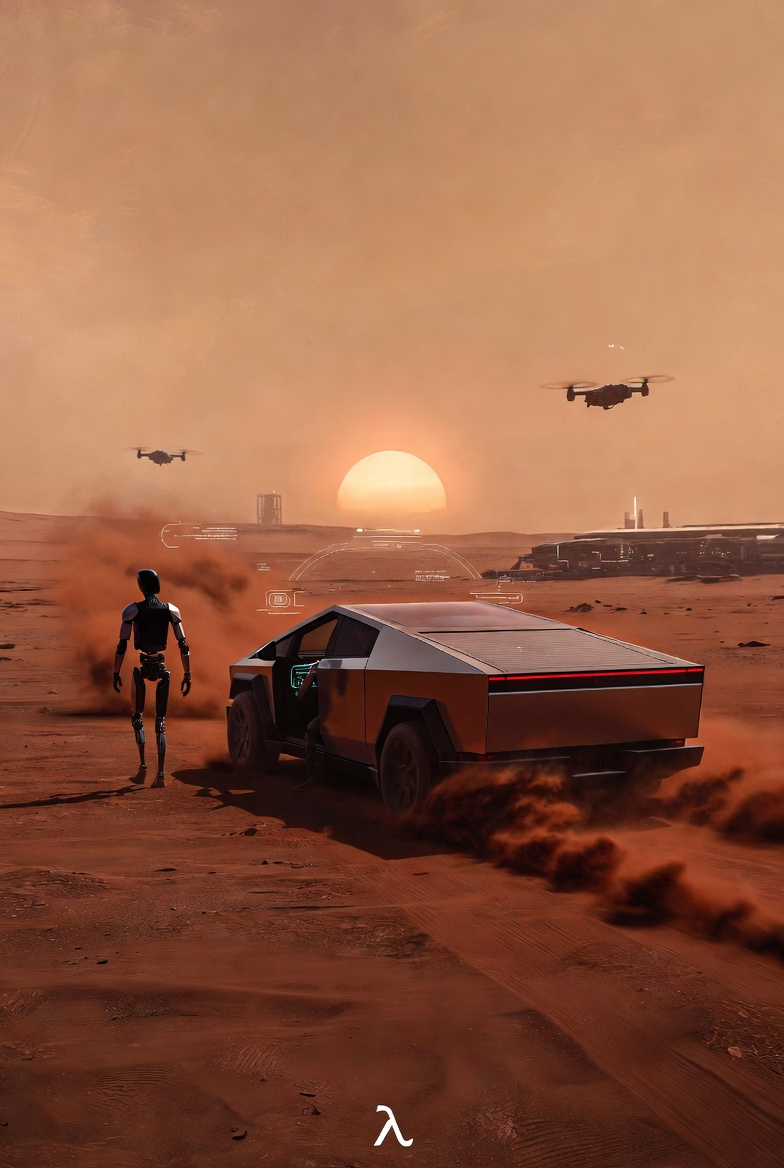
The convergence of AI, robotics, and autonomous mobility could reshape how users discover transportation services online, moving search beyond traditional rankings.
A futuristic video concept showing a robot driving a Cybertruck across Mars has been circulating online recently. While clearly fictional, the idea touches on something that is becoming increasingly real: the convergence of robotics, autonomous mobility, and AI-driven systems. Companies like Tesla and xAI are pushing the boundaries of both robotics and artificial intelligence, and Tesla’s robotaxi initiatives and autonomous driving technology continue to move forward as discussions around autonomous mobility networks grow.
For the search industry, the interesting angle may not be the futuristic imagery itself but what it represents. Mobility services could eventually become deeply integrated into AI assistants, meaning users may not always navigate through multiple taxi websites, ride platforms, or aggregator pages. Instead, AI systems could increasingly surface transportation services directly based on context, location, and user intent.
We have already seen early signals of this pattern with AI-powered search experiences summarizing options rather than simply ranking pages. Search visibility in these environments may increasingly depend less on traditional rankings and more on whether AI systems can understand services, entities, and real-time availability. If autonomous mobility networks expand in the coming years, search behavior around transportation queries could evolve significantly.
Rather than optimizing only for keywords like “taxi near me,” companies may eventually need to focus more on machine-readable services, entity clarity, structured data, and real-time service availability. For now, the Cybertruck-on-Mars concept remains science fiction, but the broader convergence of AI, robotics, and autonomous mobility is something the search community is starting to watch more closely, especially as the line between search, AI assistants, and real-world services continues to blur.
In that sense, the shift may ultimately be subtle but important for SEO. Visibility may increasingly depend not just on ranking pages, but on whether AI systems can clearly understand services, entities, and real-world availability — something that could also influence how content gets referenced or summarized by large AI models over time.
Put simply, the future of search may not be about which page ranks first, but about which service or entity an AI system understands well enough to recommend.