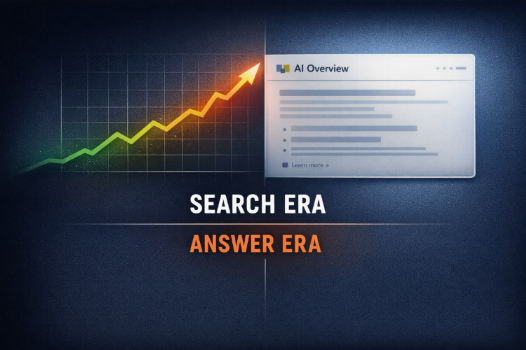
SEO is no longer just about rankings. A new discipline is emerging to measure how often and how well brands are cited inside AI-generated answers. Here’s why it matters.
For years, measuring visibility online was relatively straightforward. You tracked rankings, impressions, clicks and share of voice. If you moved up in the SERP, you won more traffic. If you dropped, you investigated.
That model is starting to fracture.
Large Language Models and AI-enhanced search interfaces do not simply list links. They generate responses. Inside those responses, they reference, mention and sometimes recommend brands. Or they don’t.
This is where a new layer of visibility appears.
It is no longer enough to ask whether your pages rank. The more strategic question is whether your brand is included when AI systems synthesize an answer in your industry.
That shift is giving rise to something new. A discipline focused not on position, but on citation.
Today it is possible to test prompts across different AI systems and verify whether your brand appears inside the generated response. It is possible to compare how different models describe your company. It is possible to benchmark competitors and evaluate who is being referenced more frequently in a given thematic cluster.
This is not theoretical. Dedicated tracking tools are emerging that monitor AI visibility across platforms like ChatGPT, Gemini and AI-driven search interfaces. They attempt to quantify what could be called “AI share of voice” or “LLM citation presence”.
The implications are significant.
If users increasingly consume synthesized answers rather than browsing multiple links, then brand presence inside those answers becomes a critical layer of influence. Traditional SEO metrics still matter, but they may not capture the full picture of authority and awareness in a generative environment.
The risk is subtle. A brand can maintain strong rankings and still lose cognitive ground if it is not consistently referenced by AI systems when relevant questions are asked.
This is why tracking citations matters. Not because rankings are obsolete, but because visibility now operates in parallel systems. One measures where you appear. The other measures whether you are integrated into the answer itself.
We are moving from being indexed to being interpreted.
For digital teams, this raises practical questions. How consistent is your entity footprint across the web. How clearly is your expertise defined. How frequently are you mentioned in independent sources that models may rely on during training or retrieval.
The companies that understand this shift early will not abandon SEO. They will expand it.
Ranking is exposure.
Citation is influence.
And in the age of generative interfaces, influence is increasingly mediated by AI systems.