
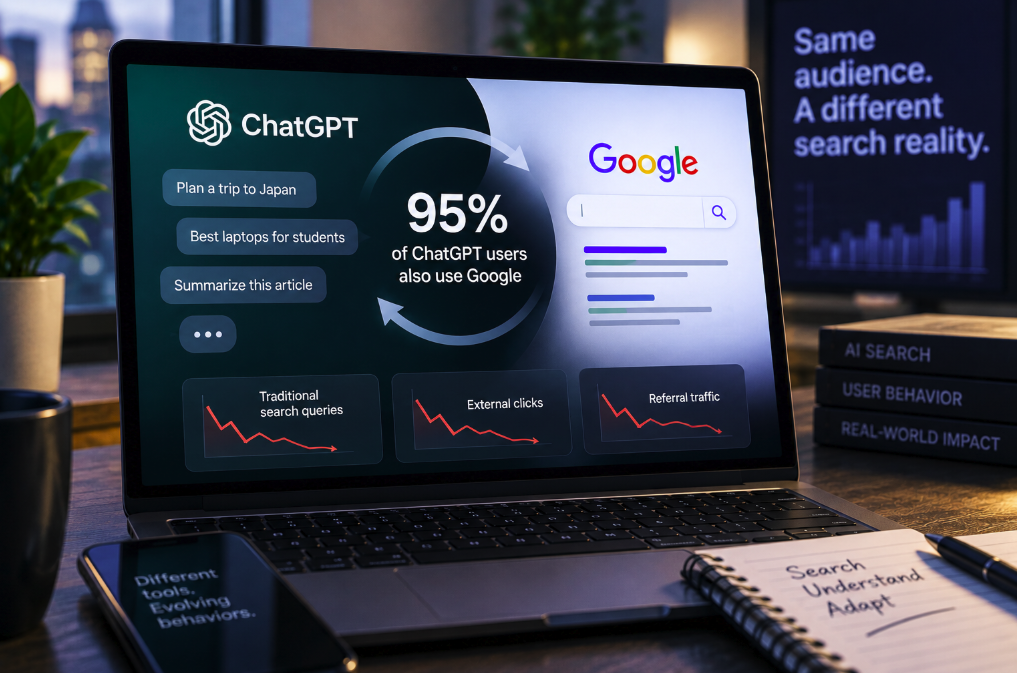
One statistic has become a convenient rebuttal to predictions that AI assistants are replacing Google: 95% of ChatGPT users still use Google. The number is real, but it does not mean search behavior is unchanged. A growing body of research suggests that people can remain inside Google's audience while making fewer traditional searches, and they can continue searching on Google while clicking through to fewer external websites.
That apparent contradiction is the focus of a September 4 analysis by Matt G. Southern at Search Engine Journal. The underlying datasets are measuring different stages of behavior. Similarweb measures whether the same people appear in the audiences of ChatGPT and Google. Academic studies have instead examined query frequency, search sessions and outbound clicks. Those metrics do not have to move together.
The result is a more complicated picture than either “AI is replacing Google” or “nothing has changed.” Google can retain almost every ChatGPT user as a Google user while losing some of that person's searches. It can retain the search itself while losing the click to a publisher. Audience, query volume and referral traffic are different layers of the same journey, and 2026 data increasingly shows them separating.
What the 95% figure actually measures
Similarweb's 2026 analysis of AI and search behavior says 95% of ChatGPT users also used Google in September 2025. Eight months later, in May 2026, the overlap was still 95%, even after substantial growth in generative-AI usage.
That is strong evidence against a simple mass migration in which people adopt ChatGPT and abandon Google entirely. If large numbers of ChatGPT users were becoming AI-only searchers, the overlap should be expected to decline. Instead, the two services remain heavily shared by the same audience.
But audience overlap sets a low threshold. A person can conduct one Google search during a month and still count as a Google user. The same person might have moved dozens of informational tasks that previously started in Google into ChatGPT.
Similarweb itself makes this distinction. Its overlap analysis tells us whether users appear in both audiences, not how they divide individual research tasks between them. It also does not capture every AI interaction: the company notes that API usage, desktop applications and some in-app AI behavior are outside the panel even though those environments may substitute for search activity.
So 95% answers an important question — are ChatGPT users still touching Google? — but not the more commercially important question of how much of their old Google behavior remains.
The same users can make fewer searches
Search Engine Journal contrasts the Similarweb audience data with a Bocconi University working paper examining households that gained access to ChatGPT Search. The researchers used U.S. desktop clickstream data from Comscore covering October 2024 through July 2025 and compared search behavior around OpenAI's expansions of ChatGPT Search access.
On average, households gaining access reduced their traditional search activity by 3.14 queries per week, roughly 9.4% below the pre-expansion average of 33.51 weekly queries. The gap became larger over time and reached 17% after 20 weeks.
The paper also used a more conservative comparison between logged-in ChatGPT users who gained Search access earlier and anonymous users who received access later. That design produced smaller reductions: about 4.9% on average and 8.2% after 20 weeks.
Those differences matter because they illustrate the difficulty of isolating cause. People who adopt AI products early may already behave differently from nonusers, so some of the larger observed gap may reflect who adopts ChatGPT rather than what ChatGPT Search does to them. The authors do not present every descriptive category difference as proof of causality.
Even with that caution, the important measurement lesson remains. In the same broad period, Google's household reach could stay stable while participating households conducted fewer searches. Audience retention and query retention are not the same thing.
Google can keep the query and still lose the click
A separate 2026 experiment pushes the distinction one step further. Researchers recruited 1,100 U.S. Chrome users who already used Google as their main search engine, observed a baseline period and then randomly assigned participants to standard Google, Google with AI Overviews hidden or a version in which searches were routed through AI Mode.
The AI Mode condition was deliberately strong. At baseline, only 0.6% of searches used AI Mode; in the treatment group, 94.7% were routed there. The researchers describe this as forced, full adoption, not the gradual voluntary adoption that normally happens in the real world.
Under that experimental condition, external click-through fell by 18.8 percentage points, with a reported 95% confidence interval from -22.2 to -15.3 points. Search sessions also declined by about 0.92 per day from a baseline average of four, while average session duration increased by 0.43 minutes.
The result is important precisely because those participants were still using Google. AI Mode did not need to make them leave Google's ecosystem to reduce the number of visits Google sent outward. The search engine itself could absorb more of the research process.
The study has clear limitations. It ran for only a week, the forced AI Mode experience was more extreme than normal opt-in behavior, and the sample skewed younger and more educated than the overall U.S. population. It is evidence of what can happen when AI Mode becomes the dominant interface, not a direct measurement of every Google user today.
Audience, queries and clicks describe different layers
The easiest way to reconcile these findings is to stop treating “search usage” as one number. There are at least three distinct questions.
Audience measures whether a person uses a service at all during a period. Query volume measures how frequently that person asks the service for something. Click-through measures whether the resulting interaction sends the person to an external website.
A user can remain present at all three stages while behavior changes at the next one. Someone can remain a Google user but conduct fewer Google queries because ChatGPT handles some research tasks. Someone can still make a Google query but stop clicking because AI Mode or an AI Overview answers the question directly.
For publishers and SEO teams, the last stage is often the one that pays the bills. A stable Google audience does not guarantee stable search demand for a particular category, and stable search demand does not guarantee stable referral traffic.
The effect appears stronger for informational destinations
The Bocconi study found that referral changes were uneven across website categories. Academic sites saw a reported 32.8% reduction in search referrals after households gained ChatGPT Search access, reference sites declined 26.5%, developer sites 15.1% and news sites 13.4%.
Marketplace and entertainment referrals changed much less or were statistically difficult to distinguish from no change. The paper treats these category patterns as descriptive, so they should not be converted into universal forecasts for every site.
Still, the direction makes intuitive sense as a hypothesis. Generative systems are particularly capable of absorbing informational tasks such as definitions, explanations, summaries and technical questions. Transactional journeys may continue to require external destinations because the user ultimately needs to buy, book, download or interact with a service.
This means aggregate Google usage can conceal very different economic outcomes by sector. A retailer and a reference publisher may both hear that 95% of ChatGPT users still use Google while experiencing completely different traffic trends.
AI Mode turns “Google versus AI” into the wrong comparison
The discussion becomes even harder because Google itself is increasingly an AI product. Comparing Google users with AI users assumes two separate categories when AI Overviews and AI Mode now sit inside Google Search.
Google said at I/O that AI Overviews had more than 2.5 billion monthly active users and AI Mode had surpassed one billion users. The company has also said its AI-powered Search features encourage people to use Search more and has reported record query volumes.
Those claims are relevant, but they do not provide the user-level baseline data needed to independently reconcile them with academic findings. Search Engine Journal notes that Google's public numbers do not explain in enough detail what counts as a query in AI Mode or provide the underlying data necessary to determine which kinds of queries are growing.
More importantly, a person conducting a task entirely inside AI Mode is simultaneously an AI user and a Google user. If that interaction ends without an external click, Google's audience and query metrics can remain strong while publisher referrals decline.
Zero-click behavior is becoming a separate business metric
Similarweb-based analysis has estimated that roughly 68% of U.S. Google searches in the first four months of 2026 ended without a click to the open web. That broader zero-click trend predates the current AI transition, but generative answers can intensify the separation between a successful Google interaction and a successful publisher referral.
For years, SEO reporting often treated impressions, rankings, clicks and sessions as a relatively connected funnel. AI search makes the gaps between those stages more visible. A page can be represented in an answer without receiving a visit. A brand can influence a recommendation without being the final clicked source. A user can learn about a company in ChatGPT and later perform a branded Google search that analytics attributes to organic search.
That last scenario is particularly difficult to measure. If ChatGPT creates the demand and Google captures the navigational query, Search Console records the Google click but cannot tell the marketer that an AI conversation initiated the journey.
Similarweb has pointed to branded search lift as one possible signal of AI-driven demand, but conventional attribution systems are poorly equipped to connect those cross-platform steps.
Referral traffic can fall without either platform “winning”
This is why framing the market as ChatGPT versus Google can mislead publishers. The user does not need to choose one winner. They can use ChatGPT to understand a topic, Google to validate a brand, Maps to locate a business and an external website only when an action requires it.
From the user's perspective, that may be a better workflow. From a publisher's perspective, it can mean fewer visits even though the publisher's information still contributes to the journey.
The competitive question for Google is whether people continue initiating enough valuable tasks within its ecosystem. The commercial question for publishers is different: how often does that ecosystem still send the user outward?
Those questions can produce opposite-looking answers from the same population.
Other studies show that AI and web browsing can also be complementary
The evidence is not uniformly substitutionary. Search Engine Journal also highlights research in which new LLM users visited more unique websites after adoption, with a temporary increase in traditional search activity before that effect declined. Another field study found that sessions combining an LLM and a search engine lasted longer and involved more sites than LLM-only sessions.
Those studies examine earlier periods and different products, including behavior before ChatGPT Search and the current version of AI Mode. Their value is not that they disprove later findings, but that they show behavior depends on the task and product design.
An AI assistant can replace a search, complement a search or create a new search. It can eliminate an outbound click, generate a later branded click or encourage deeper browsing. There is no single substitution rate that captures all of those pathways.
The datasets also have different blind spots
None of the current studies follows the same large population across Google Search, AI Mode, ChatGPT, Gemini, mobile apps, desktop applications and APIs over a long period while identifying the user's underlying task. That is the dataset marketers would ideally want, and it does not currently exist publicly.
Similarweb is strong for broad audience overlap but does not see every form of AI use. The Bocconi analysis uses U.S. desktop clickstream data and ends in July 2025, before today's AI Mode scale. The 1,100-person AI Mode experiment is randomized and therefore useful for identifying effects under controlled conditions, but its seven-day forced-adoption design is not the same as long-term voluntary behavior.
The relevant papers are also working papers rather than final peer-reviewed publications. Their findings should be followed as the research develops rather than frozen into permanent industry statistics.
That uncertainty is not a reason to ignore the evidence. It is a reason to stop demanding that one metric settle the entire debate.
SEO dashboards need to separate reach from behavior
For search teams, the practical implication is measurement design. Reporting that says “Google still has the audience” can be true while an informational publisher loses referral sessions. Reporting that says “AI traffic is tiny” can also be true while AI changes which Google queries users make or creates branded demand that later arrives through organic search.
A more useful dashboard separates several layers: overall search visibility, query demand, search sessions, external click-through, referral traffic, branded search, AI citations and downstream conversions. Those measures can then be compared rather than collapsed into a single narrative about whether AI has or has not replaced search.
Category-level analysis is equally important. Businesses should ask which user tasks AI can complete without visiting their site and which tasks still require a destination. The answer for a software documentation site will differ from the answer for a restaurant, marketplace or entertainment service.
The 95% statistic is reassuring only if you ask the wrong question
Similarweb's figure is useful evidence. It tells us that ChatGPT adoption has not produced a mass abandonment of Google. The overwhelming majority of ChatGPT users remain part of Google's audience, and that overlap has stayed remarkably stable while AI usage has grown.
What it cannot tell us is whether those users are giving Google the same number of informational queries, whether Google's AI interfaces are satisfying more of those queries internally, or whether publishers receive the same number of clicks afterward.
Other studies suggest the answer to each of those questions can be no. Traditional queries can decline while Google reach remains stable. External clicks can decline while users continue searching on Google. Referral traffic can weaken while both Google and AI platforms continue growing.
That is the more important search story of 2026. The market is not moving cleanly from one box to another. The same people are using multiple systems, and each system is absorbing a different part of the journey.
So the headline number remains true: 95% of ChatGPT users still use Google. The mistake is assuming that “still use” means “still search the same way” — or that keeping the user necessarily means keeping the click.