
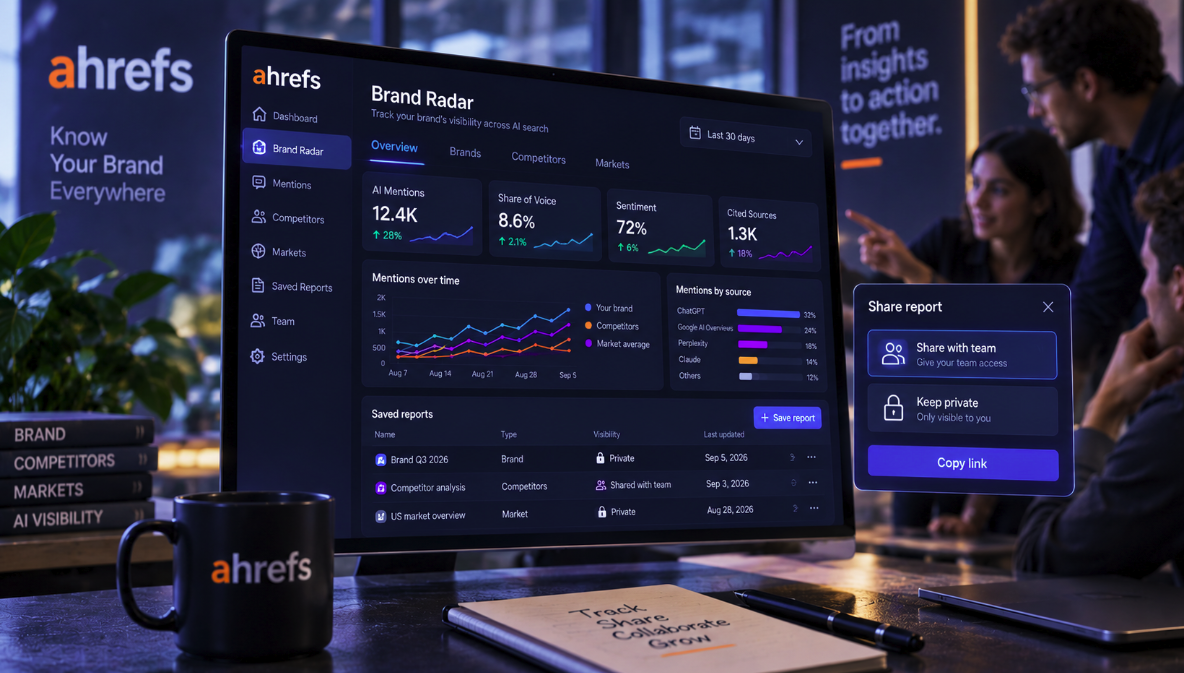
AI visibility tracking is starting to look less like a one-off research exercise and more like an operating workflow. Ahrefs has pushed Brand Radar further in that direction by adding saved reports for brands, competitors and markets, allowing teams to preserve the exact views they use repeatedly instead of rebuilding the same analysis every time they return to the tool.
The feature appeared in the Ahrefs changelog on September 5. Brand Radar reports can now be saved with access controls, so a view can remain private or be shared across a team. It sounds like a modest interface improvement, but it addresses a practical problem that becomes increasingly obvious as AI-search monitoring moves from experimentation into recurring marketing work.
Saved reports turn an AI search into a reusable workspace
According to Ahrefs’ Brand Radar help documentation, a saved report preserves the entities, filters and location used in a search. Teams can configure the brand they want to analyze, competitors to benchmark, an optional market or niche, geographic settings and other filters, then give the report a name and return to it later for updated results.
That changes the unit of work. Instead of asking an analyst to remember how a particular competitive view was assembled, the configuration itself becomes reusable. A company could maintain one report for its core brand, another for a product category, separate reports for regional markets and additional views for specific competitor groups. Each can function as a persistent lens on AI visibility rather than an ephemeral query.
The ability to keep reports private or share them with the wider team adds a collaboration layer. An analyst can build and test a view before exposing it to colleagues, while established reports can become common reference points for SEO, content, brand, PR and leadership teams. That is particularly useful in AI search, where stakeholders may otherwise arrive at meetings with screenshots generated from different prompts, platforms and time periods.
AI visibility has a repeatability problem
Generative search creates an awkward measurement environment because answers are not conventional rankings. Responses can vary, the number of possible prompts is effectively unlimited and different AI platforms can retrieve different sources. A single manual test can show what happened in one interaction without establishing whether the pattern is broad, persistent or commercially meaningful.
Ahrefs addresses that problem by modeling visibility across large prompt sets rather than treating individual chatbot conversations as the whole dataset. Its Brand Radar methodology says the system builds question sets from Ahrefs’ keyword database and Google People Also Ask data, expands them semantically and runs millions of questions across platforms including ChatGPT, Perplexity, Gemini, Microsoft Copilot, Google AI Overviews and AI Mode.
Ahrefs is also explicit about the limitations. Metrics such as AI Share of Voice and Estimated Impressions are modeled visibility signals rather than measurements of actual audience reach. Chatbot usage is personalized, possible prompts are effectively infinite and geographic coverage reflects Ahrefs’ underlying keyword data rather than measured AI usage by country. Those caveats make consistent report definitions even more important: teams need stable comparison frameworks if they want to interpret directional changes responsibly.
Brands, competitors and markets become repeatable reporting units
The new report structure is especially useful because Brand Radar entities can represent more than one spelling or domain. A company with multiple brand variations can group them into a single entity, and the same approach can be used for competitors. That allows a saved report to encode a business definition of the market instead of forcing analysts to reconstruct it from scratch for every session.
Ahrefs’ 2026 case study on Octopus Energy’s use of Brand Radar illustrates why that matters. The energy company needed to compare AI visibility across multiple countries, where local operations had different domains, competitors and historical brand names. Ahrefs reports that the previous process involved manually extracting question-based searches, checking AI platforms and turning the results into material that global marketing teams and executives could understand.
Brand Radar gave that team a way to group multiple domains and brand names into entities, compare local competitors and move market by market. Saved reports make that kind of setup more durable. Once a useful market definition has been assembled, it can become an ongoing workspace rather than a configuration that disappears after the analysis is finished.
The real feature is organizational memory
For agencies and larger in-house teams, the value goes beyond convenience. Reusable reports create a form of organizational memory. A colleague joining a project can open an established market view and see which brand entities, competitors and filters the team has chosen to monitor. A client-facing analyst can revisit the same competitive framework before the next reporting cycle. A regional marketer can work from a shared configuration rather than creating an incompatible version of the analysis.
This also makes AI visibility easier to integrate into recurring meetings. Instead of preparing a bespoke investigation whenever leadership asks how the brand is performing in AI search, teams can maintain a small set of agreed reports and use them as recurring dashboards. The discussion can then shift from how the numbers were assembled toward why visibility changed, which competitors gained ground and what cited sources or topics might explain the movement.
There is still a risk of false precision. Saving a report does not turn modeled AI visibility into deterministic rank tracking, and teams should resist interpreting every small movement as a real change in user exposure. But a consistent reporting setup is a prerequisite for useful longitudinal analysis. Without it, changes in filters, competitor definitions or markets can be mistaken for changes in performance.
AI-search tools are becoming collaborative software
The September 5 update points toward a broader maturation of the AI visibility category. The first generation of tools focused on proving that brands were appearing in chatbot answers at all. The next layer added citations, competitors, share-of-voice metrics and platform comparisons. Now the product challenge is increasingly about turning those measurements into repeatable processes that teams can actually operate.
Saved reports are a small feature in that evolution, but they reveal the direction clearly. AI visibility is moving from an interesting query an SEO specialist runs occasionally toward a monitored business signal with named markets, defined competitors, recurring views and shared ownership. Ahrefs is effectively turning Brand Radar from a place to explore AI answers into a workspace where organizations can preserve how they measure them.
That may prove more consequential than another chart or metric. As AI search becomes a regular part of brand and content strategy, the teams that benefit most will not simply collect more visibility data. They will establish repeatable definitions, revisit the same questions over time and make the results accessible to the people responsible for acting on them. Saved reports give Brand Radar a practical mechanism for doing exactly that.