
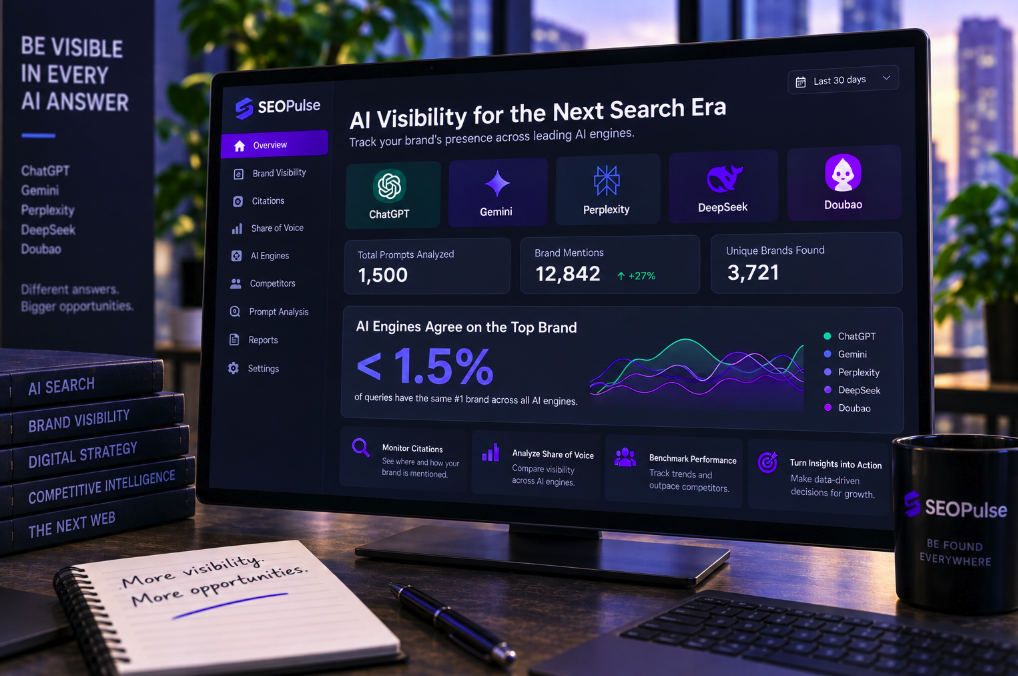
Brands accustomed to asking where they rank on Google are encountering a much messier question in AI search: which answer engine thinks they are the best option? A new company benchmark from SEOPulse suggests there may be remarkably little agreement. Across 1,500 commercial prompts, the company says leading AI engines selected the exact same top vendor in fewer than 1.5% of queries.
The finding was published alongside the September 3 launch of SEOPulse's enterprise AI Visibility & Intelligence Platform, according to the announcement carried by MarTech Cube. The platform is designed to monitor how brands appear across conversational AI systems including ChatGPT, Gemini, Perplexity, DeepSeek and ByteDance's Doubao, with an emphasis on citations, recommendations and AI share of voice across different markets.
The benchmark should be treated for what it is: company-reported research released as part of a product announcement, not an independent academic study. The published release does not provide enough methodological detail to generalize the 1.5% figure to every industry or every kind of prompt. Even with that caveat, the result points to a problem marketers increasingly encounter in practice: there may be no single AI ranking to optimize.
AI search visibility is fragmented by engine
Traditional SEO already varies by location, device, personalization and query interpretation, but marketers still work within a relatively familiar model of ranked search results. AI assistants introduce another layer of variation because each system can use different models, retrieval infrastructure, source indexes, freshness policies, ranking logic and answer-generation behavior.
That means the same commercial question can produce different recommended companies depending on where it is asked. ChatGPT may emphasize one vendor, Gemini another and Perplexity a third. DeepSeek and Doubao add further variation, particularly for international organizations that care about visibility across Western and East Asian AI ecosystems.
SEOPulse's reported benchmark puts an unusually stark number on that fragmentation. If the exact same company occupies the top position across engines in fewer than 1.5% of the commercial prompts it tested, marketers cannot safely infer performance on one platform from performance on another.
There is no universal number-one position in conversational search
The finding challenges one of the most persistent mental models imported from conventional SEO. A brand might say it wants to “rank number one in AI,” but conversational systems do not expose one universal ranking table. They generate answers dynamically, and the preferred brand can change with the model, prompt wording, geography, available sources and time of retrieval.
Even the idea of first place requires definition. One answer may explicitly recommend a company first, another may list several alternatives without ranking them, and another may cite a source discussing the brand without recommending the brand itself. Visibility, recommendation and citation are related metrics, but they are not interchangeable.
For enterprise measurement, that makes share of voice more useful than a single position metric. A company can ask how frequently it appears across a controlled prompt set, how often competitors appear instead, which systems recommend it and which sources are associated with those answers.
Brand mentions and citations are also different signals
SEOPulse reports another useful distinction from its benchmark: more than half of the AI answers it analyzed mentioned brands, but only 10% both mentioned and cited a brand. The wording matters because an AI system can recommend a company without linking to that company's website, and it can cite a third-party publisher while discussing the company.
For marketers, those scenarios create different outcomes. A mention can influence awareness without generating measurable referral traffic. A citation can give the user a path to investigate the source. A direct recommendation can affect consideration even if neither the brand nor its own website receives a clickable attribution.
This is one reason AI-search measurement cannot rely exclusively on referral sessions. Some of the most commercially important influence may occur inside the answer before the user reaches a website — or without a website visit at all.
SEOPulse is positioning prompt tracking as the new rank tracking
The new platform is aimed at enterprise marketing teams, agencies and brands operating across multiple markets. Instead of monitoring only conventional keyword positions, SEOPulse says it tracks prompts and records how brands and competitors appear in AI-generated answers.
The product announcement emphasizes citation monitoring and AI share of voice, giving teams a way to compare their presence across engines. The basic unit of analysis becomes a prompt-market-engine combination rather than simply a keyword and search-results position.
That shift is logical because conversational queries are often longer and more contextual than traditional search terms. “Best CRM” and “Which CRM is best for a 200-person European SaaS company that needs Salesforce integration?” may lead to very different recommendation sets even though both belong to the same broad commercial category.
Real-user sessions may produce different evidence from APIs
SEOPulse says one of its differentiators is that it simulates real user experiences on AI engines rather than relying only on API environments. That distinction deserves attention because consumer-facing AI products and developer APIs are not necessarily identical surfaces.
A public assistant may use web search, product-specific system instructions, personalization, interface features or retrieval components that are absent from a raw model API. Measuring an API response can therefore answer a different question from measuring what an actual user sees inside the consumer product.
Real-session monitoring introduces its own methodological challenges, including answer variability and changing product behavior, but it is closer to the experience marketers ultimately care about. If a buyer asks ChatGPT or Gemini for a recommendation, the relevant observation is the answer that interface returns, not necessarily what the underlying model produces in a controlled API call.
International AI visibility cannot stop at ChatGPT and Google
The inclusion of DeepSeek and Doubao is another notable part of SEOPulse's positioning. Much of the Western discussion about generative search focuses on ChatGPT, Gemini, Perplexity and Google's AI search experiences. Global brands have a wider problem.
AI adoption differs across markets, and a visibility strategy built entirely around Western platforms can miss important discovery channels elsewhere. SEOPulse says its platform supports multilingual and multi-region tracking and is intended to give international brands a common measurement layer across Asian and Western AI engines.
That matters because language is not simply a translation variable. Models may retrieve different local sources, recognize different brands and interpret commercial intent differently across regions. A company prominent in English-language AI answers may have little visibility when an equivalent question is asked in another language or market.
AI share of voice needs a controlled prompt set
Any share-of-voice metric is only as meaningful as the universe being measured. A company could appear dominant if the prompt set heavily favors questions associated with its strongest products, or almost invisible if the sample overrepresents categories it does not serve.
Enterprise teams therefore need a disciplined prompt taxonomy. That means separating informational, comparison and high-intent commercial questions; mapping prompts to products and customer segments; defining target markets and languages; and keeping enough of the set stable to measure changes over time.
The goal is not to collect the largest possible list of prompts. It is to build a representative measurement panel that reflects the questions actual prospects are likely to ask. Without that discipline, an AI visibility percentage can look precise while measuring an arbitrary slice of demand.
Answer variability makes repeated measurement essential
Generative systems are not deterministic search-result pages. The same prompt can produce different wording, source selection and brand ordering across repeated sessions. Models are updated, retrieval indexes change and product teams continuously modify search behavior.
A single screenshot is therefore weak evidence of durable AI visibility. If a brand appears first once and disappears in the next several runs, describing it as the top recommendation would overstate the result. Monitoring systems need enough repeated observations to distinguish persistent visibility from stochastic variation.
This is another reason the reported cross-engine disagreement is interesting. Some disagreement may reflect genuine differences in the engines' information environments, while some may reflect generative variability. Understanding the balance requires transparent methodology and repeated testing rather than one-off prompting.
The cited source may be more actionable than the generated answer
For SEO and digital PR teams, one of the most useful outputs from AI monitoring is not simply whether the brand appears. It is which sources the model relies on when constructing the answer.
If competitors repeatedly appear because AI systems cite industry rankings, specialist publishers, review sites or authoritative comparison pages, those sources reveal part of the information environment shaping recommendations. The optimization opportunity may therefore exist outside the company's own domain.
This extends familiar off-page SEO thinking into AI discovery. A brand can publish a perfectly optimized product page and still lose recommendation visibility if the independent sources trusted by the relevant answer engine consistently favor competitors. Building a credible external footprint can be as important as improving first-party content.
Different engines may reward different information ecosystems
Cross-engine disagreement also suggests that brands should be cautious about universal “GEO ranking factors.” If every major assistant consistently selected the same companies, marketers could plausibly search for one dominant set of signals explaining the outcome. Very low agreement points toward a more heterogeneous system.
One engine may have stronger access to certain publishers. Another may prioritize fresher web retrieval. A third may lean more heavily on structured commercial data or its model's prior knowledge. Regional systems may draw on entirely different source ecosystems.
This does not mean optimization is impossible. It means the useful unit of analysis may be engine-specific. Teams should identify where visibility is weak, inspect the sources and answer patterns on that platform, then test changes rather than assuming a tactic observed on one AI product transfers automatically to every other one.
The market for AI visibility software is getting crowded quickly
SEOPulse is entering a rapidly expanding category. Search, communications and marketing technology vendors are adding tools that monitor brand mentions, prompts, citations and sources across generative systems. The competitive rush itself is evidence that AI discovery has become measurable enough for enterprise teams to demand dedicated reporting.
The difficult part will be standardization. Different vendors can define prompts, mentions, citations, rankings and share of voice differently. Without clear methodologies, two dashboards may produce different visibility scores for the same company while both appear authoritative.
Buyers should therefore evaluate more than engine coverage. They should ask how prompts are selected, how often they are run, whether sessions represent consumer interfaces or APIs, how geographic and language settings are handled, how answer variability is normalized and exactly what counts as a citation or recommendation.
AI visibility metrics need business context
Being mentioned frequently by an AI engine is not automatically valuable. A company can have high visibility for low-intent educational questions and little presence when users are actually comparing vendors. Another brand may appear less often overall but dominate the prompts closest to purchase.
Enterprise reporting should therefore connect AI share of voice to the customer journey. Discovery prompts, problem-definition questions, product comparisons, pricing questions and vendor recommendations should not all carry identical strategic weight.
The same applies to sentiment and positioning. A brand appearing in an answer because the model describes a well-known limitation is technically visible, but that is not equivalent to being recommended. Useful measurement has to distinguish presence from favorable commercial representation.
The under-1.5% finding is a benchmark, not a law of AI search
SEOPulse's headline statistic is compelling precisely because it is so low, but it should not be converted into a universal fact about all generative engines. The company says its research analyzed 1,500 commercial prompts, yet the launch announcement does not publish enough detail about category mix, exact engine versions, prompt distribution, geography or repetition methodology to independently reproduce the result.
Marketers should therefore read the number as a benchmark from SEOPulse's test set. Independent studies with different prompts or markets may find higher or lower agreement. The more durable insight is the direction: major AI engines can produce substantially different brand recommendations for commercially similar questions.
That direction is already enough to change measurement strategy. A company cannot confidently declare itself “visible in AI” because it performs well on ChatGPT alone, just as poor visibility on one assistant does not prove it is absent everywhere.
AI search is becoming a portfolio of visibility markets
The emerging picture looks less like one replacement for Google and more like a portfolio of answer engines. Each platform has its own users, models, retrieval systems and information environment. Brands may have to manage visibility across them in much the same way they already manage organic search, marketplaces, social platforms and review ecosystems separately.
SEOPulse's launch is built around that premise. Its reported benchmark — fewer than 1.5% of queries producing the same top vendor across AI engines — is the clearest expression of why a cross-platform dashboard might be necessary. If the engines rarely agree, measuring only one creates a large blind spot.
The strategic lesson is not that marketers need to chase every model response. It is that AI discovery has become fragmented enough to require disciplined measurement. Define the prompts that matter, monitor the engines your customers actually use, track citations and recommendations separately, and investigate the sources behind persistent winners. In conversational search, there may be no single number-one ranking — only a changing share of the answers.