
Search marketing has spent decades training us to look for the click. A page appears in Google, a user clicks it, analytics records the visit and, if everything works, that session eventually becomes a conversion. The funnel is imperfect, but at least the website sits near the center of the measurable journey.
AI search breaks that assumption. A buyer can spend 20 minutes inside ChatGPT comparing vendors, ask Gemini which products fit a particular technical requirement, use Perplexity to validate claims and narrow a shortlist before visiting a single company website. By the time that person finally appears in analytics, much of the discovery and persuasion has already happened somewhere we cannot observe.
Yet many companies are still measuring AI search as though it were simply another referral channel. They create a GA4 segment for ChatGPT, Perplexity and other recognizable AI domains, watch the sessions arrive and ask whether the number is large enough to justify investment.
That is useful data. It is also measuring the last visible part of a much larger process.
The website visit is no longer the beginning of the measurable journey
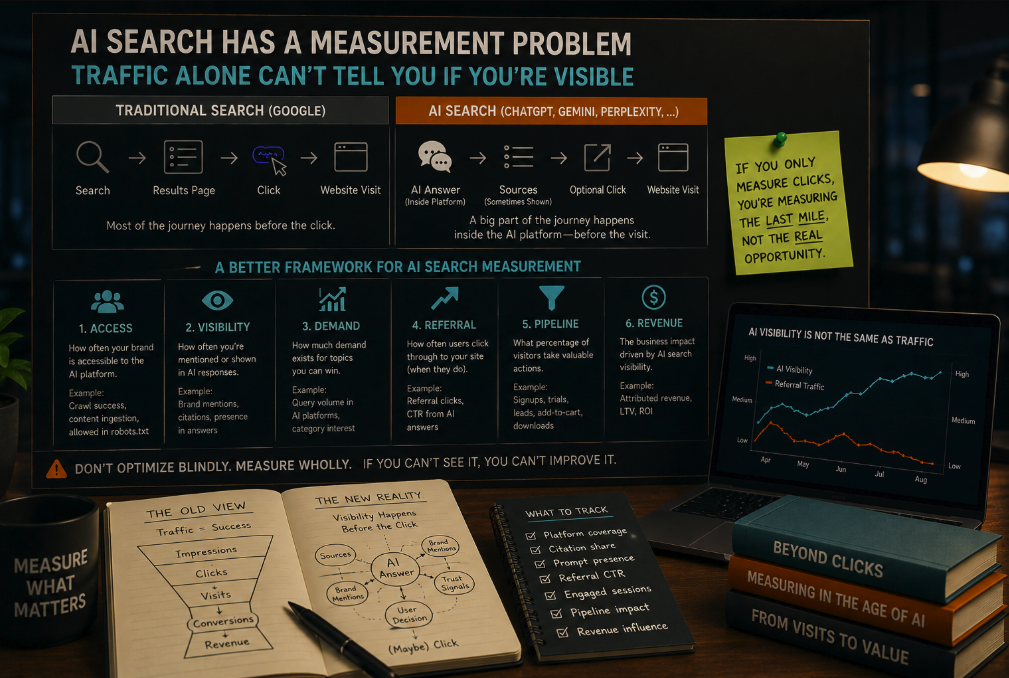
A recent framework published by Search Engine Land makes the problem explicit. Rather than treating AI search as a traffic source, strategist Aimee Jurenka proposes measuring performance across five layers: AI access, AI visibility, identifiable AI referral traffic, downstream demand and business outcomes such as pipeline and revenue.
The framework reflects a simple change in user behavior. Traditional analytics starts observing a prospect when the prospect reaches an owned property. AI systems can now influence the prospect before that moment.
Imagine a software buyer asking ChatGPT for the best platforms for a specific use case. The assistant recommends five companies and explains the strengths of each. The buyer asks follow-up questions, eliminates two options, requests a comparison of pricing approaches and eventually decides to investigate two finalists. Instead of clicking a citation, the buyer closes ChatGPT and later searches one of those brands by name on Google.
Google Analytics sees organic search. Search Console sees a branded query. The CRM may eventually see a demo request. ChatGPT receives no attribution whatsoever, despite having performed much of the work traditionally associated with a search results page, a comparison article and perhaps even an analyst report.
This is not an edge case in the measurement model. It is structurally possible every time an AI interface answers a question without requiring a visit to the source.
AI search can create value without creating traffic
Recent academic research makes the distinction even sharper. A July 2026 paper comparing ChatGPT and Google information-seeking behavior using U.S. desktop clickstream data found outbound clicks in only 5.2% of ChatGPT conversation sessions. The researchers also found that expanded access to ChatGPT reduced traditional search use, with the largest referral losses occurring in informational categories.
The precise percentage will vary by product, query type and methodology, but the underlying mechanism is obvious: AI systems are designed to resolve more of the information need inside the interface. A successful answer does not necessarily produce a successful referral. In some cases, not requiring a click is part of the product’s value proposition.
That creates an uncomfortable measurement paradox for publishers and marketers. A brand can become more visible in AI answers while receiving little additional AI referral traffic. It can even gain influence while traffic remains flat.
If the marketing dashboard defines AI success as sessions from chatgpt.com, that improvement is invisible.
We need to separate access from visibility
The first measurement mistake happens before citations or clicks. A company can invest heavily in content without knowing whether the AI systems it cares about can reliably reach that content.
Access is therefore the first layer worth monitoring. Are relevant AI crawlers reaching the site? Which sections are they visiting? Are important resources blocked by robots rules, authentication, JavaScript behavior or infrastructure decisions? Is the content technically retrievable in the environments that feed AI discovery?
Server logs can help answer these questions, although crawler identification needs care because user-agent strings can be spoofed. Published IP ranges, reverse DNS verification and verified-bot services can provide stronger evidence than simply counting requests containing a familiar bot name.
But crawler activity is not success. A bot requesting 50,000 URLs does not mean the brand is visible in a single useful answer. Access is a prerequisite, not an outcome.
This distinction matters because AI measurement tools can otherwise encourage a false sense of progress. More crawling feels positive because it produces a rising graph. The real question is whether that access eventually translates into representation where buyers are asking relevant questions.
Visibility needs its own measurement layer
Visibility is where AI search begins to diverge most clearly from conventional analytics. The question is not whether somebody visited the website. It is whether the brand, product or content appeared in the answer.
That can be measured through mentions, citations, recommendations, sentiment and share of voice across a controlled prompt set. The important word is controlled. Running ChatGPT manually five times after publishing an article and celebrating because it appeared once is not a measurement system.
LLM outputs are variable. Prompt wording matters. Personalization can matter. Geography, model version, retrieval behavior and time can all affect what appears. A useful visibility program therefore needs a stable library of prompts representing real customer intents and a repeatable collection process across the AI platforms relevant to the business.
The unit of analysis should usually be larger than an individual prompt. Grouping prompts by topic, funnel stage, product category or customer segment makes trends more meaningful. The objective is not to pretend AI answers have fixed rankings. It is to estimate whether a brand is consistently present in the information environment buyers encounter.
This layer can move even when referral traffic does not. That is precisely why it belongs on the dashboard.
Demand may be the missing middle
Between AI visibility and a measurable website referral sits a large area traditional attribution struggles to describe. Call it downstream demand, influenced demand or the dark funnel; the label matters less than recognizing that it exists.
A user who encounters a company repeatedly in AI answers may later search the brand name, type its URL directly, subscribe through another channel or mention it to a colleague. None of those actions necessarily preserve the original AI touchpoint.
That makes branded demand particularly interesting. Search Console can show changes in branded query impressions and clicks. Analytics can show changes in direct traffic and visits to high-intent landing pages. CRM and survey data can reveal how prospects say they discovered the company.
None of those signals proves that AI caused the increase. That caveat is essential. A new advertising campaign, PR coverage, conference appearance or viral social post can create the same movement. The goal should not be to relabel every unexplained direct visit as “AI traffic.”
The better approach is triangulation. If measured AI visibility increases across strategically important prompts and branded search demand subsequently rises without another obvious explanation, the evidence becomes more interesting. If sales teams simultaneously begin hearing customers mention ChatGPT or Gemini during discovery calls, it becomes stronger still.
This is influence measurement, not deterministic attribution.
Referral traffic still matters—just not as much as we want it to
None of this means companies should stop tracking AI referrals. When ChatGPT, Perplexity, Gemini or another assistant sends an identifiable visit, that is unusually valuable evidence. We know an AI experience preceded the website session, and we can measure what the visitor does next.
Those sessions can be compared with other channels for engagement, signup rate, conversion, pipeline creation and revenue. Over time, they can reveal which AI platforms send useful traffic rather than merely visibility.
The problem is treating observable referrals as the total population of AI-influenced users. They are not.
Google’s own AI surfaces complicate attribution further because AI Overview and AI Mode clicks are generally blended into Google organic reporting rather than appearing as a clean independent AI referral channel. A buyer can therefore move through an explicitly AI-generated search experience while analytics records the visit under the same broad channel used for conventional Google results.
What is easy to count is not automatically what matters most.
Pipeline is where the argument becomes commercial
Visibility metrics alone can become another form of vanity reporting. A marketing team can proudly announce that brand mentions in ChatGPT increased 60% while having no idea whether those mentions occur in commercially useful contexts.
That is why AI measurement eventually needs to reach pipeline. Which opportunities came from identifiable AI referrals? Which prospects report using AI during research? Are high-intent prompts increasingly mentioning the company? Do accounts exposed to AI-driven discovery move through the funnel differently? Are there changes in qualified leads, trials, demos or sales conversations that coincide with improved AI visibility?
For B2B companies, adding an AI option to “How did you hear about us?” fields and training sales teams to record AI discovery during calls can produce evidence analytics cannot. It is imperfect and self-reported, but so are many other forms of marketing attribution.
The objective is not to force every deal into an AI attribution bucket. It is to establish whether AI search is becoming a meaningful part of how qualified buyers discover and evaluate the business.
Revenue is still the final metric
AI does not change what companies ultimately care about. Marketing still needs to create customers, revenue and durable business value.
What AI changes is the chain of evidence available before those outcomes arrive. In traditional SEO, teams could often move relatively cleanly from rankings to clicks to sessions to conversions. In AI search, the sequence may look more like access, visibility, influenced demand, occasional referrals, pipeline and revenue.
No single metric proves causation across that chain. Taken together, however, the layers can tell a coherent story. AI systems increasingly access the company’s useful content. The brand begins appearing more frequently for relevant buyer questions. Branded demand rises. AI-referred visitors convert well. Sales conversations increasingly mention AI-assisted research. Qualified pipeline grows in the segments where visibility improved.
That is not perfect attribution. It is a body of evidence.
Marketing has always relied on this kind of reasoning more than dashboards sometimes admit. Television, podcasts, word of mouth, public relations and brand advertising all influence behavior in ways that cannot be reconstructed perfectly at the individual level. AI search may force digital marketers to relearn a lesson performance marketing allowed us to temporarily forget: measurable does not mean fully attributable.
The danger of building an AI dashboard too early
There is another risk in the rush to measure AI search: creating sophisticated dashboards before deciding what the numbers actually mean.
A citation count can look authoritative while depending entirely on an arbitrary prompt list. An “AI share of voice” metric can change because the monitoring tool switched model versions. Crawler traffic can rise because a bot revisited thousands of low-value URLs. Direct traffic can increase for reasons unrelated to AI. Pipeline can be influenced by dozens of simultaneous channels.
Every AI metric therefore needs a definition, a collection method and an explicit statement of what it cannot prove. Visibility should be measured over stable prompt sets. Platforms should be separated rather than blended into one universal AI score. Access should use verified crawler data where possible. Demand indicators should be treated as correlated signals. Revenue attribution should distinguish identifiable AI referrals from broader AI influence.
A smaller dashboard with honest metrics is more useful than a comprehensive one that quietly converts assumptions into numbers.
AI search needs a six-part scorecard
For practical reporting, the emerging frameworks can be simplified into six questions. Can AI systems access the information we want them to find? Are we visible when customers ask relevant questions? Is that visibility associated with increased brand or category demand? Which AI systems send identifiable referral traffic? Is AI discovery appearing in qualified pipeline? And, ultimately, is any of this contributing to revenue?
Each question belongs to a different layer and moves at a different speed. Access can change immediately after a technical fix. Visibility may shift over weeks as retrieval patterns evolve. Demand can lag. Pipeline takes longer. Revenue takes longer still.
Expecting all six to move together produces bad decisions. A company might stop investing because referral traffic remains small just as its visibility is beginning to improve. Another might celebrate rising citation counts indefinitely without ever demonstrating downstream commercial value.
The purpose of the framework is not to create more metrics. It is to prevent one convenient metric from standing in for the entire system.
Traffic is becoming the last mile, not the whole journey
The web’s old economic model made traffic unusually powerful as a measurement tool. Search engines discovered information, displayed links and sent users outward. Publishers and businesses could observe those visits, monetize them and optimize around the feedback.
AI search changes the bargain because the intermediary can consume information, synthesize it and satisfy part of the user’s need before the user ever leaves. Research published in July describes this as a shift from referral toward resolution inside the intermediary itself.
For marketers, the consequence is unavoidable. A traffic-only dashboard will systematically undervalue visibility that happens before the click. It will also overvalue channels whose influence happens to preserve a measurable referral.
That does not mean traffic has stopped mattering. Websites remain where many transactions, subscriptions, demos and deeper experiences happen. Clicks are still valuable. Referral sessions are still valuable. Conversions are still valuable.
They simply no longer tell us whether we were present during the entire decision.
The question AI search teams should ask is therefore not “How much traffic did ChatGPT send us?” It is “When customers use AI to understand this market, are we part of what they learn—and can we see evidence that this visibility eventually creates demand and business?”
That is harder to put into one number. It is also much closer to what we actually need to know.