
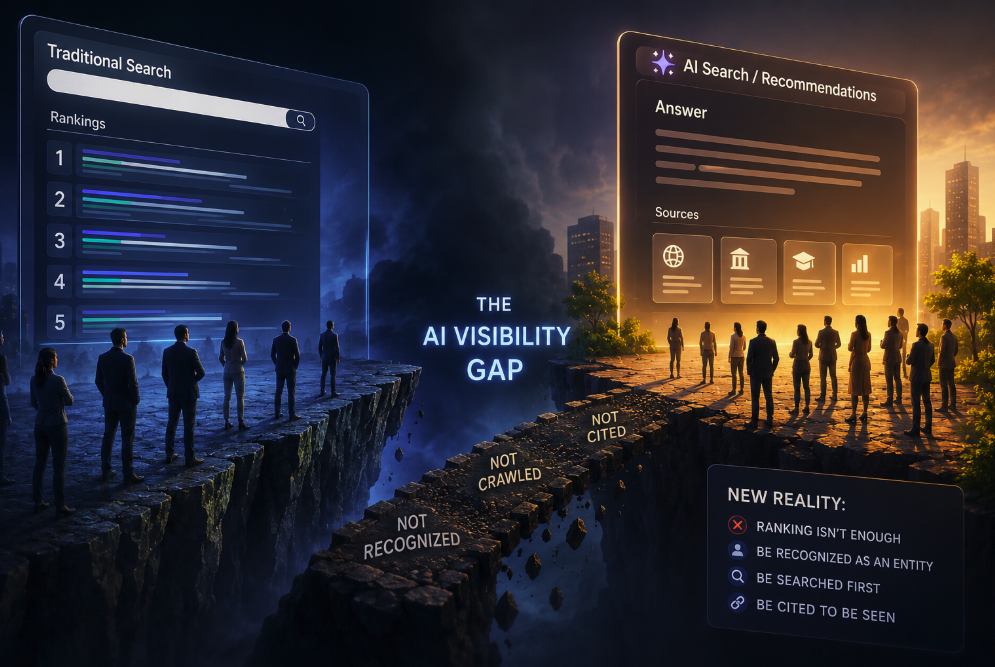
For two decades, search visibility had a familiar geometry. A brand could move from position eight to position three, measure the resulting impressions and clicks, and understand roughly where it stood against competitors. AI search is breaking that geometry. A company can rank prominently in conventional search and still disappear when a user asks an AI assistant which brands, products, services or providers it should consider.
That difference is becoming measurable. Recent 2026 studies suggest that traditional search authority and AI recommendation visibility overlap, but they are not interchangeable. An analysis published by Search Engine Land, based on Fractl research, found that stronger conventional organic authority generally tracked with stronger AI visibility for most brands in its dataset. Yet the exceptions were strategically important: some brands with large keyword footprints and substantial organic traffic appeared far less often in AI answers than their SEO strength would suggest, while smaller competitors repeatedly surfaced as default recommendations.
This creates a new visibility gap. Ranking answers the question, “Can a searcher find us among the results?” AI recommendation visibility asks something more selective: “When the system has to reduce the market to a handful of choices, are we one of them?”
AI search compresses the competitive set
A traditional results page can expose users to many competing domains. Even a brand outside the first few positions can remain visible, particularly across multiple queries and stages of a buying journey. Generative systems behave differently. When a user asks for the best project management platforms, insurance providers, running shoes or restaurants for a particular need, the answer often becomes a short synthesized list rather than a broad catalogue of ranked pages.
That compression matters because it changes the unit of competition. In SEO, a page competes for a position. In an AI recommendation, a brand may first need to qualify for the model’s consideration set. If it does not, there may be no equivalent of ranking sixth or tenth. It simply is not named.
The Fractl analysis illustrates this effect across categories. It found recurring “default” brands that appeared frequently in AI answers even when those companies were not necessarily the largest businesses or the strongest conventional SEO performers in their sectors. The authors also observed category-specific patterns, including digital-native insurance brands outperforming some established incumbents in AI mentions. The precise winners will change as models, retrieval systems and source ecosystems evolve, but the structural point is more important: AI recommendations can reorder a competitive market differently from a search engine results page.
Local search shows an even larger gap
The difference becomes particularly stark in local discovery. Earlier this year, Search Engine Land reported on SOCi’s 2026 Local Visibility Index, which analyzed nearly 350,000 locations across 2,751 multi-location brands. According to the report, brands appeared in Google’s local three-pack 35.9% of the time, while only 1.2% of locations were recommended by ChatGPT, 11% by Gemini and 7.4% by Perplexity.
Those figures should not be interpreted as a universal conversion formula between Google rankings and AI visibility; the platforms and methodologies are different. They do, however, expose the degree of selectivity involved. SOCi estimated that achieving AI local visibility could be between three and 30 times harder than appearing prominently in traditional local search. Fewer than half of the brands leading Google local visibility also appeared among the most visible AI brands in some sectors.
This suggests that an AI assistant is not simply reproducing a search ranking in conversational form. It is filtering. Ratings, sentiment, profile consistency, available business data, third-party evidence and the assistant’s confidence in a recommendation can all affect whether a location survives that filter. A business can therefore be discoverable in Google while remaining absent from the smaller shortlist generated by an AI system.
Ranking and recommendation are different events
The distinction becomes clearer if we separate the stages of AI visibility. A page can be indexed or retrievable without its brand being recommended. A source can be cited as evidence without the publisher itself becoming the recommended company. Conversely, a brand can be recommended because an AI system has repeatedly encountered favorable third-party information about it, even when the brand’s own website does not dominate the corresponding organic rankings.
This means “AI visibility” is too broad to be useful as a single number. At minimum, publishers and brands should distinguish source visibility, citation visibility, entity or brand mentions, and recommendation share. Each describes a different relationship with the answer. For commercial queries, recommendation share may ultimately be the most consequential because it measures whether the brand enters the user’s consideration set rather than merely contributing information to the response.
The distinction also connects with another emerging characteristic of generative search: instability. Academic research on measuring GEO has argued that AI visibility should be treated as a distribution rather than a single observation because outputs vary across prompts, repeated runs and time. In their 2026 paper “Don’t Measure Once: Measuring Visibility in AI Search (GEO)”, Julius Schulte, Malte Bleeker and Philipp Kaufmann emphasize repeated measurement rather than relying on one-off tests. That principle is especially important for recommendations, where small changes in phrasing can alter the shortlist a model produces.
The new test: rank the same brands, then ask AI to recommend them
This gap gives us a useful experimental framework. Instead of asking whether AI visibility correlates with SEO in the abstract, we can construct matched sets of commercial queries. First, record which brands dominate conventional organic and local results. Then transform the same intent into natural recommendation prompts across ChatGPT, Gemini, Perplexity and other systems. The comparison should track not only whether a brand appears, but its recommendation frequency, position within the answer, supporting citations and the sources the system retrieves.
The interesting cases will be the mismatches. Which brands repeatedly rank well but fail to enter AI shortlists? Which brands are recommended disproportionately despite weaker organic visibility? Once those groups are identified, we can compare their entity strength, review profiles, third-party mentions, publisher coverage, topical associations, structured business data and source diversity.
That approach avoids the temptation to declare a new AI ranking factor from a handful of prompts. It turns the visibility gap into something falsifiable. If conventional rankings strongly predict recommendations after repeated testing, the gap is smaller than it appears. If they do not, the next task is to identify which signals explain the residual difference.
Recommendation visibility may sit closer to brand authority than page authority
There is already a plausible hypothesis. Traditional SEO has become exceptionally good at evaluating pages and domains in relation to queries. Recommendation systems have an additional problem: they must decide which entities are safe, relevant and useful to suggest. That can place more weight on how consistently a brand is described across the wider information ecosystem.
A product page can rank because it satisfies a query exceptionally well. But when a user asks an assistant to recommend three companies for an important purchase, the system may seek corroboration across reviews, editorial coverage, comparison pages, forums, databases and other independent sources. In that environment, being an unambiguous and frequently corroborated entity may matter more than owning one excellent ranking URL.
This does not make SEO obsolete. The recent Fractl analysis actually points in the opposite direction: traditional organic authority still appears related to AI visibility for the majority of brands studied. The strategic mistake would be assuming that correlation means equivalence. SEO can help establish the information, authority and discoverability on which AI systems rely while still failing to guarantee inclusion in a generated shortlist.
Visibility is moving from position to selection
The deeper shift is conceptual. Search marketers are accustomed to measuring relative position: first, third, tenth, page two. AI recommendations introduce a more binary stage before position becomes relevant. The system selects a small group of entities, and everyone else receives effectively zero exposure in that answer.
That selection pressure could become more significant as users delegate more research to AI interfaces. Separate research on the economics of AI search has already found that generative systems can satisfy information needs without producing the same outbound referral behavior as conventional search. A 2026 paper titled “Answering Without Referring: How AI Search Rewrites the Web’s Economic Bargain” found substantially lower outbound-click behavior in ChatGPT information-seeking sessions than in Google search sessions. If users increasingly consume conclusions inside the interface, being present in the conclusion becomes more valuable than simply having a page available somewhere behind it.
For brands, this creates a second visibility scoreboard. Organic rankings still tell us whether pages are competitive in search. AI recommendation share tells us whether the brand survives a generative system’s compression of the market. The two metrics will often move together, but the exceptions are precisely where competitors can gain an advantage.
The next phase of AI search optimization therefore should not begin with the question, “How do we rank number one in ChatGPT?” It should begin with a more fundamental measurement problem: when a user asks an AI to choose, does the brand make the shortlist at all? The growing distance between rankings and recommendations suggests that this is becoming a distinct layer of digital visibility — and one that conventional SEO dashboards were never designed to see.