
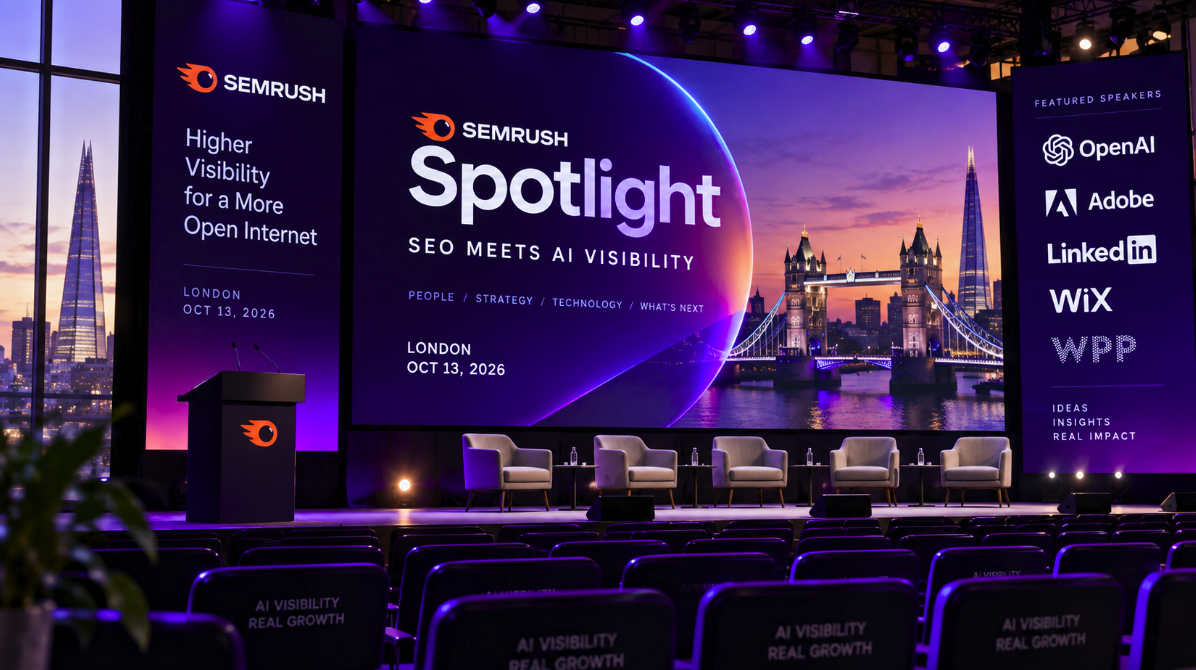
AI visibility has spent the past two years moving through the familiar stages of a new marketing discipline: first a curiosity, then a collection of experiments, then a wave of tools, metrics and acronyms. Now it is getting something more institutional—a major marketing conference built around the idea that visibility in AI systems belongs alongside traditional SEO as a core business problem.
On October 13, Semrush will bring its Spotlight conference to London with a program centered on the convergence of SEO, AI search and broader digital brand visibility. The event is expected to attract more than 1,000 senior marketers and features practitioners and executives with experience at companies including OpenAI, Adobe, LinkedIn, Wix and WPP.
The September 4 Search Engine Land article promoting the event is sponsored content written by Semrush, so its claims about the market should be read with that commercial context in mind. But the existence and scale of the event are still noteworthy. AI visibility is no longer being treated merely as a speculative SEO side session. It is becoming an operating discipline that brands are expected to measure, staff and budget for.
Spotlight puts SEO and AI Search on the same strategic map
Semrush first announced Spotlight 2026 in March, describing it as a forum for more than 1,000 CMOs, heads of brand, SEO executives and growth leaders. In its official announcement, the company explicitly framed the conference around the convergence of SEO and AI Search.
That framing matters. The early debate around generative search often treated SEO and AI visibility as competing disciplines. One camp argued that conventional optimization remained sufficient; another rushed to define entirely new categories such as GEO, AEO or LLM optimization.
The conference agenda suggests the market is settling into a less dramatic but more practical position. Brands still need technically sound websites, authoritative content and search visibility, but they increasingly need to understand how the same brand is represented, cited and recommended across ChatGPT, Gemini, Google AI Mode, AI Overviews, Claude, Perplexity and other discovery systems.
Instead of replacing SEO, AI visibility is broadening the surface area that search and brand teams are expected to manage.
The speaker list shows AI visibility moving beyond the SEO department
Search Engine Land’s sponsored article says Spotlight will feature more than 80 experts. Named speakers include Leila Woodington, Head of B2B Marketing for EMEA at OpenAI; Paula Ximena Mejia, VP of Marketing at Wix; and Daniel Hulme, Chief AI Officer at WPP.
The wider lineup includes participants from Adobe, LinkedIn, McKinsey, ElevenLabs, Wise, Spotify, Johnson & Johnson, Uber Eats, Getty Images and G2.
That mix is more revealing than any single session title. AI visibility is increasingly a problem shared by SEO, brand, communications, content, analytics and executive marketing teams. A brand can rank well in Google and still be represented inconsistently in an AI answer. It can be mentioned frequently by an LLM without earning measurable referral traffic. It can have strong owned content but discover that third-party sources dominate how AI systems describe it.
Those are not purely keyword-ranking questions. They involve brand narrative, source authority, digital PR, measurement and product positioning.
AI visibility now has its own measurement stack
Another sign of maturation is that marketers are no longer limited to manually asking chatbots whether they know a brand.
Semrush itself now offers an AI Visibility reporting system that tracks metrics such as mentions, citations, cited pages and visibility across different AI platforms. Its broader domain reporting increasingly places AI visibility beside organic search, paid search and backlink authority rather than hiding it in an experimental corner of the product.
Other SEO and analytics vendors have made similar moves. The category now includes prompt tracking, citation analysis, AI referral measurement, brand sentiment monitoring and competitive share-of-voice reporting across LLMs.
Once a marketing behavior becomes measurable, it becomes easier to assign targets, compare competitors and justify spending. Conferences are a predictable next step because teams need shared methods for interpreting metrics that are still less standardized than traditional search rankings.
The agenda is moving from “what is GEO?” to operational questions
The sponsored Spotlight preview is striking for the kinds of questions it says the conference will address. The agenda includes how to get cited by AI platforms and turn exposure into pipeline, where brands should draw boundaries around AI-generated content, how to create material that earns trust, how to measure ROI and what to do when AI systems fail.
Those are implementation questions rather than introductory ones.
That shift mirrors what has happened across the search industry in 2026. Marketers are increasingly less interested in debating whether AI search matters and more interested in deciding what to measure, which platforms deserve attention, how much content strategy needs to change and whether AI visibility produces commercial value.
Semrush is reinforcing that practical positioning with an AI Search Bootcamp on October 12, the day before Spotlight, focused on hands-on workflows for improving visibility across traditional and AI-driven discovery platforms.
Vendor enthusiasm should still be separated from independent evidence
Because the Search Engine Land article is sponsored by Semrush, several headline statistics deserve appropriate context.
The piece says more than a third of consumers now start searching with AI rather than traditional search engines, cites Semrush research suggesting customers from AI search channels convert at 4.4 times the rate of organic search visitors, and says only 15.2% of 1,094 categories analyzed had a clear AI-visibility leader.
Those figures may be useful signals, but they come from the company promoting an AI-visibility conference and selling AI-visibility software. They should not be treated as neutral proof that every company urgently needs the same investment level.
The stronger evidence is behavioral. Major marketing platforms are building dedicated AI visibility products. Enterprises are assigning teams to the problem. Search conferences are adding AI tracks, and Semrush is now making the convergence of SEO and AI discovery the central theme of a flagship event for senior marketers.
The category is becoming institutionalized even while its precise ROI remains uneven and difficult to measure.
AI visibility is broader than getting a link from ChatGPT
One reason the topic can support an entire conference is that “AI visibility” covers several different outcomes that marketers often collapse into one metric.
A brand can be mentioned without being cited. A website can be cited without receiving a click. A company can receive referral traffic without being recommended positively. An AI system can accurately describe a product while relying entirely on third-party sources rather than the brand’s own website.
Traditional SEO metrics do not fully capture those distinctions.
For many organizations, the real question is not simply whether an LLM links to the corporate site. It is whether the brand appears in the answer set when customers ask category-level questions, which sources shape the response, how competitors are positioned and whether AI-generated descriptions reflect the company’s actual proposition.
That makes AI visibility partly a search discipline and partly a reputation discipline.
SEO fundamentals remain underneath the new category
The rise of AI visibility does not mean every established SEO practice has become obsolete. In fact, Semrush’s own messaging around Spotlight emphasizes many familiar fundamentals: technically sound owned properties, content aligned with the brand, authoritative information and a consistent customer experience.
AI systems still need discoverable source material. Search engines, retrieval systems and LLM-powered products frequently rely on the same public web ecosystem that SEO teams have spent years trying to make accessible and authoritative.
The difference is that the optimization target has expanded. Ranking position is no longer the only possible form of visibility, and the brand’s own domain is no longer the only source that matters.
A modern search strategy may therefore need to ask both “Does our page rank?” and “Does the information ecosystem give AI systems enough reliable evidence to include and describe our brand correctly?”
The conference format itself signals a budget shift
Marketing disciplines become durable when organizations spend more than experimental time on them. They acquire software budgets, specialist roles, executive reporting and professional events.
Spotlight is designed around senior decision-makers rather than only technical SEO practitioners. Semrush says the audience will include CMOs, marketing directors and brand leaders, with keynote stages, workshops, mastermind sessions and peer discussions.
That positioning suggests AI visibility is moving upward in the organization. It is increasingly being framed as a question of total digital brand visibility rather than a niche tactic owned by whoever manages organic rankings.
For agencies and consultants, that shift may be equally important. Clients are likely to expect reporting that connects SEO, AI citations, brand mentions and business outcomes rather than receiving a separate experimental dashboard with no relationship to broader marketing performance.
There is still no settled playbook
A conference does not mean the industry has solved AI visibility. In many respects, the opposite is true.
AI answers are volatile. Platforms use different retrieval systems and source sets. Citation behavior can change by model, query, location and time. Referral attribution remains imperfect, and visibility does not automatically translate into clicks or revenue.
Even terminology remains unsettled. GEO, AEO, AI SEO, LLM optimization and AI visibility are often used to describe overlapping practices.
That uncertainty is precisely why events like Spotlight can attract attention. Marketers are looking for patterns from organizations that have already tested strategies at scale, including what failed rather than only what produced a successful case study.
The value of those discussions will depend on whether the industry can distinguish repeatable evidence from vendor marketing and anecdotal wins.
AI visibility has crossed from trend to operating concern
Semrush has an obvious commercial interest in declaring AI visibility a major marketing category. It sells the tools used to measure it and is promoting the conference built around it. That context should remain visible.
But the underlying signal is difficult to dismiss. A flagship London marketing event expecting more than 1,000 senior leaders is dedicating its central narrative to the convergence of SEO and AI-driven discovery, with practitioners from OpenAI, Adobe, LinkedIn, Wix, WPP and other major organizations sharing what they have learned.
Two years ago, AI visibility was largely a question marketers asked in experimental Slack channels: “Does ChatGPT mention us?” In 2026, companies are building measurement systems, assigning budgets, creating workflows and gathering executives in conference halls to decide what to do about the answer.
That does not prove every AI visibility tactic works. It does show the discipline has become important enough that marketing leaders no longer want to figure it out alone.