
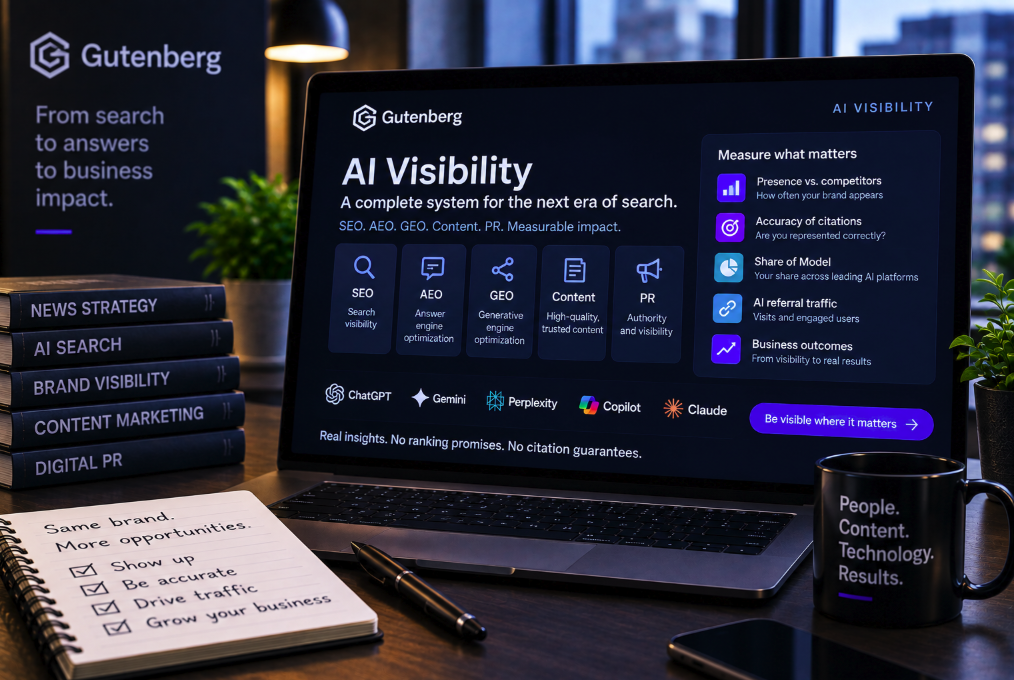
AI search optimization is starting to look less like a new branch of SEO and more like a full-stack marketing service. Gutenberg's newly launched AI Visibility offering combines technical search work, answer-engine optimization, generative-engine optimization, content and public relations inside one measurement and execution system.
The service, announced by Gutenberg on September 1 and covered by Express Computer on September 2, is designed to measure whether a brand is visible, accurately represented and cited relative to competitors across traditional search and AI-generated answers. Its reporting includes what Gutenberg calls Share of Model, citation accuracy, AI referral performance and downstream business outcomes alongside conventional search metrics.
Just as important is what the agency does not promise. Gutenberg explicitly says it cannot guarantee specific rankings or citations from third-party AI platforms.
That qualification makes the launch more interesting than another agency simply adding “GEO” to an existing SEO package. The emerging service model is increasingly about coordinating the signals a brand can influence while measuring outputs that no marketer can directly control.
SEO, AEO and GEO are being packaged as one system
In Gutenberg's own launch announcement, the agency describes SEO, AEO and GEO as complementary disciplines rather than competing replacements.
SEO continues to address discoverability through conventional search. AEO focuses on making information clear and usable in answer-led environments. GEO addresses how brands are understood, referenced and potentially recommended by generative systems.
That division is conceptually useful, but the operational boundaries are already blurry. Clear product information can improve conventional search relevance and help an LLM understand the company. Strong entity relationships can support knowledge retrieval across several interfaces. An authoritative third-party article can influence human buyers, search results and AI-generated answers simultaneously.
The more those mechanisms overlap, the less practical it becomes to operate SEO, AEO and GEO as isolated teams with separate content calendars.
Public relations is moving into the AI visibility stack
The most consequential part of Gutenberg's model may be the explicit inclusion of PR. The agency divides its system into Digital, Content and Public Relations, with each contributing a different layer of evidence.
Digital establishes the technical and search foundations. Content creates material that systems can understand and retrieve. PR is intended to build independent authority and third-party validation around the brand.
This reflects a structural difference between optimizing a company page and influencing a generative recommendation. A brand can control the claims on its own website, but an answer engine may construct its view of the market from review platforms, industry publications, news coverage, comparison pages and other independent sources.
If AI systems use the wider web to decide which companies belong in a shortlist, earned authority becomes part of discoverability rather than merely reputation management.
“Citation-worthy” is becoming a marketing objective
Gutenberg co-founder and president Amardeep Singh frames the shift around becoming citation-worthy rather than simply visible. That phrase captures an important change in how content teams may need to think about distribution.
Traditional SEO often asks whether a page can rank for a query. AI visibility adds another question: does the information provide evidence that a generative system can confidently use when constructing an answer?
Those are not identical standards. A commercially optimized landing page can perform well in search while offering little independent evidence for a comparative answer. An original research report may receive fewer direct conversions but become a strong citation source because it contributes facts that other pages do not contain.
The implication is not that every page should be rewritten for AI. It is that publishers and brands may increasingly evaluate content by both destination value and evidence value.
The service begins with a competitive baseline
Gutenberg says an engagement first establishes how the brand currently appears across relevant search and AI environments, including whether it is visible, accurately represented and cited relative to competitors.
That baseline is necessary because AI visibility without a comparison set can be misleading. A brand appearing in 40% of tracked answers might look healthy until the leading competitor appears in 85%. Conversely, a seemingly modest visibility rate may be strong in a category where AI systems rarely name vendors at all.
Competitive measurement also helps distinguish recognition from category participation. An assistant may accurately explain a company when asked directly while never surfacing that company when a buyer asks for the best providers in its market.
A useful AI audit therefore needs to test the category, not merely the brand name.
Share of Model attempts to quantify the new competitive surface
Among the metrics Gutenberg lists is Share of Model. The terminology is still developing across the industry, and different vendors can define similar concepts differently, so the underlying calculation matters more than the label.
In general, the objective is to measure how much of the AI-generated category conversation belongs to one brand relative to competitors. That can include frequency of mentions, recommendation prominence or other normalized visibility measures across a controlled prompt set.
The metric is potentially useful because generative answers do not provide a conventional ranking page with ten stable positions. A brand can appear in some prompts, disappear from others and move between prominent recommendation and incidental mention.
Share-style measurement turns those probabilistic outputs into a competitive trend, provided the prompt set and methodology remain stable enough for comparisons over time.
Citation accuracy measures something visibility alone misses
Gutenberg also includes citation accuracy in its framework. This is an important addition because appearing in an AI answer is not necessarily positive if the answer misstates what the company does.
An assistant can surface an outdated product name, old pricing, a discontinued service, the wrong geographic availability or an incorrect category association. A dashboard counting that response as a successful mention would hide a reputational problem inside a visibility metric.
Accuracy therefore needs to be measured separately from presence. A brand can have high AI visibility and poor AI representation at the same time.
This is one reason human review remains difficult to remove from serious AI monitoring. Automated systems can detect a brand string, but deciding whether a nuanced product description is materially correct can require domain knowledge.
AI referrals reconnect visibility with observable behavior
The service also tracks referral performance from AI platforms. This brings AI visibility back into the part of the funnel conventional analytics can observe.
Prompt monitoring can show that a brand is mentioned or recommended, but synthetic tests do not prove that real users saw those answers or acted on them. Referral sessions provide a different signal: a person actually moved from an AI product to the website.
Even that metric is incomplete. Many AI interactions produce no outbound click, and some products or applications can make referral attribution difficult. A recommendation can influence a later branded search or direct visit without passing a clean referrer.
The strongest measurement model therefore combines answer visibility with behavioral data rather than pretending either dataset is complete on its own.
Downstream business outcomes are the hardest layer
Gutenberg's framework extends measurement beyond AI referrals into downstream business outcomes. That is the right ambition and the most difficult part to execute credibly.
A mention inside ChatGPT has little intrinsic business value if it never affects a buyer. Likewise, an AI referral can be impressive in analytics while producing low-quality sessions that do not convert.
Teams ultimately need to connect AI discovery with qualified leads, pipeline, purchases, registrations, subscriptions or whatever outcome defines value for the organization.
Attribution will rarely be clean. AI research can happen early in a buying journey and influence decisions that surface weeks later through direct, organic or sales-assisted channels. The goal should therefore be evidence of contribution rather than a fictional precision in which every AI mention receives a revenue number.
The human-in-the-loop model is a response to unstable outputs
Gutenberg says every engagement combines AI-enabled analysis and monitoring with human strategic, editorial, digital and PR oversight.
That design is sensible because answer engines are probabilistic and context-sensitive. The same prompt can produce different vendors on repeated runs, and a platform update can change citations without any corresponding change on the brand's website.
Automated monitoring is necessary to create enough observations for trend analysis. Human interpretation is necessary to determine whether the movement is meaningful, whether a citation is accurate and what intervention might plausibly address the gap.
AI visibility is therefore becoming an analytics problem and an editorial judgment problem at the same time.
The agency is selling coordination, not control
The most responsible sentence in the launch announcement may be Gutenberg's explicit statement that it does not guarantee specific rankings or citations from third-party AI platforms.
No agency controls which sources ChatGPT retrieves tomorrow, how Gemini changes its answer-generation behavior or whether an AI search product modifies its citation interface. Promising a guaranteed citation would confuse an optimization effort with ownership of the underlying distribution system.
What marketers can control is the quality and consistency of their own information, technical accessibility, content architecture, evidence production, public relations strategy and measurement process.
The full-stack service model is essentially an attempt to coordinate those controllable inputs around uncontrollable outputs.
Gutenberg's launch is an announcement, not proof of performance
The source context deserves emphasis. Express Computer's article reports Gutenberg's corporate launch announcement, and the claims about the service's capabilities come from the agency itself.
There is no independent before-and-after study in the announcement showing that the integrated system increases AI recommendations, citations, referral traffic or revenue by a particular amount.
Gutenberg's broader GEO and AI search service page describes audits, entity work, AI-ready content, cross-platform monitoring and authority-building services, but those descriptions remain the provider's account of its offering.
The launch should therefore be read as evidence of how agencies are packaging the emerging discipline, not as evidence that this particular package has already produced a proven performance lift.
The service category is converging around the same architecture
What makes the announcement notable is that the architecture increasingly resembles what the measurement data itself suggests brands need.
Cross-engine studies show that different AI systems can recommend different brands for identical prompts. Citation analyses show that third-party sources can matter heavily in commercial answers. Referral data shows that AI discovery can create traffic, while zero-click behavior means traffic alone misses much of the exposure.
A service built only around technical SEO cannot address all of those dimensions. Neither can a PR program that never measures whether earned coverage appears in AI answers.
The natural result is convergence: technical search, entity clarity, content, authority, PR, answer monitoring and analytics begin operating as one system.
AEO and GEO may become capabilities rather than departments
This convergence raises a longer-term organizational question. If SEO, AEO and GEO use many of the same inputs, companies may not need three permanent departments.
AEO can become a capability within content and search teams: make information easy to extract and answer. GEO can become a capability across search, content and PR: make the brand understandable and well supported across the information ecosystem.
The dedicated function may instead be AI visibility measurement — the layer that continuously tests how systems actually represent the brand and routes problems to the team best equipped to fix them.
An accuracy problem might go to product marketing. A technical retrieval problem might go to SEO or engineering. Weak independent corroboration might go to PR. Missing comparison content might go to editorial.
Full-stack does not mean every tactic causes every outcome
There is a risk in integrated service models: once many disciplines are bundled together, attribution can become even harder.
If a company improves technical SEO, publishes research, earns press coverage, rewrites product pages and launches an AEO program simultaneously, a subsequent increase in AI recommendations cannot automatically be assigned to one component.
Full-stack execution therefore needs disciplined experimentation. Prompt sets should remain stable for trend measurement. Interventions should be logged. Engine-level changes should be reported separately. Where possible, teams should use control groups or staged rollouts.
Integration should improve coordination without eliminating the ability to learn what actually moved the metric.
AI visibility is becoming a reputation metric as much as a search metric
Gutenberg's emphasis on accuracy, authority and PR points to another change. Search visibility historically focused heavily on whether users could find a page. AI visibility increasingly includes what a system says about the organization before the user ever reaches that page.
That makes the discipline relevant to communications teams. An incorrect answer about a product, executive or company position can be a reputation issue even if it generates no measurable traffic.
The brand's machine-mediated representation is becoming a public-facing surface in its own right.
As that surface grows, monitoring it may begin to resemble media monitoring: identify mentions, assess accuracy and sentiment, compare competitors and respond where the underlying information environment can be improved.
The market is moving from optimization packages to visibility systems
The title “AI Visibility” is revealing. Gutenberg could have launched a GEO package or an AEO service. Instead it has framed the offering around a broader outcome and placed multiple disciplines underneath it.
That may be where the market is heading. Buyers do not necessarily care whether a recommendation improved because of schema, an authoritative article, clearer entity information or a piece of earned media. They care whether the brand is correctly represented, considered and chosen.
SEO, AEO, GEO, content and PR remain useful specialist languages for the work required to influence that outcome. But the reporting layer increasingly needs to unify them.
Gutenberg's launch does not prove that one full-stack system can manufacture AI recommendations, and the agency wisely does not promise that. It does show how quickly AI search is dissolving the old boundary between search visibility, content authority and brand reputation. The emerging service is no longer simply about ranking a page. It is about measuring and improving the entire information environment from which humans and machines decide what a brand is worth considering.