
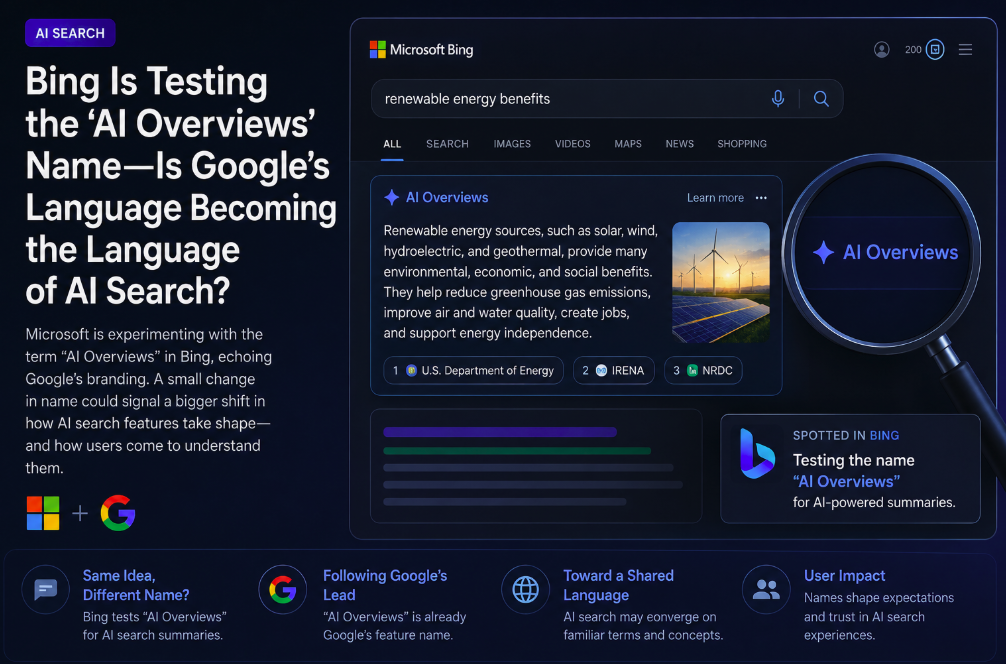
Bing Is Testing the ‘AI Overviews’ Name — Is Google’s Language Becoming the Language of AI Search?
Microsoft is testing a surprisingly familiar label for generative answers in Bing: “AI Overviews.” According to Search Engine Roundtable, some Bing users have seen the name appear above an AI-generated answer box that would normally be identified as Copilot Search. The Copilot branding remains visible, but the terminology is notable because “AI Overviews” is already strongly associated with Google Search.
The test does not mean Microsoft has officially renamed Copilot Search. Microsoft's own documentation still describes the experience as Copilot Search, a combination of traditional search and generative answers with prominent citations and links to publishers. What makes the experiment interesting is therefore not a confirmed product change, but the possibility that the vocabulary used to describe AI search is beginning to converge.
Google may have created a category name
Google introduced AI Overviews broadly in 2024 and has since expanded the feature across markets while developing AI Mode as a more conversational search experience. Google describes AI Overviews as snapshots of key information with links that let users explore the web. The term has now been exposed to an enormous search audience, making it increasingly understandable even outside the SEO industry.
That creates an unusual branding dynamic. “AI Overview” sounds descriptive rather than highly proprietary: it tells the user exactly what is happening. An AI system is producing an overview. If Bing is experimenting with the same language, Microsoft may simply be testing whether users understand a familiar functional label more quickly than a product-specific name such as Copilot Search.
AI search interfaces are starting to resemble each other
The larger trend goes beyond terminology. Google, Bing and other answer engines increasingly combine generated summaries, citations, source links, follow-up exploration and conventional web results. The implementation differs, but the user expectation is becoming recognizable: ask a question, receive a synthesized answer, inspect the sources and continue the conversation or search.
This convergence matters for publishers because visibility can no longer be understood only through the traditional ranked list. NetContentSEO has been examining this transition through its work on how AI-powered search retrieves, reconstructs and attributes information. Whether a feature is called Copilot Search, AI Overviews or something else, publishers increasingly need to understand when their information becomes part of the generated answer itself.
A small naming test with a larger implication
For now, Bing's “AI Overviews” label should be treated as a test, not a permanent rebrand. But naming experiments can reveal how a market is maturing. Early technologies tend to accumulate competing terminology; mature categories often settle around a handful of expressions that users immediately recognize.
If “AI Overview” begins appearing beyond Google, the phrase could gradually become less like the name of one Google feature and more like a generic description of an AI-generated search summary. That would be a subtle but significant sign that Google is not only shaping the interface of generative search — it may also be shaping the language the rest of the industry uses to explain it.