
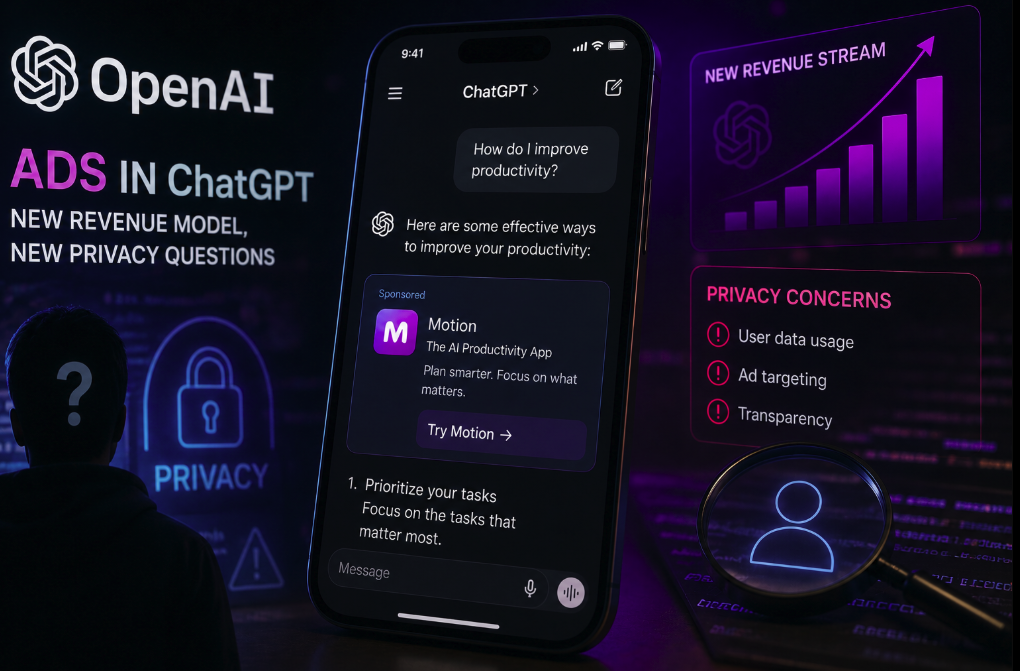
Advertising in ChatGPT is no longer a hypothetical future business model. OpenAI has moved from its initial U.S. pilot into a broader international rollout, and as of August 24 ChatGPT Ads are expanding across 31 European markets, including Germany, France, Italy, Spain, the Netherlands and the Nordic countries. That makes the central question less about whether OpenAI will put ads inside its conversational product and more about how deeply advertising will be allowed to use the context that makes ChatGPT different from a conventional search engine or social feed.
A new Igor'sLAB analysis published on August 29 focuses on precisely that tension, highlighting OpenAI’s assurances that advertisers will not receive users’ conversations or personal data while questioning how contextual targeting, measurement and future personalization are implemented. Some of the article’s rollout details reflect an earlier stage of OpenAI’s advertising plans, however. OpenAI’s current documentation now answers several of those previously open questions — and reveals a more mature advertising system than the original announcement alone suggested.
ChatGPT ads have already moved beyond the initial announcement
OpenAI began testing advertising in the United States earlier this year and subsequently expanded ChatGPT Ads to the United Kingdom, Mexico, Brazil, Japan and South Korea. On August 18, the company announced a 31-market European expansion beginning August 24. Advertisers initially gain access through OpenAI’s Ads Solutions team, agencies and technology partners, with broader self-service access through Ads Manager planned to follow.
The basic consumer split remains straightforward. Ads can appear for users on the Free and Go plans, while Plus, Pro and business-oriented paid plans remain ad-free. OpenAI also says accounts identified as belonging to users under 18 are excluded from advertising.
The format is now clearer as well. OpenAI’s advertiser documentation says ads appear below ChatGPT responses and include an advertiser name, favicon, headline, description, landing page and image creative. This placement is important because OpenAI is attempting to create commercial relevance around a conversation while maintaining a visible boundary between the generated answer and the paid message underneath it.
OpenAI says advertisers cannot see your conversations
The strongest privacy promise is also the simplest: OpenAI says advertisers do not receive users’ ChatGPT conversations, chat history, memories or personal information. According to the company’s current ChatGPT advertising FAQ, advertisers receive aggregated, non-identifying performance information such as total impressions and clicks rather than access to the underlying conversation that caused an ad to appear.
OpenAI also says user data is not sold to advertisers. Advertisers cannot access a user’s name, email address, exact location, IP address or sensitive information such as health or political data through the ChatGPT advertising system. If a user deliberately sends a message to an advertiser through an interactive ad, the advertiser can see the messages that user sends directly to it, but not the surrounding private ChatGPT conversation.
That separation addresses one of the most obvious fears around conversational advertising: that a brand might effectively receive the transcript of the discussion in which its ad was selected. OpenAI says that is not how the system works. But it does not mean the conversation is irrelevant to ad selection.
The important distinction is internal targeting versus advertiser access
ChatGPT can use information from the current conversation to decide which ad may be relevant while keeping that information inside OpenAI’s systems. This distinction is easy to miss. An advertiser does not need to receive the user’s prompt for an advertising system to make use of the prompt’s context internally.
OpenAI says ad selection can consider the topic of the current chat along with basic context such as general location and language. When personalized ads are enabled, the pool of signals can become substantially broader. OpenAI’s current documentation says personalization may also use the current thread — including personalized responses generated by the model — previous chats, memory and the way a user interacts with ads, such as which ads they hide or engage with.
This is where ChatGPT advertising becomes fundamentally different from placing a generic banner next to an AI answer. A conversational system can potentially understand what the user is trying to accomplish at the moment the commercial message is selected. Someone may be comparing software, planning a trip, researching furniture or evaluating a purchase in a dialogue that has already established constraints and preferences. The commercial value lies precisely in that context.
Memory makes personalization much more consequential
The inclusion of previous chats and saved memory in personalized advertising is likely to attract the most scrutiny. Memory is designed to make ChatGPT more useful across conversations by preserving information that helps the assistant tailor future responses. When a user enables personalized ads, some of that broader ChatGPT context can also contribute to advertising relevance.
OpenAI emphasizes that those memories still are not handed to advertisers. The targeting occurs within ChatGPT, while the advertiser receives aggregated campaign reporting. Nevertheless, from the user’s perspective, the privacy question is broader than data disclosure. It also concerns purpose: information originally retained to personalize an AI assistant can, with advertising personalization enabled, become a signal used to decide which commercial message the user sees.
That is why consent and controls matter. OpenAI says users can disable ad personalization and delete advertising-related data. Its Help Center states that deleted ad data will no longer be used for advertising and can remain on OpenAI’s servers for up to 30 days before deletion. Users who do not want advertising at all can also use an ad-free eligible plan, subject to the availability and terms of those plans.
Sensitive conversations are supposed to be off limits
OpenAI has now published a dedicated ad placement policy covering contexts where advertising should not appear. The company says it avoids ads around sensitive, high-stakes or emotionally vulnerable conversations where commercial placement could undermine trust. It also restricts brand-unsafe contexts and prohibited categories.
This is a crucial safeguard for a conversational product. A search engine can often infer commercial intent from a relatively short query, but ChatGPT conversations can include deeply personal context that develops over many turns. The potential relevance of an advertisement may increase with that context, while the risk of an inappropriate or manipulative placement increases at the same time.
The policy therefore matters as much as the privacy architecture. Even if no advertiser receives private conversation data, users could still react negatively if advertising appears beside medical, emotional, financial or other sensitive discussions. OpenAI’s stated approach is to exclude sensitive contexts rather than attempt to monetize every commercially relevant signal.
OpenAI is building an advertising platform, not just testing a banner
The scale of the infrastructure now surrounding ChatGPT Ads suggests this should be understood as a new advertising platform rather than a limited interface experiment. OpenAI has introduced cost-per-click bidding, agency and technology partners, campaign measurement tools and a self-service Ads Manager. It has also published advertising terms, policies and an Ad Tools Data Processing Addendum governing data processing for advertising customers.
The economic logic is obvious. ChatGPT serves a vast audience, and many conversations occur at exactly the point where users are exploring options or making decisions. OpenAI can monetize Free and Go usage while preserving higher-priced subscriptions as an ad-free experience. For advertisers, the attraction is not merely audience size but intent: the user may already be explaining what they need in natural language.
That also explains why the independence of ChatGPT’s answers is such an important promise. OpenAI says advertising does not influence the assistant’s responses and is clearly separated and labeled. If users begin to suspect that an answer recommends a product because an advertiser paid for proximity to the conversation, the usefulness of the assistant itself would become entangled with the economics of the ad system.
The privacy debate has changed
The Igor'sLAB article is right to focus attention on privacy, but the debate is already moving beyond some of the unanswered questions surrounding OpenAI’s earliest announcement. We now know substantially more about where ads appear, which plans can receive them, how users can manage personalization, how long deleted ad data may be retained, how age restrictions work and which conversational contexts OpenAI says are unsuitable for advertising.
The more interesting unresolved issue is whether users will accept the conceptual boundary OpenAI is drawing. The company’s position is that conversations remain private from advertisers even when ChatGPT itself uses conversational context to select an ad. Technically and commercially, those are different forms of data use. To many users, however, an advertisement that appears because the system understood a private conversation may still feel highly personalized even if the advertiser never sees a single word of that conversation.
ChatGPT Ads therefore create a new trust test for OpenAI. The company must demonstrate not only that advertisers cannot access private chats, but that contextual targeting, memory-based personalization and commercial measurement remain understandable and controllable enough that users can distinguish a useful sponsored message from an intrusion into the relationship they have with the assistant. As ChatGPT advertising expands internationally, that distinction is likely to become one of the defining privacy questions of conversational AI.