
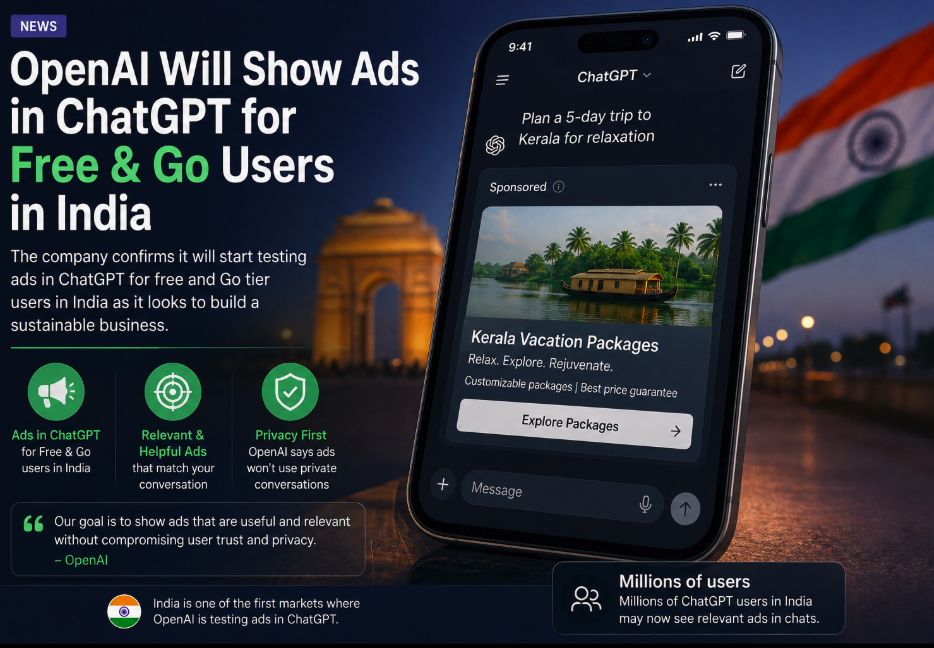
ChatGPT’s advertising business has reached the market that may reveal more about its future than almost any other. OpenAI is rolling out ads to logged-in adult users on the Free and lower-cost Go tiers in India, putting sponsored placements in front of a vast audience that already uses conversational AI for research, recommendations, learning and everyday decisions.
The immediate news, reported by The Daily Star and other outlets, is straightforward: India is joining the expanding ChatGPT Ads program. But the strategically important part is not that another internet product now contains advertising. It is where the ads appear in the user journey. OpenAI is trying to build an advertising market around conversations that often happen immediately before a decision.
That makes ChatGPT Ads different from simply inserting banners into a popular app. Search advertising became enormously valuable because Google could infer commercial intent from a query. Social advertising became enormously valuable because platforms could infer interests and audiences from behavior. Conversational advertising potentially combines elements of both: the system can understand what the user is trying to accomplish, how their requirements evolve through the conversation and when they may be moving from exploration toward action.
India gives OpenAI scale and a price-sensitive audience
India is not a minor expansion market for ChatGPT. OpenAI said earlier this year that the product had more than 100 million weekly active users in the country. The company originally introduced ChatGPT Go in India in August 2025 as a lower-cost subscription before eventually expanding the plan globally.
That history makes the advertising rollout particularly significant. OpenAI has been experimenting with a three-part consumer model: free access supported partly by ads, a low-cost Go tier that can also contain ads, and higher-priced subscriptions that remain ad-free. India provides a large-scale test of whether users will accept advertising not only in a free AI product but inside an inexpensive paid tier designed specifically to make more capable AI accessible to price-sensitive markets.
According to TechCrunch, OpenAI is beginning with more than 50 brands and has partnered with WPP and Omnicom for the Indian launch. The company is also preparing self-service buying tools, with Ads Manager expected to open to marketers on September 4 and a reported minimum daily campaign budget of ₹725, roughly $7.60.
That low entry point is revealing. OpenAI is not designing ChatGPT Ads solely as a premium placement for multinational brands with enormous agency budgets. A self-service platform with a modest daily minimum points toward the familiar long-term playbook of digital advertising: make the inventory accessible to a broad market of businesses, collect performance data, improve targeting and optimization, and gradually turn the interface into an auction-driven advertising ecosystem.
The valuable inventory is the conversation before the purchase
OpenAI’s own language about advertising repeatedly focuses on moments when “decisions are beginning to take shape.” That phrase describes the economic opportunity unusually well. A person may ask ChatGPT to compare phones under a particular budget, plan a trip to Kerala, choose software for a small business, find a suitable course or decide which appliance fits a specific home.
These are not generic demographic signals. They are expressions of active intent, often accompanied by constraints that become clearer with every follow-up question. The user might begin with “Where should I travel in December?” and eventually specify a budget, departure city, preferred climate, number of travelers and desired hotel standard. By the end of the conversation, the commercial context can be considerably richer than the original query.
OpenAI’s official advertising announcement says ads are shown below answers and are clearly labeled and visually separated from the assistant’s organic response. The company says the answer itself remains independent and advertisers cannot pay to influence what ChatGPT says.
If that separation holds, the commercial product is effectively the space immediately after an AI has helped the user frame the decision. That is potentially powerful inventory. The assistant performs the informational work; the advertisement appears when the user may be ready to investigate a product or service.
ChatGPT is not selling advertisers your conversation
The privacy distinction around ChatGPT Ads needs precise language because two very different ideas are easily collapsed into one. OpenAI says advertisers do not receive access to users’ conversations, chat history, memories or personal details. They receive aggregated, non-identifying performance information such as ad views and clicks.
That does not mean the conversation is irrelevant to ad selection. OpenAI’s current Ads FAQ explains that ads can be selected using the context of the current chat. Where personalized advertising is enabled, OpenAI may also use past chats, memory and previous ad interactions to make ads more relevant.
The distinction is architectural. The advertiser does not read the conversation and decide whom to target. OpenAI’s systems use available context internally to determine which eligible ad to display. The advertiser sees performance data, not the underlying private chat.
This distinction will probably become central to public acceptance of conversational advertising. A user can reasonably consider an ad influenced by a private conversation more intimate than a contextual ad on a webpage even if the advertiser never sees that conversation. Privacy is therefore only part of the trust question. The other part is whether users are comfortable with the assistant using personal conversational context for commercial relevance inside the same product.
OpenAI is offering a free ad-free option — with a cost measured in capability
One of the more unusual elements of OpenAI’s model is that Free users can choose an ad-free experience without paying money. According to the company’s current help documentation, users in eligible markets can switch the Free plan to Ads-Free, but doing so reduces message limits and can remove access to some features such as image generation or deep research.
That creates a new kind of exchange. The choice is not simply “pay money or see advertising.” It can be “accept advertising and receive more AI capacity, or reject advertising and receive less capacity.” OpenAI explicitly frames ads as a way to finance broader access to expensive computing resources.
For India, where the company has already used aggressive pricing to expand adoption, this model may be especially important. AI inference has a real marginal cost in a way that displaying another social-media post does not. Advertising can therefore become part of the mechanism through which OpenAI subsidizes higher usage for users who are unwilling or unable to purchase Plus or Pro.
The Go tier creates a more controversial version of the same trade. Go is already a paid subscription, yet it remains eligible for advertising. That suggests OpenAI increasingly sees ad-free use as a premium benefit rather than an automatic consequence of paying anything at all.
India could be where ChatGPT Ads becomes a performance channel
The first months of an advertising product are usually dominated by large brands, controlled partnerships and manual sales. The more consequential phase begins when ordinary advertisers can buy campaigns directly and optimize them against measurable outcomes. OpenAI’s reported September 4 Ads Manager launch in India points toward that phase.
If small businesses can start with ₹725 per day, ChatGPT Ads could quickly move from an experimental brand format into the territory occupied by Google Ads and Meta Ads. The important questions will then become familiar to performance marketers: what counts as an impression, how clicks are priced, which conversion events can be optimized, how attribution works and whether conversational context produces materially better intent signals than conventional audience targeting.
India is an unusually strong market in which to test that proposition. It combines massive consumer scale, a mature digital advertising ecosystem, fast-growing online commerce and an enormous population of small and medium-sized businesses. If OpenAI can demonstrate that a sponsored placement following a relevant AI conversation produces valuable customer acquisition, advertiser demand could grow much faster than if the format remains primarily a branding experiment.
This is not search advertising, even if it competes for the same budget
The easiest analogy is Google Search Ads, but the mechanics are not identical. A search query is normally short and explicit. A ChatGPT conversation can be long, iterative and ambiguous. The user may not even begin with commercial intent. They may ask for advice, explore possibilities and only gradually reach a point where a product or service becomes relevant.
That means OpenAI has to solve a difficult timing problem. Showing an ad too early can feel intrusive and damage trust. Showing it too late can miss the commercial moment. Matching too aggressively can make the assistant feel as if it is exploiting a private discussion. Matching too loosely can produce irrelevant ads that users quickly dismiss.
The company says it is measuring consumer trust and dismissal rates as the program expands. Those may be unusually important metrics for conversational advertising. Search users expect commercial results around many queries. ChatGPT users have spent years interacting with an interface that originally contained no advertising at all. The product is introducing a commercial layer into a relationship that many users experience as more personal than a search-results page.
Answer independence is the asset OpenAI cannot afford to lose
OpenAI repeatedly emphasizes that advertising does not influence ChatGPT’s answers. That promise is not merely a privacy or product-design principle; it is the foundation of the advertising model’s credibility.
Imagine a user asking for the best laptop for video editing. If ChatGPT independently recommends three machines and a clearly labeled sponsored laptop appears below the answer, the user can understand the separation. If advertisers could pay to alter the recommendation itself, every commercial answer would become suspect. The value of ChatGPT as a decision assistant would deteriorate precisely because the user could no longer distinguish advice from paid placement.
OpenAI therefore faces an incentive structure that differs subtly from traditional search. Google has long separated paid search ads from organic rankings, but users already understand a search-results page as a marketplace of links. ChatGPT presents a synthesized answer in a single authoritative conversational voice. Commercial contamination of that voice could be more damaging.
The company’s challenge is to monetize the moment without monetizing the answer.
For marketers, optimization may move from keywords to conversational situations
If ChatGPT Ads scales, it could create a new discipline alongside search advertising. Keywords may matter less than the broader situation in which a product becomes useful. A travel advertiser may care about users planning a five-day family trip with a specific budget. A software company may care about conversations where a small business is comparing accounting workflows. A retailer may care about someone narrowing a purchase according to size, features and price.
OpenAI has said it intends to prevent narrow or inappropriate targeting, so marketers should not assume they will receive direct access to all of that conversational granularity. But the platform itself can potentially understand context at a semantic level that keyword systems historically approximated through query matching and audience signals.
This could also change creative strategy. An advertisement that appears after a detailed AI conversation has less need to explain the entire category. The user may already understand the problem. The winning creative may instead need to establish why a particular business is relevant at that exact decision point.
The expansion is becoming global, not experimental
India also confirms that ChatGPT Ads has moved beyond a small U.S. pilot. OpenAI began testing ads with Free and Go users in the United States in February, expanded into Canada, Australia and New Zealand, and later launched in the United Kingdom, Mexico, Brazil, Japan and South Korea. In August, the company announced expansion into 31 European markets.
The pace matters. Six months after the initial U.S. test, OpenAI is building agency relationships, preparing self-service buying infrastructure and opening large international markets. Advertising is becoming a product line, not merely an experiment attached to ChatGPT.
That creates a second business alongside subscriptions. The consumer can pay directly for more access and an ad-free experience, or advertisers can subsidize part of the cost of serving Free and Go users. As usage grows, OpenAI can potentially monetize both the people willing to pay for AI and the enormous population that prefers low-cost access.
India may tell us whether conversational advertising actually works
The decisive question is not whether users tolerate a sponsored card beneath a ChatGPT response. It is whether advertisers can generate enough measurable value from those cards to justify sustained spending.
If the answer is yes, ChatGPT becomes more than a subscription software business. It becomes a new advertising surface positioned upstream of commerce, where consumers explain problems, compare options and formulate decisions. That would put OpenAI in competition not only with other AI companies but with the platforms that currently capture marketing budgets at the search, social and shopping stages of the customer journey.
India is a particularly important proving ground because OpenAI already has scale there and because the Go plan demonstrates the company’s willingness to adapt pricing to local economics. A successful advertising market could help finance that accessibility while giving businesses a new route into high-intent conversations.
The privacy debate will continue, and it should. Using conversational context to select ads raises legitimate questions even when advertisers never receive the conversations themselves. But the strategic significance of the India launch goes further. OpenAI is attempting to define a new unit of advertising inventory: not a keyword, not a social profile and not a webpage impression, but the moment inside a private AI conversation when a person is beginning to decide what to do next.
If advertisers discover that moment converts, ChatGPT Ads will not remain a side experiment for long.