
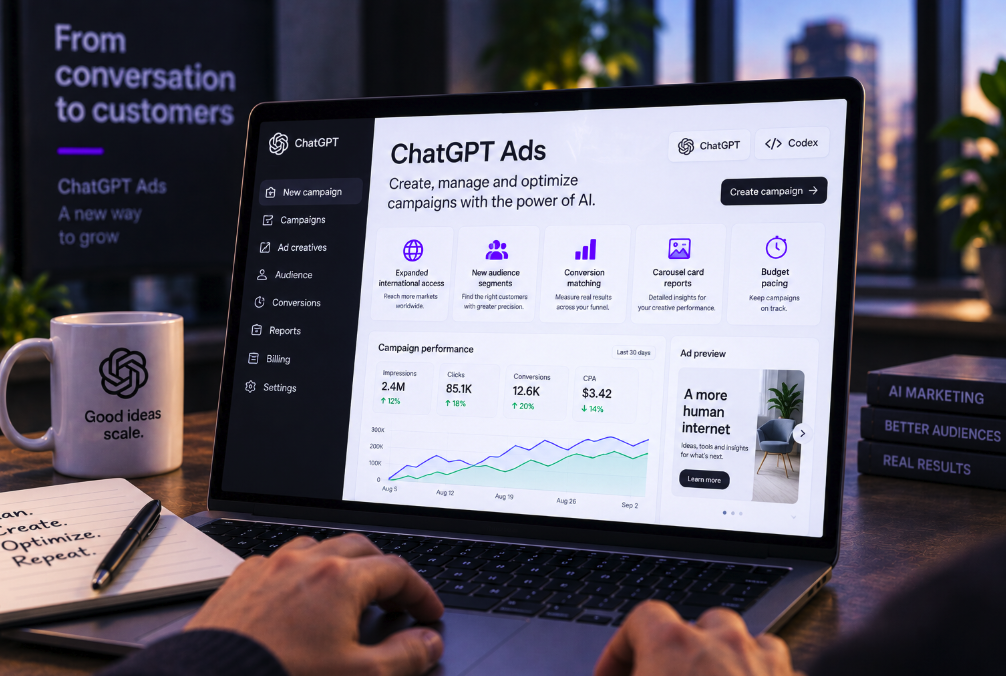
OpenAI is turning ChatGPT Ads from a conventional self-service advertising dashboard into something closer to an AI-operated campaign platform. Advertisers can now use an Ads Manager integration from ChatGPT or Codex to create, manage, analyze and optimize campaigns through natural-language instructions, while a wider package of updates expands audiences, conversion matching, reporting and budget controls.
The changes were detailed on September 4 by Barry Schwartz at Search Engine Roundtable, who said most of the product updates came from an email OpenAI sent to advertisers. The announcement arrives as ChatGPT Ads expands internationally and as OpenAI builds a more mature measurement and campaign-management stack around an advertising business that has grown unusually quickly.
The most consequential change may not be another targeting field or report. It is the ability to operate Ads Manager from the same conversational and coding environments marketers already use to plan campaigns, write creative and analyze performance. Instead of treating AI as a tool outside the advertising platform, OpenAI is beginning to place the advertising platform inside the AI workflow.
Ads Manager can now be operated from ChatGPT and Codex
According to the update reported by Schwartz, advertisers can add the ChatGPT Ads Manager plugin, connect an advertising account and begin working with campaigns through a conversation in ChatGPT or Codex. The integration is designed to handle practical campaign tasks rather than simply answer questions about advertising.
An advertiser can turn a website or brief into ads that are ready to launch, generate variants, update campaigns, troubleshoot delivery, review performance and receive prioritized recommendations. The integration can therefore participate across much of the campaign lifecycle, from initial construction to ongoing optimization.
OpenAI is not presenting that interaction as uncontrolled automation. The reported workflow previews recommended changes and asks the advertiser to confirm them before they are applied. That approval step is important because natural-language campaign management introduces a new risk: a misunderstood instruction can potentially affect real budgets, targeting and delivery rather than merely produce an imperfect draft.
Natural language is becoming an Ads Manager interface
OpenAI's existing Ads Manager Beta documentation describes the platform as the place to create, launch and manage ChatGPT Ads campaigns, monitor impressions, clicks and spend, and manage account settings. Until now, those functions largely belonged to the familiar advertising-console model: forms, tables, dashboards and bulk uploads.
The ChatGPT and Codex integration adds a second interface layer. A marketer can describe the outcome rather than manually navigate every configuration screen. That could make common operations faster, particularly for users managing many campaigns or diagnosing performance across several dimensions.
Codex adds another interesting dimension because advertising operations increasingly involve technical assets as well as media decisions. Campaign APIs, conversion pipelines, product feeds and reporting exports all sit close to code. An AI coding environment connected to Ads Manager can potentially reduce the distance between diagnosing a data problem and implementing the fix.
The strategic direction resembles a broader shift across enterprise software: the graphical interface remains available, but an AI agent becomes an operational layer capable of manipulating the underlying system on the user's behalf.
The advertiser still approves changes
That human confirmation mechanism deserves more attention than it may initially receive. Advertising systems can spend money quickly, and optimization recommendations are not neutral suggestions when applying them changes bids, budgets or delivery.
A useful campaign agent therefore needs two properties that ordinary chat assistants do not always require: it must understand the account state accurately, and it must make consequential actions inspectable before execution. OpenAI's reported preview-and-confirm workflow attempts to preserve that boundary.
For advertisers, this means the new integration should be understood as assisted campaign operations rather than permission for an autonomous model to rewrite an account without oversight. How much autonomy OpenAI eventually gives the system will be worth watching as the platform matures.
Custom audiences are becoming more flexible
The September update also expands custom-audience management. Advertisers can reportedly add, remove or replace audience members without recreating the entire audience, mix identifier types within the same request and work with larger audience sets.
Audience exclusions can now use audiences below 25,000 matched users, while audience construction can extend beyond five million members. OpenAI is also providing more granular audience-size ranges and adding Google Advertising ID, or GAID, as a supported identifier.
These changes may sound operational, but they matter for a platform trying to compete for serious performance budgets. Mature advertising programs constantly refresh first-party audiences as customers convert, unsubscribe, enter loyalty groups or move between lifecycle stages. Requiring advertisers to rebuild audiences for routine membership changes creates friction and increases the risk of stale targeting.
More flexible identifiers also make it easier to connect an advertiser's customer data with ChatGPT Ads, although privacy, consent and regional data-protection requirements remain the advertiser's responsibility.
Conversion matching is getting more identity signals
OpenAI is also expanding the fields available for conversion matching through its Measurement Pixel and Conversions API. Schwartz reports that the pixel now supports hashed phone number, first name, last name, region and postal code.
The Conversions API is gaining plural-list fields for hashed email, phone, external ID, first and last name, country, city, region and postal code, along with Android GAID for mobile measurement.
The purpose is familiar to performance marketers: improve the probability that an ad interaction can be matched with a later conversion even when browsers, devices or user journeys make direct attribution difficult. Better matching can improve reporting and provide stronger signals to optimization systems.
It also increases the importance of data governance. Hashed customer identifiers are still derived from personal information, and advertisers need appropriate rights and processes for transmitting them. Better attribution does not remove the underlying privacy obligations associated with customer matching.
Carousel ads now expose card-level performance
Product-feed campaigns serving in ChatGPT's multi-product carousel format are also receiving more detailed reporting. Ads Manager can now show impressions and clicks for individual carousel cards, while product-level fields are available through the public Insights API.
A carousel card impression is counted when the individual product card becomes viewable. OpenAI distinguishes that measurement from the billable ad impression, meaning card impressions are diagnostic metrics rather than additional billable impressions.
According to the advertiser update, complete card-level data is available beginning August 20 on a rolling 30-day basis. This gives retailers a more useful way to understand which products users actually see and engage with inside a multi-product unit rather than judging the carousel only as one aggregated advertisement.
That distinction can influence merchandising decisions. A product may receive few clicks because it is unattractive, or because users rarely scroll far enough to see its card. Viewability-level reporting helps separate those possibilities.
Total campaign budgets now get pacing
Campaigns using total budgets are receiving pacing intended to spread spend more evenly across their scheduled period. Actual daily spend can still vary depending on available delivery opportunities, but the system is designed to avoid spending too aggressively at one point and leaving too little budget for later.
Budget pacing is a basic expectation in mature ad platforms, yet it becomes especially important in a newer marketplace where inventory and demand patterns may still be developing. Advertisers need confidence that specifying a campaign-level total does not result in an unpredictable spending curve.
The change also creates another area where the conversational Ads Manager integration could become useful. Instead of manually inspecting daily spend against plan, a marketer could ask why a campaign is pacing ahead or behind and potentially receive both an explanation and a proposed adjustment.
OpenAI is preparing another conversion-optimization model
The advertiser email also previews a conversion-optimization option that will incorporate view-through conversions. Under the reported model, delivery can optimize toward conversions associated with both ad clicks and ad views, while billing is impression-based.
This differs from the conversion-optimized cost-per-click model already documented by OpenAI. The company's current campaign documentation describes CPM, CPC and oCPC objectives, with oCPC billing advertisers for valid clicks while optimizing toward clicks more likely to generate the selected conversion event.
Adding view-through conversion optimization would give advertisers another way to value ads that influence a purchase without producing the final click. It will also make attribution methodology more consequential, because crediting conversions after an impression can produce very different performance numbers from click-only measurement.
OpenAI says more details will come as the campaign type rolls out more broadly, so advertisers should not treat the preview as a fully standardized buying model yet.
ChatGPT Ads is becoming an international platform
The product updates arrive alongside a significant geographic expansion. OpenAI announced on August 31 that self-service ChatGPT Ads access is now available across Europe, India, the Middle East and North Africa. Its official expansion announcement says tens of thousands of advertisers are using the platform and that ChatGPT Ads has reached a $1 billion annualized revenue run rate less than 200 days after launch.
OpenAI had already announced expansion to 31 European markets, including Germany, France, Spain, Italy, Sweden, Norway, Denmark, the Netherlands and Austria. The company subsequently updated that announcement to confirm self-service access through Ads Manager.
International availability changes the relevance of the September product improvements. Audience tools, conversion matching and budget controls are no longer features for a narrowly U.S.-focused advertising test. They are becoming infrastructure for advertisers operating across multiple regulatory and commercial markets.
OpenAI continues to describe ChatGPT Ads as an evolving product. Its public help center labels Ads Manager as beta, and availability and features can continue to change as testing expands.
The advertising proposition is built around conversational context
OpenAI's advertiser site positions ChatGPT Ads around a difference from conventional keyword advertising: users reveal richer context through conversation. Someone discussing a trip, comparing products or planning a purchase can communicate intent with more detail than a short search query typically contains.
That creates the possibility of advertising based on a more developed understanding of what the user is trying to accomplish. It also creates a higher bar for relevance and trust because the advertisement appears inside a conversation rather than beside a conventional list of search results.
OpenAI says ads are separate from ChatGPT's answers and do not influence those answers. The company currently shows ads to eligible users on supported ad-funded plans, while paid and enterprise-oriented plans remain ad-free according to its current advertising FAQ.
As the advertiser tooling becomes more sophisticated, maintaining that separation will be central to the product's credibility. Better campaign optimization cannot come at the cost of users believing the assistant's answer has been shaped by whoever paid for placement.
The product-feed shopping claim needs a separate evidentiary label
One claim circulating alongside the September advertising updates deserves special caution. Schwartz reports an observation from analyst Juozas Kaziukėnas that ChatGPT Shopping results now appear to come only from brands that submit product feeds.
That is not presented in the Search Engine Roundtable article as part of the OpenAI advertiser email that supplied the other updates. It is an external observation, and it should not be rewritten as an official OpenAI policy unless the company confirms it.
There are reasons the hypothesis attracts attention. OpenAI already uses product feeds in advertising campaigns, including the multi-product carousel format whose reporting was expanded in this update. Direct merchant feeds can provide structured, current product information that is valuable for commerce experiences.
But the existence of product-feed advertising does not by itself prove that every organic or non-advertising ChatGPT Shopping result is restricted to feed-submitting merchants. Until OpenAI documents such a rule or broader independent testing establishes it, the safest description is exactly what the evidence supports: an analyst has observed a pattern worth testing.
Ads Manager inside ChatGPT changes the advertiser workflow
The most interesting part of the announcement is therefore not that OpenAI has added another ad-management feature. It is that the company is collapsing the distance between planning a campaign and operating the system that delivers it.
A marketer can already use ChatGPT to analyze a brief, generate positioning ideas, rewrite creative and reason about performance. Connecting Ads Manager means some of those conversations can now lead directly to account actions. The model is moving from adviser to interface.
That shift can reduce repetitive work, but it also changes what campaign-management skill looks like. Knowing which menu contains a setting becomes less valuable when the setting can be changed through a sentence. Knowing what outcome to request, how to judge the recommendation and when not to approve it becomes more important.
For agencies and large advertisers, this could also alter account-management scale. Routine diagnostics and bulk changes that once required navigating multiple campaign views can potentially be initiated conversationally, leaving specialists to spend more time on strategy, measurement design and creative decisions.
Codex suggests advertising operations will become more programmable
The inclusion of Codex is especially notable because modern ad accounts increasingly behave like software systems. They depend on APIs, structured feeds, event schemas, conversion pipelines and automated reporting. Campaign performance can be constrained by an engineering problem as easily as by weak creative.
A Codex-connected Ads Manager creates the possibility of workflows where an advertiser identifies a measurement discrepancy, inspects implementation logic and then analyzes campaign consequences without moving between entirely separate tools.
That does not eliminate the need for technical expertise. It may increase the value of people who understand how advertising data flows through systems well enough to verify what an AI agent proposes. An agent can make the mechanics faster while still requiring humans to define the correct business and measurement logic.
OpenAI is building the boring infrastructure that makes an ad platform serious
Natural-language campaign creation is the headline feature, but the less glamorous updates may be just as important. Audience maintenance, conversion matching, card-level reporting and budget pacing are the infrastructure advertisers expect before they move substantial performance budgets onto a platform.
These features also reinforce one another. Better matching produces stronger conversion signals. Better signals can improve optimization. More granular carousel reporting helps merchants understand product-level performance. Better pacing makes budgets easier to control. A conversational management layer can then help advertisers interpret and act on all of that information.
That combination suggests ChatGPT Ads is moving beyond an experimental placement attached to a popular AI product. OpenAI is assembling the operational components of a full advertising platform while simultaneously giving that platform an AI-native interface.
The distinction matters. The future competition may not be only about whether ChatGPT can attract advertising demand from Google, Meta or retail media. It may also be about whether advertisers come to expect that managing an ad account should feel like briefing an intelligent operator rather than manipulating a dashboard.
The next question is how much control advertisers will hand to the agent
For now, OpenAI's reported workflow keeps a human approval step between recommendations and consequential campaign changes. That is a sensible boundary for a product that can affect real spending and customer targeting.
As the system accumulates more performance history, richer conversion signals and better optimization models, pressure will grow to automate more decisions. Budget adjustments, creative rotation, audience changes and troubleshooting are all areas where an agent could eventually operate with less direct supervision.
The challenge will be proving that increased automation produces predictable, auditable decisions. Advertisers need to know not only that a campaign improved, but what changed, why it changed and whether the system stayed within the constraints the business intended.
September 4 therefore marks a meaningful step in OpenAI's advertising strategy. ChatGPT and Codex are no longer just tools marketers can use around Ads Manager; they can become interfaces for operating it. Combined with international expansion and increasingly mature targeting, measurement and reporting controls, that makes ChatGPT Ads look less like an advertising experiment and more like an AI-native campaign platform under active construction.