
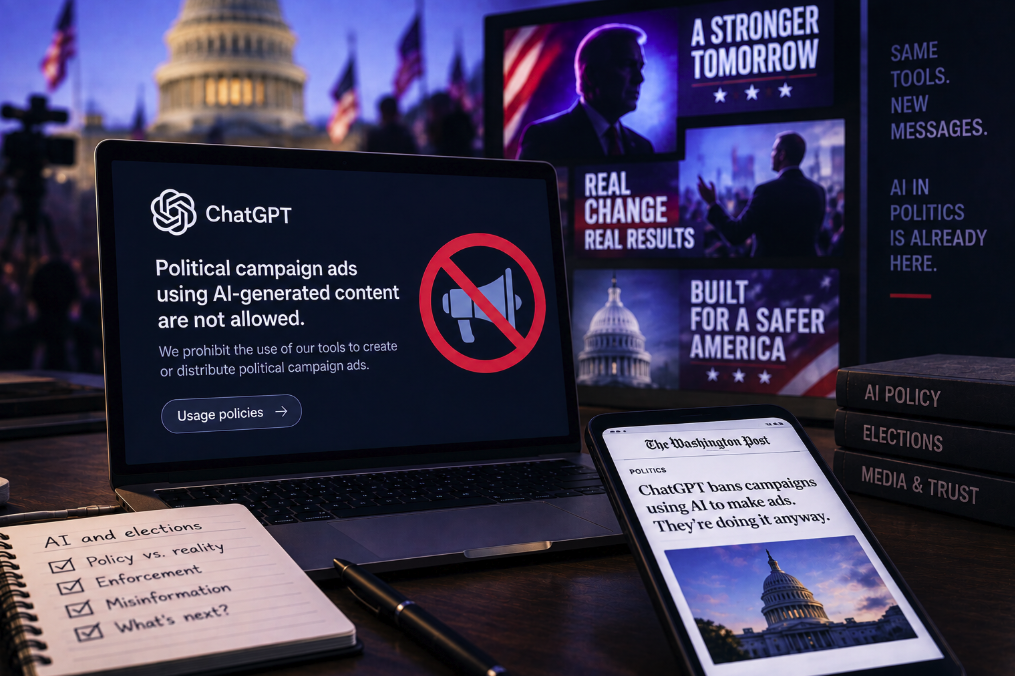
OpenAI prohibits political campaigns from using ChatGPT to generate scaled persuasive messaging for voters. That has not stopped artificial intelligence from entering the machinery of the 2026 U.S. midterms.
A Washington Post investigation published September 5 found that 39 congressional candidates disclosed payments for OpenAI subscriptions during the current election cycle. Two explicitly described advertising uses in campaign-finance filings, while political consultants told the newspaper that actual AI use is considerably broader than public disclosures reveal.
The important distinction is that paying OpenAI does not itself demonstrate a policy violation. OpenAI permits campaigns to use its tools for certain internal, human-directed tasks such as research, planning, administration and budgeting. Its restrictions target political persuasion, lobbying, election interference and scaled campaign messaging advocating for or against candidates, parties or ballot measures.
The emerging problem is therefore not simply that politicians have ChatGPT accounts. It is that generative AI is becoming routine campaign infrastructure while the line between permitted productivity work and prohibited voter-facing persuasion can be difficult to observe and unevenly enforced.
Thirty-nine campaigns disclosed OpenAI payments
The Post's analysis of campaign-finance records identified 39 congressional candidates that reported spending money on OpenAI subscriptions during the election cycle.
Rep. Mike Lawler, a Republican running for reelection in New York, was the largest candidate spender identified by the newspaper, with roughly $3,260 in OpenAI payments since 2025. His campaign defended the use of AI as one of many legitimate productivity tools and emphasized that the overall spending was small relative to ordinary campaign operations.
The Post also found around 30 political action committees and parties reporting OpenAI payments. The Republican National Committee was the largest political spender in that portion of the analysis at roughly $9,700.
Those figures establish adoption, not misuse. A subscription can support activities OpenAI explicitly allows, and campaign-finance records do not necessarily reveal what prompts staff entered or what outputs they published.
Two campaigns explicitly reported advertising uses
The more direct tension with OpenAI's rules comes from filings in which two candidates explicitly said the subscription had been used for advertising.
OpenAI's current Political Campaigning Restrictions define prohibited political campaigning as the generation or distribution of scaled campaign messaging that advocates for or against a candidate, political party or ballot measure. Advocacy can be direct or implied.
That means the word “advertising” matters, but context still matters too. An AI system used to analyze ad performance internally is different from an AI system used to write voter-facing persuasive copy.
The public filing alone may not provide enough detail to reconstruct exactly how the tool was used. The Post's broader reporting, however, shows political consultants openly acknowledging that AI-generated emails, ad copy and scripts are already part of campaign workflows.
Consultants say public disclosures understate AI use
Republican digital strategist Eric Wilson told the Post that campaigns are using AI for tasks including emails, advertising copy and scripts, even though they are reluctant to advertise that fact to voters.
That reluctance creates a measurement problem. Campaign-finance databases can reveal a direct payment to OpenAI, but they cannot show every use of generative AI.
A consultant may pay for a general business subscription and use it across multiple clients. An agency may incorporate AI into its workflow without itemizing the underlying software on every campaign invoice. Staff can also use consumer accounts that never appear as a direct campaign expenditure.
The 39-campaign figure is therefore better understood as a documented floor within the Post's disclosure analysis, not an estimate of total political AI adoption.
Campaigns have an incentive not to say they use AI
The opacity is partly reputational. Generative AI has become an ordinary workplace tool, but political messaging carries a different trust burden.
The Post describes a paradox: candidates may fear being competitively disadvantaged if opponents use AI to produce content faster, test more variants and personalize communications, while voters may distrust a message once they learn a machine helped create it.
This encourages invisible adoption. The campaign gains the productivity advantage while presenting the final message as ordinary political communication.
Unlike a synthetic video with obvious visual artifacts, AI-written copy can be almost impossible for a voter to identify reliably after human editing.
OpenAI allows internal campaign work
The policy is more nuanced than a blanket ban on politicians using ChatGPT. OpenAI says campaigns can use its systems for responsible, human-directed work that makes routine internal tasks more efficient.
The company's examples include research, planning, administration and budgeting. A campaign could therefore use AI to summarize public policy research, organize a project plan or help structure internal operational material without necessarily violating the campaigning restriction.
This distinction matters when interpreting campaign-finance records. It would be inaccurate to describe every disclosed OpenAI payment as evidence that a candidate broke the rules.
The policy boundary appears when the tool moves from helping the campaign operate to generating or distributing persuasive campaign messaging at scale.
The Washington Post found inconsistent enforcement
The Post did more than inspect financial disclosures. Its reporters also tested whether ChatGPT would follow OpenAI's own restrictions.
In late July and early August, the newspaper asked the system to create campaign fundraising text messages targeting mothers on behalf of a female veteran running for office. ChatGPT generated several tailored messages, according to the report.
When the Post repeated the type of request later, ChatGPT refused, explaining that it could assist with general campaign fundraising language but could not draft political persuasion or fundraising messages targeted to a demographic group.
The newspaper observed a similar inconsistency with candidate fundraising emails. In tests during the same week, ChatGPT sometimes produced an email soliciting donations for a specific candidate and later refused the same prompt.
A policy is only as strong as the enforcement layer
Those tests illustrate a broader problem with generative-AI governance. Written rules can be precise while model behavior remains probabilistic.
A traditional advertising platform can reject a prohibited campaign through deterministic account, creative and targeting controls. A conversational model has to interpret an enormous range of natural-language requests, infer intent and decide whether a particular transformation crosses a policy boundary.
Small differences in wording or context can change how a request is classified. Model updates can also change refusal behavior over time.
For election safeguards, that creates a gap between policy compliance on paper and reliable behavior in practice.
OpenAI says refusals are only one safeguard
OpenAI told the Post that it continuously updates its products to improve compliance and that a visible refusal is only one mechanism used to prevent campaign abuse.
Spokesperson Nate Evans said the company's rules are clear about permitted campaign use and apply to everyone. The company emphasizes internal productivity work as acceptable while maintaining restrictions on political persuasion and scaled messaging.
That response points toward a layered enforcement model. Account controls, automated monitoring, abuse detection and post-use enforcement can theoretically supplement prompt-level refusals.
The Post's tests nevertheless show why output behavior remains important. If the model sometimes generates material the policy says it should not generate, downstream controls have to detect a violation after the system has already produced usable content.
Political consultants think some restrictions are difficult to apply
Wilson argued that OpenAI should consult more closely with political professionals because some distinctions can feel arbitrary in real campaign work.
His example captures the ambiguity: a campaign may be allowed to use ChatGPT to help develop a policy position on early-childhood education but prohibited from using the same tool to write a social post promoting that position to voters.
From OpenAI's perspective, the difference is the transition from internal policy development to external political persuasion. From a campaign worker's perspective, those tasks can be consecutive steps inside one workflow.
As AI becomes embedded in productivity software, maintaining that boundary may become technically and operationally harder.
AI use among political consultants is already mainstream
The Post cites a survey from the American Association of Political Consultants showing that 57% of surveyed consultants reported using AI in their work every day, up from 34% a year earlier.
That does not mean 57% are using AI for prohibited voter persuasion, nor does it measure OpenAI products alone. It does indicate that generative technology has moved well beyond experimental use inside the political consulting industry.
The adoption curve matters because policy restrictions become more difficult to enforce as AI stops being a specialized campaign tool and becomes part of ordinary office software.
Writing assistants, presentation tools, analytics platforms, video editors and advertising products can all incorporate generative features without requiring staff to make an explicit decision to “use AI.”
The most obvious risk is not necessarily the most important one
Public concern about AI and elections has focused heavily on deepfakes: synthetic images, cloned voices and videos that falsely depict candidates saying or doing things that never happened.
Those risks remain real. More than 30 U.S. states have enacted laws limiting certain uses of political deepfakes, according to the Post, although enforcement capacity varies and some restrictions have faced constitutional challenges.
But synthetic media is highly visible. Ordinary AI-assisted persuasion can be much harder to detect.
An AI-generated fundraising email, script or ad headline can look completely conventional. Human staff can edit it before publication, removing any practical way to determine which sentences originated with a model.
Microtargeting is the larger structural concern
Researchers and technology executives have also warned that generative AI could make personalized political persuasion dramatically cheaper.
Traditional campaigns already segment voters and test messages. Generative systems can potentially multiply that process, producing large numbers of variations tailored to narrow audiences or individual concerns.
The danger is not simply that one message is false. At scale, campaigns could create different persuasive realities for different voter groups, making public scrutiny more difficult because journalists and opponents may never see the same messages.
This is one reason OpenAI's rules focus on scaled political messaging rather than only obvious factual misinformation.
Outsourcing can complicate platform enforcement
Political consultants interviewed by the Post expect more campaigns to route risky AI-generated material through outside groups such as super PACs as Election Day approaches.
The analogy is familiar from negative advertising. Candidates can benefit from messages produced by aligned outside organizations while maintaining some separation from the most aggressive creative.
AI introduces another layer. Even if a campaign itself follows a vendor's usage policy, consultants, contractors or independent political groups may use other systems with different restrictions.
Platform policy can constrain users of one product. It cannot establish a universal rule for the entire political advertising ecosystem.
The 39 disclosed campaigns are not the story by themselves
It would be easy to turn the Post's finding into a simple headline: 39 campaigns used ChatGPT despite an OpenAI ban. That would overstate what the evidence shows.
OpenAI does not ban all campaign use, and financial disclosures cannot reveal the purpose of every subscription. Only some reported activity directly raises the advertising issue described by the policy.
The more significant finding is structural. Campaigns are adopting AI faster than disclosure systems, platform safeguards and public norms can make that use transparent.
The technology is entering politics through ordinary productivity workflows rather than waiting for a clearly labeled “AI campaign” category to exist.
Campaign-finance disclosure was not designed for generative AI
The reporting also exposes a weakness in existing transparency systems. Campaign-finance rules are good at recording who was paid and how much. They are much less useful for describing what a general-purpose software subscription actually did.
A line item for OpenAI may represent internal research, advertising copy, coding help, data analysis or several activities at once.
Conversely, a campaign can use AI extensively without ever listing OpenAI if the technology is embedded inside a vendor's service.
Meaningful transparency may eventually require disclosure rules based on use rather than software vendor — particularly when synthetic or personalized content reaches voters.
The Washington Post itself has an OpenAI relationship
The Post discloses in the article that it has a content partnership with OpenAI. That relationship is worth noting because the investigation scrutinizes the policies and behavior of a commercial partner.
The disclosure does not invalidate the reporting. It gives readers relevant context about the institutional relationship between the publication and the company it is covering.
That kind of transparency will become increasingly important as AI companies build licensing, technology and distribution relationships across the media industry while remaining subjects of journalism.
AI is becoming infrastructure for publishers, advertisers and political organizations at the same time that those institutions are expected to scrutinize its effects.
The real election challenge is moving from generation to governance
AI systems can already write competent political copy. That technical capability is no longer the interesting question.
The harder problem is governance: which uses should be permitted, how reliably platforms can enforce those boundaries, what campaigns must disclose and whether voters can understand when generative systems influenced the messages they receive.
OpenAI has drawn a relatively clear normative line by allowing internal campaign productivity while prohibiting scaled political persuasion. The Post's reporting shows that translating that line into consistent product behavior and observable campaign practice remains difficult.
As the 2026 midterms accelerate, the question is no longer whether artificial intelligence will enter political campaigns. It already has. The unresolved question is whether policies designed to constrain its most sensitive uses can remain meaningful once AI becomes an invisible part of everyday campaign work.