
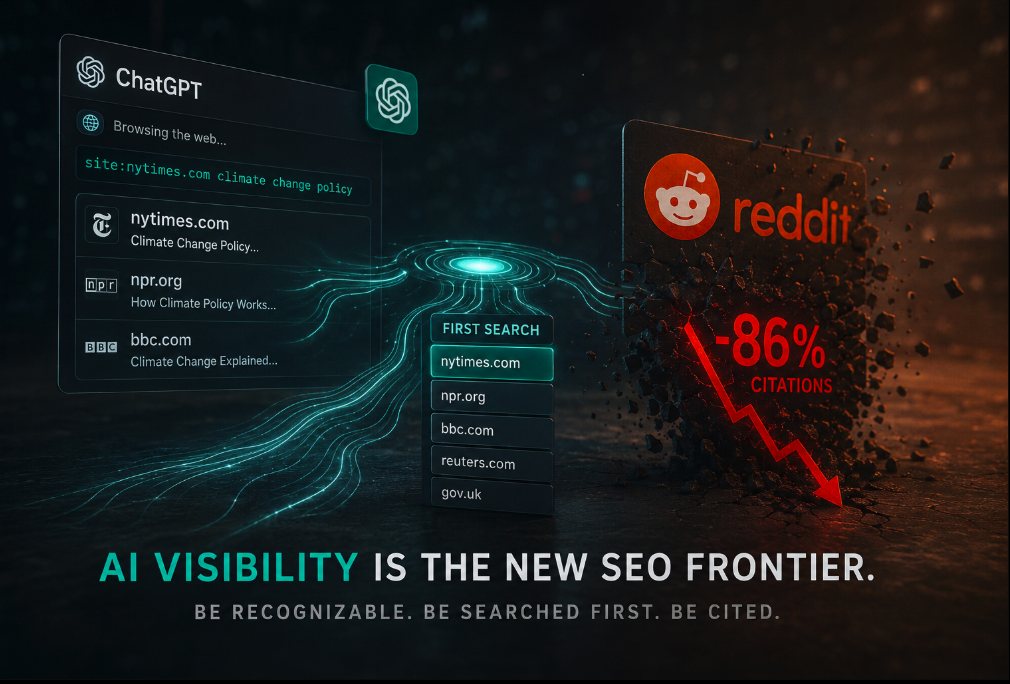
Reddit’s sudden disappearance from a large share of ChatGPT citations is an interesting story on its own. But the more consequential signal may be happening one step earlier, before a citation is ever selected. New data from Promptwatch suggests that ChatGPT changed the way it searches the web in August 2026, sharply increasing the use of domain-specific site: queries in its search fanout. If that behavior persists, AI visibility may depend not only on whether a model knows what a brand or publisher is, but on whether the retrieval system decides that the domain is worth searching directly in the first place.
Promptwatch measured Reddit at an average 3.83% share of ChatGPT Search citations between July 18 and August 7. By August 14–17, that share had fallen to 0.52%, an 86.4% relative decline. The same dataset shows a striking change several days earlier: on August 8, the share of ChatGPT fanout queries using the site: operator reportedly jumped from roughly 0.37% to 16.8%. At the same time, the average number of searches generated per response rose from about 1.08 to 1.83. Promptwatch’s interpretation is important: these domain-scoped searches appear to have been added to broader searches rather than simply replacing them.
The important change may happen before ranking
Traditional search thinking tends to focus on competition inside a results set. A query is issued, eligible pages are retrieved, and publishers compete to rank. But a system that increasingly generates queries such as site:example.com [topic] introduces another decision upstream: which domain should be searched at all? That distinction could change how we think about generative engine optimization.
If an AI system first identifies a publisher as a likely source and then scopes a search to that domain, visibility is partly determined before individual pages compete for retrieval. In that model, excellent content is still necessary, but page-level relevance is only one layer. The system must also associate the publisher with the topic strongly enough to consider the domain a useful retrieval target.
This is where entity recognition becomes especially interesting. A recognizable publisher is not merely a collection of indexed URLs. It is an entity with a name, topical associations, references across the web, historical authority signals and relationships to other entities. If those signals influence which domains appear in generated search fanouts, publisher recognition could function as a retrieval advantage: the system knows where it wants to look before it looks.
That is not something Promptwatch’s data proves. The observed increase in site: queries demonstrates a change in measured search behavior, not the internal criteria ChatGPT uses to choose a domain. OpenAI has not publicly established a rule saying that stronger publisher entities receive more domain-scoped searches. The distinction matters because it turns an attractive SEO theory into something better: a hypothesis we can test.
A NetContentSEO experiment: does publisher recognition influence fanout?
The useful experiment is not simply to count citations. It is to observe the retrieval chain. We can build a controlled set of prompts around topics covered by multiple publishers, then compare domains with different levels of recognizability while keeping topical relevance and content quality as comparable as possible. For every prompt, the key variables would be whether ChatGPT generates a domain-scoped query, which domain it names, which pages it retrieves and which sources ultimately receive visible citations.
The strongest version of the test would separate publisher recognition from page performance. For example, two sites could publish similarly comprehensive resources addressing the same narrowly defined question. One domain would have a stronger established association with the subject; the other would be less recognizable but equally accessible and technically indexable. Repeating the prompts across topics and fresh sessions could reveal whether one publisher is disproportionately selected in site: fanout before page-level citation differences emerge.
We should also distinguish three outcomes that are often collapsed into a single AI visibility metric: being selected as a domain to search, being retrieved as a page, and being cited in the final answer. A publisher can succeed at one stage and fail at another. That makes fanout analysis particularly valuable because citation tracking alone only observes the final visible layer.
Why Reddit’s decline makes this hypothesis plausible
The Reddit numbers provide a useful natural experiment because the change is much sharper in ChatGPT than on Google’s AI surfaces. Promptwatch reported a far gentler decline in Reddit citation share in Google AI Overviews and AI Mode during the comparable period. That divergence makes a universal collapse in Reddit’s usefulness less convincing than a ChatGPT-specific retrieval or source-selection change.
There is also an intuitive reason domain-scoped retrieval could alter the source mix. When answering a question about a company, product, technical standard or public institution, a system may deliberately search an official website, documentation portal, regulator or specialist publication. Reddit can still contain highly relevant information, but it is less likely to be the obvious named domain for many factual queries. Increasing the number of searches explicitly aimed at predetermined domains could therefore reduce Reddit’s relative citation share even without a direct penalty against Reddit.
The timing, however, argues for caution. Promptwatch observed the major site: fanout shift on August 8, while Reddit’s most dramatic citation collapse occurred around August 14. Promptwatch itself has noted methodological caveats around interpreting the precise magnitude of the decline. The safest conclusion is therefore not that domain-scoped search definitively caused Reddit’s fall, but that the two changes are sufficiently aligned to justify closer experimentation.
AI visibility may have a publisher-selection layer
For marketers and publishers, the broader implication is more durable than Reddit’s weekly citation share. Much of AI SEO has focused on getting brands mentioned in model answers or producing pages that are easy for retrieval systems to quote. Both remain important. But if generative search systems increasingly decide which domains to interrogate explicitly, another objective emerges: becoming a source the system recognizes as an obvious place to search.
That would make publisher identity more operational. Consistent topical coverage, clear organizational identity, strong entity associations, authoritative external references and a technically accessible archive could matter not only because they improve conventional authority signals, but because together they help establish a domain as a known source for a subject. The critical question is whether that recognition can be observed in the model’s generated searches.
This also changes what should be measured. A dashboard that records only citations may miss the earliest and perhaps most revealing signal. For our experiments, we should track domain selection in fanout, retrieval frequency and final citation rate separately. If recognizable publishers are systematically searched first, we would have evidence that AI visibility begins before the answer and even before the page is chosen.
From a news event to a falsifiable test
The headline is that Reddit lost roughly 86% of its tracked ChatGPT citation share in a matter of days. The more interesting research question is why ChatGPT appears to be naming domains much more frequently in its own search process. Promptwatch has given the industry a useful observation; the next step is to test what determines those domain choices.
If publisher recognition turns out to predict site: fanout, GEO will need a broader model of visibility. Being understood by an LLM would not be enough. A publisher would need to become recognizable enough that, when the system decides where to search for evidence, its domain is one of the places that comes to mind first. That is a claim we should not assume. It is exactly the kind of claim we can design an experiment to prove or disprove.