
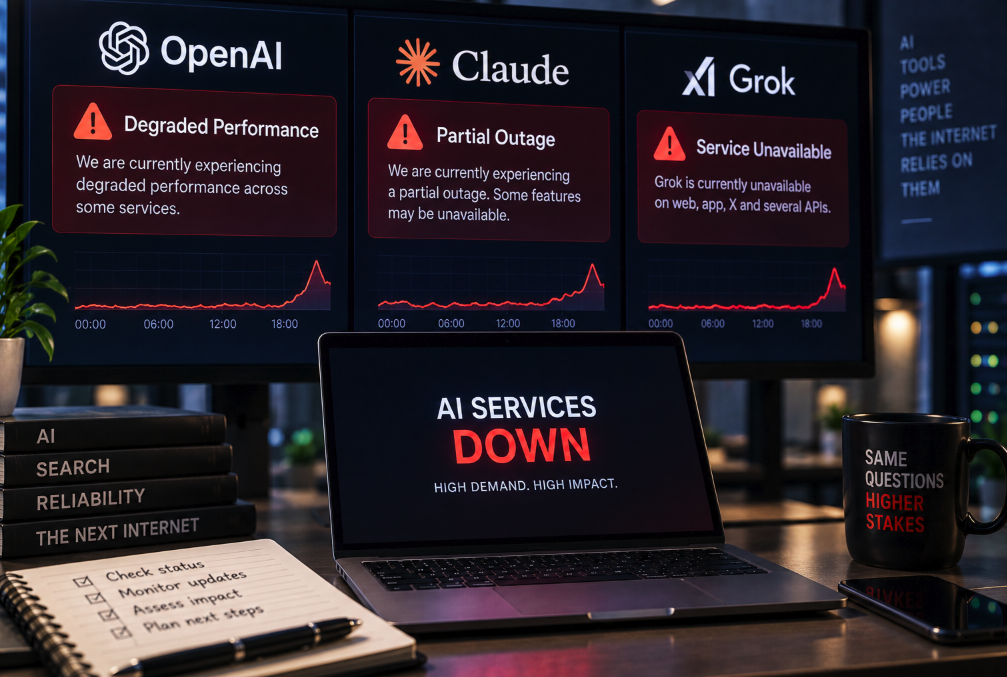
AI assistants are becoming infrastructure before they have achieved infrastructure-level reliability. On September 3, users encountered overlapping service problems across products from OpenAI, Anthropic and xAI, affecting some of the most prominent systems now used for conversational search, coding, research and everyday productivity. The incidents do not prove that the companies suffered from a common technical failure, but their proximity exposes a larger weakness in the rapidly expanding AI layer of the internet: users and businesses are increasingly depending on services that can still disappear or degrade with little warning.
The companies’ official status properties provide the most reliable way to separate confirmed incidents from speculation. OpenAI’s status site recorded service degradation affecting ChatGPT-related functionality during the day, while Claude’s status infrastructure reported a partial system outage. xAI’s status pages also documented model availability problems affecting Grok services. Status conditions evolved as engineers investigated and mitigated the incidents, so the precise set of affected components changed over time.
Three outages do not automatically mean one cause
The most tempting conclusion from simultaneous AI failures is that the providers must share a hidden dependency. That is possible in principle: modern cloud services depend on overlapping networks, infrastructure vendors, content-delivery systems, identity services and other upstream components. But there is no basis yet for saying that the September 3 incidents were connected.
Each company operates a complex stack with its own models, APIs, product layers and deployment systems. Two services can fail at roughly the same time for entirely unrelated reasons, particularly when high-traffic AI platforms are continuously shipping changes and operating near demanding performance thresholds. Without incident reports identifying a common dependency, simultaneity is evidence of timing, not causation.
That distinction matters for responsible reporting. An outage can produce thousands of user complaints within minutes, and social platforms quickly amplify theories about cloud failures, cyberattacks or coordinated events. Official status updates typically confirm impact before they explain root cause. The explanation, when one is published at all, often arrives only after engineers have restored service and completed a post-incident review.
AI products now sit inside critical workflows
The significance of the disruption is larger than whether a chatbot temporarily failed to answer a casual question. ChatGPT, Claude and Grok increasingly function as interfaces to coding, document analysis, research, customer support, writing, search and automated business processes. When those systems degrade, the failure can propagate into workflows that were built on the assumption that an AI endpoint would be available.
OpenAI’s ecosystem illustrates the expanding dependency surface. ChatGPT is a consumer product, but Codex and APIs can also sit inside software-development and automated workflows. Claude similarly spans a consumer interface and an API used by developers and companies. Grok is available through its own applications and xAI APIs while also being integrated into X. A disruption therefore does not have a single type of user impact.
The more AI systems become agents rather than isolated chat interfaces, the more serious this reliability question becomes. A chatbot failure inconveniences a user. An unavailable agent can interrupt a multi-step process that depends on tool calls, external data, code execution or downstream actions. Reliability requirements rise as autonomy rises.
AI search creates a new single point of failure
The risk is particularly important for search and information discovery. Traditional web search has conditioned users to expect near-continuous availability from a small number of highly mature systems. Generative AI is now competing for the same behavior: users ask ChatGPT, Claude, Grok, Gemini and other assistants questions they might previously have typed into a search engine.
That transition changes the consequences of downtime. If an AI assistant becomes a user’s default interface for research, product discovery or navigation, an outage temporarily removes not just a tool but an information gateway. People can switch providers or return to conventional search, but only if their workflow has not become tightly coupled to one system.
For publishers and marketers, this also means AI referral traffic and citation visibility are inherently dependent on platforms they do not control. A company may invest in making its content discoverable inside an AI service, yet availability, retrieval behavior and interface changes remain entirely in the provider’s hands. Generative engine optimization can improve the probability of visibility; it cannot guarantee that the engine itself will be available.
Redundancy becomes part of AI strategy
Businesses integrating generative models should treat provider availability as an architectural constraint rather than an edge case. That can mean implementing retries and timeouts, queueing non-urgent jobs, monitoring provider status and designing graceful degradation when a model cannot respond. For high-value workflows, it may also mean maintaining the ability to route appropriate requests to another model provider.
Multi-provider redundancy is not trivial. Models differ in context windows, tool interfaces, output behavior, safety policies, pricing and prompt sensitivity. An application designed specifically around one provider may not be able to swap another model in without testing and adaptation. Data-governance requirements can make failover even more complicated.
Still, the principle is familiar from other areas of infrastructure engineering: a dependency with meaningful downtime risk should not be treated as infallible. The question is not whether every company needs three AI providers. It is whether the cost of a particular AI function becoming unavailable has been understood and planned for.
Status pages are becoming essential operational tools
The September 3 incidents also highlight the importance of first-party status pages. When an AI tool suddenly becomes slow, starts returning errors or stops responding, users can waste significant time debugging their own applications before realizing that the problem is upstream. Monitoring the provider’s status feed can quickly distinguish a local implementation problem from a known service incident.
For teams with production dependencies, manual checking is not enough. Status information can be integrated into incident-response processes, while application monitoring should track latency, error rates and failed requests independently. Provider status pages report aggregate conditions and may not reflect every regional, model-specific or account-specific failure immediately.
Historical incident data is useful as well. Reliability should be evaluated over time rather than inferred from a single bad day. A provider can experience an outage and still deliver strong overall availability; conversely, repeated smaller degradations can create substantial operational cost even when no incident becomes a major headline.
The reliability race will matter as much as the model race
The AI industry has spent much of its competitive energy on benchmarks, reasoning ability, context length, coding performance and model cost. As these products become embedded in ordinary work, reliability becomes a product feature of equal importance. A slightly smarter model is not necessarily more useful if it is unavailable when a customer needs it.
This pressure will intensify as companies deploy agents that execute longer tasks. A ten-minute workflow has more opportunities to encounter a transient failure than a ten-second chat response. Systems will need checkpointing, recovery mechanisms and fault-tolerant orchestration so that a temporary provider error does not force an entire task to restart.
Providers are already learning these lessons through incident response. OpenAI, for example, has published postmortems for previous disruptions describing mitigations such as stronger deployment controls, monitoring and resilience around shared dependencies. The specifics of any September 3 incident will require the companies’ own confirmed explanations, but the broader engineering challenge is already clear.
AI cannot become the new search layer on availability alone
The simultaneous visibility of problems at OpenAI, Anthropic and xAI is striking because these companies are competing to become foundational interfaces for information and work. Users are being encouraged to search with AI, code with AI, shop with AI and delegate tasks to AI. Every additional use case increases the cost of an outage.
That does not make generative AI uniquely unreliable, nor does one period of overlapping disruption prove a systemic failure. Conventional search engines, cloud providers and social networks also suffer outages. The difference is maturity and expectation: AI products are being integrated into critical workflows at extraordinary speed, often faster than organizations are developing fallback procedures around them.
The September 3 disruptions should therefore be read less as evidence of one mysterious shared failure and more as a warning about dependency. ChatGPT, Claude and Grok do not need to share a root cause to expose the same strategic problem. If AI is becoming a new layer of search and computing infrastructure, reliability, redundancy and graceful failure have to become part of the product conversation—not just what the models can answer when everything is online.