
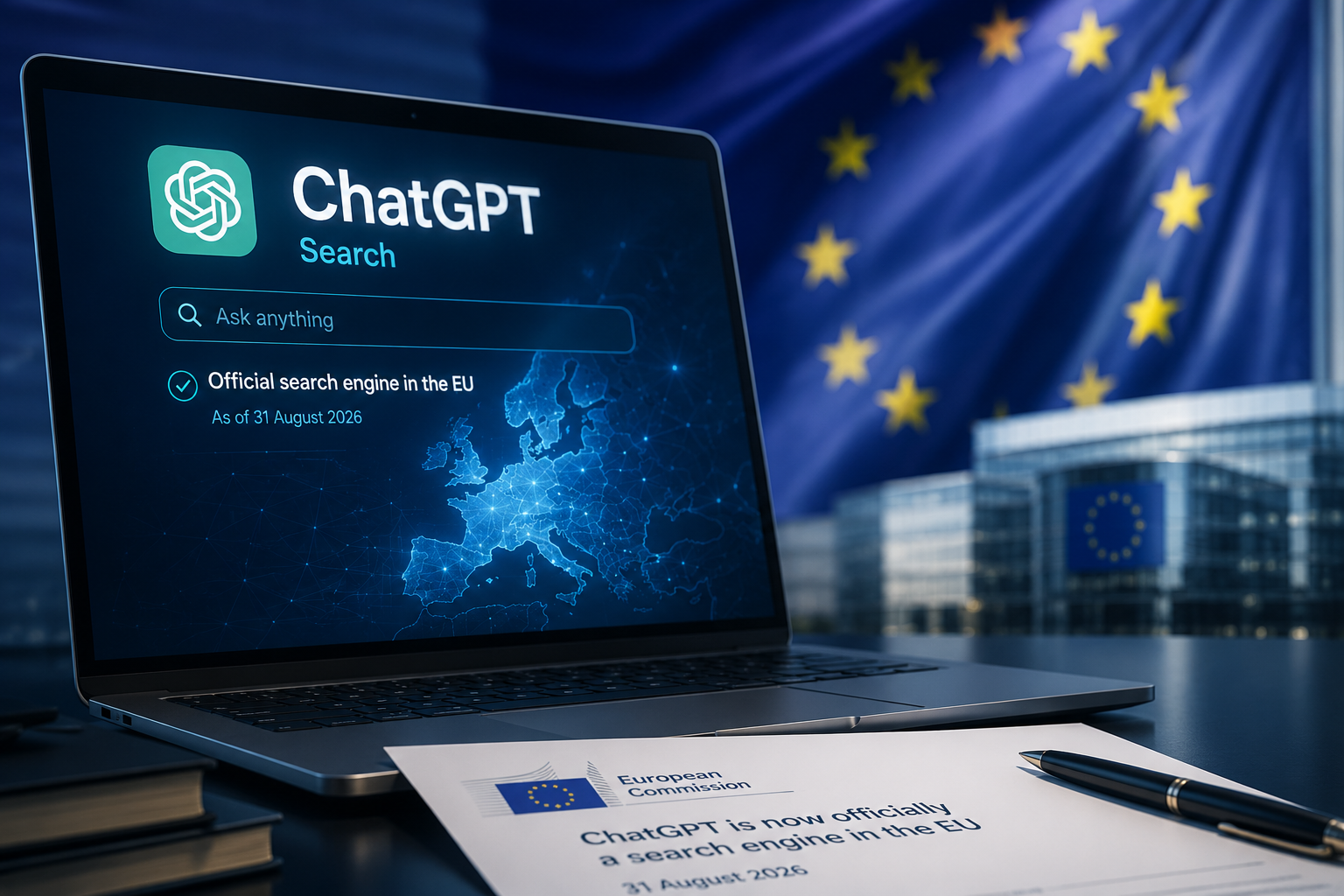
The European Commission has made a classification that may reshape how publishers, brands and search professionals think about AI visibility. On 31 August 2026, Brussels designated ChatGPT as a Very Large Online Search Engine, or VLOSE, under the Digital Services Act. Reddit and Roblox were designated at the same time as Very Large Online Platforms, but the ChatGPT decision is the most consequential for the future of search because it places a conversational AI system inside the EU’s formal search-engine category.
This does not mean ChatGPT has suddenly become Google, nor does it mean every chatbot is automatically a search engine. It means that, for the purposes of the EU’s online-safety framework, ChatGPT has crossed the scale and functional threshold that brings it under the strictest layer of DSA oversight applied to major search services. The Commission’s own DSA guidance on very large online platforms and search engines explains that services reaching more than 45 million average monthly users in the EU can be designated as VLOPs or VLOSEs, triggering additional obligations around systemic risk, transparency and accountability.
For the search industry, the label matters because it gives regulatory recognition to a shift that users and publishers have already felt in practice. Search is no longer limited to a ranked list of links. It increasingly includes synthesized answers, citations, recommendations, follow-up questions and conversational journeys where the user may never click through to a traditional results page. When the Commission calls ChatGPT a very large online search engine, it is acknowledging that generative AI has become part of the information-discovery infrastructure, not merely a productivity tool sitting outside the search ecosystem.
Why the VLOSE designation matters
Under the Digital Services Act, the largest online platforms and search engines face enhanced duties because their design choices can affect public debate, consumer decisions, information access and fundamental rights at scale. The Commission’s announcement states that ChatGPT reached the relevant EU user threshold, bringing it into a category that already includes the dominant services through which Europeans find information online. Reuters also reported that ChatGPT, Reddit and Roblox will now have to comply with the EU rules for very large online platforms and search engines, while other coverage emphasized that the move places ChatGPT under the bloc’s strictest online-safety regime.
The practical obligations are not just symbolic. VLOSEs must assess systemic risks linked to their services, put mitigation measures in place, provide greater transparency, allow external scrutiny and cooperate with regulators. In a conventional search engine, those obligations might focus on ranking systems, advertising transparency or the amplification of illegal or harmful content. In an AI search environment, the same questions become more complex because the system does not merely retrieve information; it rewrites, summarizes and contextualizes it in real time.
That difference is central to AI visibility. A website may be crawled, understood and used as a source without receiving the same kind of visible placement that search marketers historically measured through rankings. A brand can appear as a recommendation, disappear from a category answer, be paraphrased without a clear attribution trail, or be blended with other sources inside a generated response. This is exactly the kind of shift that projects such as NetContentSEO have been studying through AI search, retrieval, attribution and reconstruction research.
From rankings to answer inclusion
The VLOSE classification reinforces a broader truth for publishers and companies: visibility in AI search is not a simple extension of classic SEO. Traditional search optimization focused on crawlability, relevance signals, authority, snippets and positions on a results page. Those factors still matter, especially because AI systems often depend on web-scale search, indexed documents and trusted third-party sources. But AI answer engines add another layer: whether a model or retrieval system selects a source, interprets it correctly, trusts it enough to use it, and presents it in a way that users can recognize.
That makes editorial clarity more valuable, not less. Pages that clearly explain who is speaking, what the evidence is, when information was updated and how claims are supported are better suited to retrieval and citation than pages built only to satisfy old ranking formulas. Structured data, consistent entity signals, transparent authorship and high-quality topical coverage can help, but the underlying content still needs to be understandable by both humans and machines. In AI search, ambiguity is a visibility risk.
The Commission’s decision may also increase pressure for better transparency around how AI systems surface information. If ChatGPT is treated as a major search service under the DSA, regulators will have stronger grounds to ask how risks are assessed and mitigated when answers touch areas such as public health, elections, consumer protection, minors’ safety or illegal content. For publishers, the important question is not only whether ChatGPT can cite sources, but how reliably it represents them and whether users can evaluate where an answer came from.
What it means for publishers, brands and SEO teams
The immediate impact will be regulatory rather than tactical. Website owners should not expect a new “ChatGPT ranking factor” to appear overnight because of the EU designation. However, the direction of travel is clear. AI search visibility is becoming a mainstream strategic issue, and the legal system is beginning to treat large AI answer services as part of the search market. That means brands can no longer treat AI mentions as experimental noise or a side channel for early adopters.
For publishers, this creates both an opportunity and a threat. The opportunity is to become a reliable source in answer-based discovery, especially in topics where freshness, expertise and clear sourcing matter. The threat is that AI systems can compress the value chain between source and user, reducing referral traffic while still depending on publisher content to generate useful answers. This tension is already visible across the search economy, and the EU’s decision gives it a clearer regulatory frame.
For SEO teams, the practical response should be measured. AI visibility audits should track whether a brand, product, author or publication appears in relevant AI answers, how it is described, which competitors are included, and whether the generated answer cites or implies authoritative sources. Content strategies should prioritize original evidence, precise definitions, comparison pages, expert analysis and pages that answer real user questions without hiding the useful information behind vague marketing language. The old goal was to rank; the new goal is to be understood, selected and represented accurately.
A regulatory milestone for generative search
The EU’s classification of ChatGPT as a Very Large Online Search Engine is likely to become a reference point in debates about AI search, competition and publisher visibility. It does not settle every question about liability, attribution or the economics of content reuse, and it does not erase the technical differences between a chatbot and a web search index. But it does confirm that conversational AI has moved into the institutional category of search, with all the scrutiny that follows.
For anyone working in content, SEO or digital publishing, the message is simple: AI search is no longer a speculative future interface. It is now part of the regulated search environment in Europe. Visibility strategies will need to account for that reality by combining traditional search fundamentals with a deeper understanding of retrieval, source selection, entity recognition and answer generation. The search engine is no longer always a page of links, and the rules governing search are beginning to catch up.