
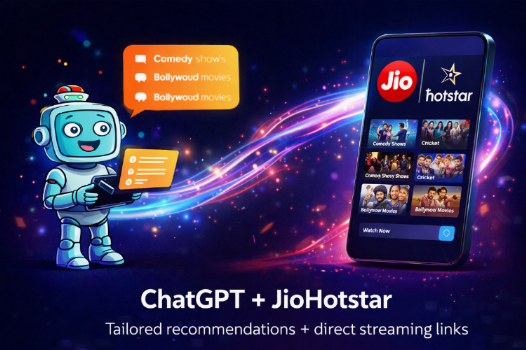
The Hindu reported that ChatGPT may begin recommending streaming links from JioHotstar when users search for entertainment content. On the surface, it sounds like a small product integration: you ask for a movie or a show, and the assistant points you directly to where it’s available. But it’s another signal of something larger happening across the web right now.
For years, we’ve thought of AI tools mainly as a new interface for search. You ask a question, you get an answer, and maybe you click through to a source. That model still exists, but entertainment is showing how quickly AI is moving beyond “information retrieval” and into something closer to guided discovery. Streaming platforms have always struggled with the same issue: users don’t lack options, they have too many. The friction isn’t finding content, it’s choosing it. People open an app, scroll for ten minutes, hesitate, and often end up watching nothing.
A conversational layer changes that experience completely. Instead of browsing categories, the user can describe intent in plain language — something funny, something short, something to watch tonight — and the system can respond not only with a suggestion, but with the direct pathway to play it. In that moment, AI isn’t acting like a search engine. It’s acting like a routing layer between intent and action.
That distinction matters because once AI becomes part of the distribution flow, it starts to shape attention, not just answers. If ChatGPT can send users directly into a streaming platform, it’s no longer neutral assistance. It becomes a channel. And entertainment is probably the easiest place for this to happen first, because the intent is immediate and the conversion is instant: watch now.
From an SEO perspective, this is another reminder that visibility is shifting upstream. The question is no longer only “can you rank?” but “can you be surfaced as the next step inside an AI-driven journey?” We’ve already seen early versions of this in shopping and travel. Streaming may simply be the next vertical where conversational discovery replaces traditional browsing.
The interesting part will be how these recommendations are handled over time. Will they behave like referrals, like search traffic, or something entirely new? How will attribution work? And which platforms will be included in these AI pathways — and which ones will be invisible?
It’s a small announcement, but it points in a clear direction: AI isn’t just answering questions anymore. It’s starting to decide what happens next.
At a certain point, the real competition won’t be between streaming platforms.
It will be between the AI systems that sit on top of them.
Because whoever controls discovery controls demand.
And that’s where this story gets much bigger than entertainment.
Stefano Galloni
Head of SEO — NetContentSEO
https://netcontentseo.net
Question: if AI becomes the default layer people use to discover content, what happens to the open web outside those recommendation pathways?
λ