
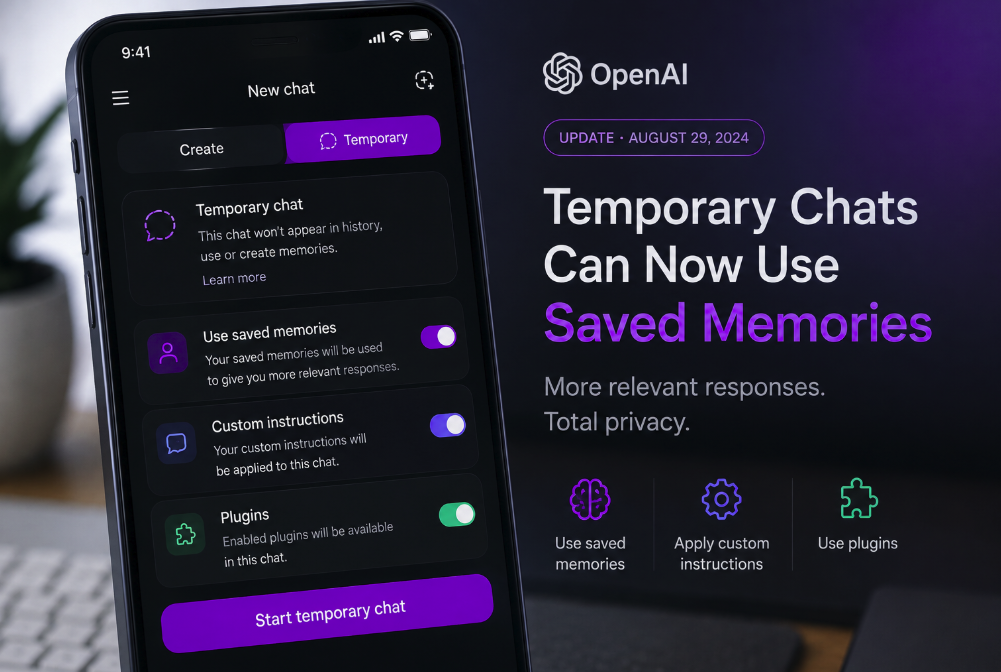
ChatGPT’s Temporary Chat is no longer necessarily a blank-slate conversation. OpenAI has updated the feature so users can start a personalized Temporary Chat that draws on information ChatGPT already knows about them, including existing memories, custom instructions and plugins, while still preventing that temporary conversation from creating or updating memories of its own.
The change is now documented in OpenAI’s Temporary Chat FAQ, which describes two distinct modes. Temporary chats remain non-personalized by default, but users can choose personalization when starting one. In personalized mode, ChatGPT can reference existing memories and other personalization context; in non-personalized mode, it does not use memory, custom instructions or plugins.
That is a meaningful shift in what “temporary” means inside ChatGPT. Previously, the feature was commonly understood as a way to start from a clean slate, with no access to memory and no lasting contribution to future personalization. The new design separates those two ideas: a conversation can now be temporary in terms of what it leaves behind while still being personalized by information that already exists.
Temporary no longer has to mean anonymous to ChatGPT
The key distinction is between reading existing context and writing new context. OpenAI says a personalized Temporary Chat can reference existing memories but cannot create or update memories while the conversation remains temporary. It also will not appear in chat history unless the user explicitly saves it.
That creates a useful middle ground. Someone can ask ChatGPT for advice that depends on preferences, ongoing projects or other remembered context without necessarily wanting the details of the new conversation to become part of their persistent ChatGPT history. The system can begin with context about the user, respond accordingly and then allow the temporary session to disappear without adding its contents to memory.
Custom instructions follow the same split. According to OpenAI’s updated documentation, personalized Temporary Chats use a user’s custom instructions, while non-personalized Temporary Chats do not. Plugins are likewise available in personalized temporary conversations and unavailable in the non-personalized version.
The user has to choose personalization at the start
The setting is not something that can be toggled midway through a conversation. OpenAI says users choose whether a Temporary Chat is personalized when they begin it, and that personalization state cannot be changed after the conversation has started. This makes the choice part of the session boundary rather than another setting ChatGPT can dynamically apply later.
Temporary Chats still start non-personalized by default, preserving the original clean-slate behavior for users who specifically want it. In that mode, the conversation does not use memories, custom instructions or plugins and does not create new memories. The newly added personalized option is therefore an expansion of Temporary Chat rather than the elimination of its previous privacy-oriented use case.
There is one important caveat in OpenAI’s documentation: Temporary Chat may still use information from prior conversations for limited safety and security purposes. OpenAI says disabling memory and personalization does not disable safety systems that can use limited safety-relevant context in rare, high-risk situations.
A temporary conversation can also become permanent
OpenAI has also clarified what happens when a temporary conversation becomes useful enough to keep. Users can save a Temporary Chat, at which point it becomes a regular chat and appears in history. From then on, the conversation follows the account’s normal personalization and model-improvement settings.
This matters because the privacy and memory rules change at that boundary. While a conversation remains temporary, OpenAI says it is not used to improve its models and does not create memories. If the user saves it, it becomes an ordinary conversation governed by the account’s existing data controls. If memory is enabled, the saved conversation may then be referenced for future personalization.
OpenAI also says it may retain a copy of an unsaved Temporary Chat for up to 30 days for safety purposes. The conversation does not appear in normal chat history during that period, and the company says Temporary Chats are not used for model improvement while they remain temporary.
The product concept is becoming more precise
The larger significance is that OpenAI is separating three concepts that were previously bundled together in the Temporary Chat experience: history, personalization and memory creation. A conversation can now be absent from normal history, use personalization that predates the conversation and still refuse to contribute new information to future memory.
That distinction makes Temporary Chat more useful for everyday work. Consider a user whose ChatGPT memory already contains writing preferences, professional context or recurring project information. Previously, choosing a clean temporary session could mean giving up that useful context. A personalized Temporary Chat can preserve the convenience of those existing preferences without necessarily turning the new conversation into another source of persistent memory.
The same logic applies to custom instructions. Users who have configured a preferred writing style, formatting rules or response behavior no longer have to choose between those instructions and a temporary session, provided they deliberately start the personalized version. The conversation can behave like “their” ChatGPT without becoming another permanent chapter in their account history.
Privacy now depends more on understanding the controls
The change also introduces a more nuanced privacy model. “Temporary” by itself no longer tells the whole story about what context ChatGPT can use. Users now need to know whether the temporary session is personalized or non-personalized. A personalized Temporary Chat can know things from existing memory even though it will not add new memories; a non-personalized Temporary Chat behaves much closer to the traditional clean-slate experience.
This is particularly relevant when users choose Temporary Chat because they want to discuss something without their usual personalization influencing the response. In that case, the non-personalized option remains the appropriate choice. If the goal is instead to prevent a particular conversation from becoming persistent while retaining established preferences and context, personalized Temporary Chat offers a more flexible alternative.
The distinction is subtle but important: privacy from future memory is not the same as isolation from past memory. OpenAI’s new controls allow users to choose between those behaviors rather than treating them as inseparable.
Temporary Chat is becoming a session policy, not just a blank slate
The update reflects a broader evolution in ChatGPT as memory becomes a deeper part of the product. Once an assistant can retain useful context across conversations, a simple binary choice between “memory on” and “start completely fresh” becomes restrictive. Users may want the assistant to remember how they work without remembering what they are about to discuss.
Personalized Temporary Chat is designed around exactly that scenario. It allows existing context to flow into the session while blocking the reverse flow back into persistent memory. That makes the temporary label less about whether ChatGPT knows the user and more about what happens to the conversation after it occurs.
For users, the practical rule is now straightforward: choose a non-personalized Temporary Chat when you want a genuine clean slate, and choose a personalized Temporary Chat when you want ChatGPT to use existing memories, custom instructions and plugins without creating new memories from the session. The conversation can be temporary without forcing the assistant to forget everything it already knows.