
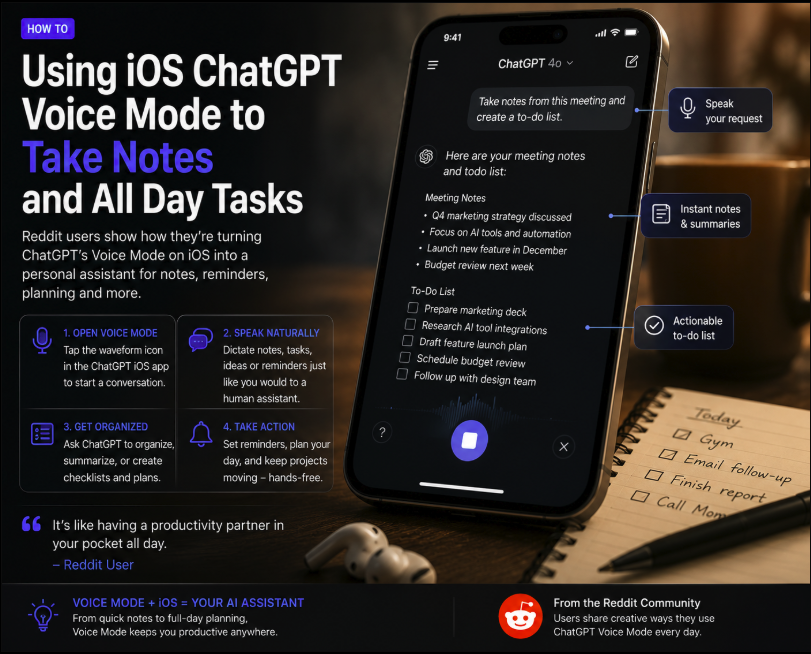
A six-minute-old Reddit question from a molecular bench scientist captures one of the most important gaps in today’s AI assistants better than a polished product demo could. The researcher does not want ChatGPT to write a paper, search PubMed or design an experiment from scratch. They want something much more mundane: while their hands are occupied at the bench for three or four hours, they want to talk naturally to ChatGPT, record what is happening, reason through decisions in real time and have the useful parts accumulate into a notebook they can update every day.
The r/ChatGPT post says the user has already experimented with ChatGPT Work, iOS Shortcuts, custom GPTs and automation tools such as Make. None quite delivers the simple experience they have in mind. Work can accept dictation, they say, but their experiments run for hours and they want an actual live conversation for decision-making, not merely speech converted into a text prompt.
It sounds like a niche workflow problem. It is actually a useful description of the boundary between conversational AI and persistent work software. ChatGPT Voice has become capable enough to accompany a user through a complex activity. What it still does not provide cleanly is the durable object on the other side of that conversation: a notebook, log or document that the assistant continuously maintains as work unfolds.
The missing feature is not better speech recognition
OpenAI’s current ChatGPT Voice documentation shows how far the product has moved beyond simple voice-to-text. Voice now works inside a normal ChatGPT conversation. With Live, the system can listen and speak at the same time, accept interruptions, use memory and web search, display text while it talks and work alongside typed messages and images where supported.
That is already close to what a scientist wants while physically performing an experiment. Instead of stopping to remove gloves, type observations and then return to the bench, the user can speak. They can say what they just observed, ask whether an unexpected result changes the next step, clarify a calculation or ask the assistant to summarize what has happened so far.
The problem arrives when the user asks, “Where is my notebook?” A Voice conversation lives primarily as a conversation. After it ends, ChatGPT adds a transcript to chat history. That is useful, but it is not the same thing as maintaining a structured laboratory record whose contents are deliberately updated throughout the session.
The distinction matters far beyond science. A mechanic may want a repair log. A field engineer may want an inspection report. A consultant may want meeting notes. A journalist may want an interview notebook. A caregiver may want a daily activity log. The AI can increasingly participate in all of those conversations, yet the user still has to bridge the final gap between conversation and persistent artifact.
Voice and Dictation solve different problems
OpenAI explicitly distinguishes Voice from Dictation. Its documentation says Voice is intended for live, interactive conversation and thinking aloud. Dictation is the better choice when the user wants to make a recording, review and edit its transcription and then send that text as a prompt.
For the Reddit scientist, neither mode alone is ideal. Dictation can capture an observation efficiently, but it does not provide the continuous back-and-forth they want for decision-making during an experiment. Voice provides the conversation, but it is not designed as a continuously edited notebook file.
This exposes a product category that sits between the two. Call it conversational capture: the assistant should be able to talk naturally while simultaneously extracting observations, timestamps, decisions, measurements, uncertainties and follow-up tasks into a persistent structured document.
Humans already perform this dual function. A laboratory partner can discuss what an unexpected result might mean while also writing “14:32 — sample B changed color after reagent addition” in the notebook. Current AI interfaces tend to split those roles into separate modes.
A transcript is not a laboratory notebook
There is an especially important caveat in OpenAI’s Voice documentation for scientific use. The company warns that the transcript added after a Voice conversation may not exactly match what either participant said, particularly when voices overlap, there is background noise or the conversation moves quickly.
That warning is easy to overlook in casual use. If ChatGPT transcribes “Tuesday” instead of “Thursday” during a travel discussion, the user can correct it. In a scientific record, an incorrect concentration, sample identifier, temperature or timestamp can be materially different.
A Voice transcript should therefore not automatically be treated as the authoritative experimental record. The safer workflow is to use the conversation as a capture and reasoning layer, then explicitly review the resulting structured notes before treating them as final. For regulated laboratories or work subject to institutional recordkeeping requirements, teams would also need to evaluate whether the system satisfies their validation, audit-trail, retention, confidentiality and data-governance requirements. ChatGPT is not automatically an electronic laboratory notebook merely because it can transcribe a scientist speaking.
That limitation does not make the use case weak. It tells us what the product would need in order to serve it properly: confirmation and provenance rather than silent transcription.
The ideal interface would separate observations from AI interpretation
A scientifically useful version of this workflow should distinguish several kinds of information. What the researcher reports observing should not be merged invisibly with what the model infers. A measured value should not be reformulated as if ChatGPT measured it. A hypothesis suggested during the conversation should not later appear in the notebook as an experimental result.
The notebook could therefore maintain separate fields for user-reported observations, measurements, protocol deviations, AI suggestions, decisions and unresolved questions. Each entry could carry a timestamp and indicate whether it originated from the user, the assistant or a later correction.
That sounds like a specialized scientific feature, but the principle generalizes. AI work products need provenance. If a meeting assistant produces minutes, users should be able to distinguish something a participant actually said from a conclusion the AI generated. If an inspection assistant writes a report, an observed defect should be distinguishable from an AI recommendation about what caused it.
As assistants become more active collaborators, the boundary between capture and generation becomes one of the most important interface problems.
The Reddit user’s four-hour experiment reveals another hard limit
The poster says experiments often run for three to four hours or longer. OpenAI’s current Voice documentation says a single Live conversation can last up to two hours. That means the desired workflow cannot currently run as one uninterrupted ChatGPT Live session even before the notebook problem is considered.
A user could start a new Voice session and continue the work in the same broader project or conversation where the product allows it, but session boundaries introduce another opportunity for context to be lost or summarized incorrectly. Long-duration professional workflows need checkpointing.
An ideal system would periodically commit the verified state of the notebook before the live context expires. At 90 minutes, for example, it could summarize the experimental state into a durable document, ask the scientist to confirm critical measurements and then start a fresh conversational context using that approved state as the handoff.
That would be much safer than expecting a four-hour stream of speech to remain the sole source of truth.
ChatGPT is becoming capable of the conversation before it owns the workflow
This is a recurring pattern in generative AI. Model capability arrives before product integration. The model can understand the request, reason about the material and generate the desired document, but connecting those abilities into a reliable continuous workflow still requires users to improvise with Shortcuts, APIs, automation platforms and copy-and-paste.
The Reddit scientist has already discovered this. Their attempts with iOS custom shortcuts, a custom GPT and Make are technically plausible, but they feel excessive for a task that sounds simple in natural language: “Talk with me while I work, and keep today’s notebook updated.”
The friction is a sign that the underlying abstraction is wrong. Users should not need to become automation engineers to make an AI assistant preserve the useful output of a conversation.
ChatGPT Work makes the gap more visible
OpenAI’s newer Work experience moves toward persistent workspaces and artifacts, which makes the separation from Voice particularly noticeable. A workspace can hold an evolving work product; Voice can provide a natural real-time interface. Combining the two would produce something more powerful than either independently.
Imagine opening a laboratory project on an iPhone, starting Voice and saying, “Begin today’s run. Use yesterday’s notebook as context, but create a new entry for August 30.” As the experiment proceeds, the assistant could talk normally while silently maintaining a draft. When the scientist reports a measurement, the system could repeat critical numerical values for confirmation. When a protocol changes, it could record both the deviation and the stated reason. At the end, the user could review a clean structured record rather than a raw conversational transcript.
The same architecture could transform field work. A construction supervisor could walk a site while an inspection report updates. A salesperson could leave a customer meeting with the CRM note already drafted. A physician operating within an appropriately compliant system could converse while documentation is prepared for review. A developer could talk through debugging while a technical incident log evolves in parallel.
The important concept is that conversation becomes the interface while the persistent artifact becomes the product.
iOS makes the use case unusually compelling
Mobile Voice is especially suited to environments where a keyboard is inconvenient. OpenAI supports Voice directly in the ChatGPT iOS and Android apps, and iPhone users can also invoke ChatGPT functionality through shortcuts in some configurations. The physical device is already in the user’s pocket, its microphone is always available and wireless earbuds can make the interaction effectively hands-free.
That changes what “note-taking” means. Traditional note apps assume the user periodically stops what they are doing to document it. A conversational assistant can invert the relationship: documentation happens while the activity continues.
For knowledge workers sitting at a desk, saving ten seconds of typing may be marginal. For someone wearing gloves, handling samples, inspecting machinery or moving through a physical environment, removing the need to touch the device can change whether observations get recorded at all.
But always-listening productivity creates privacy questions too
A live assistant operating for hours also creates a different data profile from occasional prompting. It may hear background conversations, names, confidential project details, experimental information or accidental speech that was never intended as a formal record.
Organizations considering this workflow need to understand their ChatGPT plan, data controls and retention settings rather than assuming that because the interaction feels like talking to a notebook it has the same privacy characteristics as a paper notebook. The appropriate configuration can differ substantially between an individual consumer account and a managed business or institutional environment.
Users should also remember that a generated summary is not a substitute for verifying critical source information. The convenience of voice can make the assistant feel like a passive recorder, but it remains an AI system capable of transcription and reasoning errors.
The best near-term workflow is conversation first, verification second
Until Voice can directly maintain a durable document, the simplest approach is to use one dedicated chat per project or day, speak observations in a consistent format and periodically ask ChatGPT to produce a structured checkpoint. The user can then review that checkpoint before moving on.
For a laboratory session, a researcher might verbally mark entries as “observation,” “measurement,” “decision” or “question” to reduce ambiguity. At natural breaks, they can ask the assistant to summarize only user-reported facts and list AI suggestions separately. At the end of each Voice segment, they can review the transcript and structured summary for critical numbers before transferring the approved record into the laboratory’s actual notebook system.
This is not as seamless as the Reddit user wants, but it preserves the most useful property of Voice — interactive reasoning — without pretending its transcript is an infallible record.
The next AI productivity battle is over persistent state
Chatbots have spent several years getting better at answering. Agents are getting better at acting. The Reddit scientist’s request points toward the next layer: maintaining state over the course of real work.
A useful assistant should not merely remember that a conversation happened. It should understand which parts of the conversation need to become durable objects, update those objects safely and let the user inspect exactly what changed. Voice makes this requirement more urgent because speaking is ephemeral. Once a sentence has been said while the user’s attention returns to the physical task, the assistant becomes responsible for turning that moment into something retrievable.
That is why this tiny Reddit question deserves more attention than another demonstration of a model telling jokes in a human-sounding voice. The scientist is not asking for a more impressive model. They are asking for continuity between intelligence and work.
ChatGPT can already hold the conversation. It can already summarize it. It can already reason about what happened. What is missing is almost deceptively simple: while the conversation continues, keep the notebook.