
China has built the world’s most aggressive humanoid robot industry with remarkable speed. More than 150 companies are now developing humanoids, factories are preparing production lines, local governments are subsidizing training centers, and machines that dance, box and run have become highly visible symbols of the country’s next industrial ambition. Yet the central bottleneck is becoming increasingly clear: building the body is proving easier than building the intelligence that can reliably control it.
A Reuters investigation published on August 27 offers an unusually detailed view of that gap. China has become the dominant producer of humanoid hardware, but robots that look increasingly capable in carefully prepared demonstrations still struggle with the ordinary unpredictability of useful work. They can sort objects, package goods or manipulate tools under controlled conditions, yet dexterity, adaptability and data remain stubborn problems. The result is an industry where manufacturing capacity and investment are advancing faster than the machines’ ability to create economic value.
China has solved much of the hardware problem
There is little doubt that China has established a formidable position in the physical side of humanoid robotics. Its manufacturing ecosystem already excels at motors, batteries, sensors, actuators, electronics and precision components, giving domestic robot makers access to supply chains that can reduce costs and accelerate iteration. Reuters reported that Chinese manufacturers accounted for roughly 95% of the 20,000 humanoid robots shipped globally in 2025, while government support continues to pour into the sector.
That industrial strength is visible in the sheer number of companies entering the field. More than 150 Chinese firms are developing humanoids, according to the Reuters investigation. At Beijing’s World Robot Conference this month, more than 300 robotics companies displayed over 2,000 exhibits, while humanoid makers demonstrated parcel sorting, phone packaging and household tasks alongside the more theatrical athletic performances that have attracted global attention.
China’s strategy resembles approaches that previously helped it become dominant in electric vehicles, batteries and solar equipment: encourage many competitors, expand manufacturing early, push down component costs and allow intense domestic competition to determine the survivors. That formula can be extraordinarily effective when the primary challenge is industrial scale. Humanoid robotics, however, contains another problem that manufacturing volume alone cannot solve.
A robot hand is not useful if the brain cannot control it
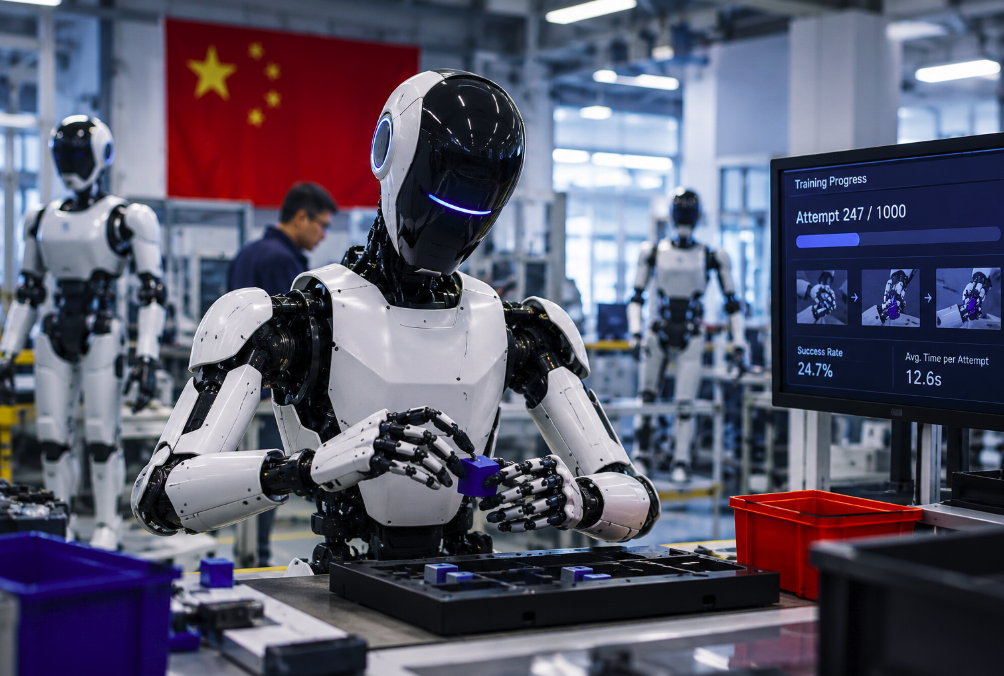
The most revealing scenes in the Reuters investigation are not robots performing spectacular demonstrations. They are robots being trained to perform mundane movements. At a training center in southern China, more than 100 humanoids are used to generate data for embodied AI systems. Human trainers wearing headsets and using sensor-equipped controllers repeatedly guide the machines through tasks such as sorting crates, packaging noodles and making coffee.
The process can be painfully inefficient. Reuters reported that a novice trainer might require around 300 attempts to obtain a single usable movement, while an experienced trainer might still need roughly 50. Those figures illustrate the scale of the intelligence problem better than a choreographed backflip ever could. Physical movement in the real world contains enormous amounts of implicit information: grip pressure, object geometry, friction, timing, balance, visual uncertainty and the ability to recover when something moves unexpectedly.
Humans absorb much of this through experience and generalize quickly. A person who learns to pick up one unfamiliar cup does not normally need hundreds of demonstrations to pick up a slightly different one. Today’s humanoids often do. Their difficulty is not merely executing a predefined trajectory; it is understanding enough about the physical environment to adapt when reality deviates from the trajectory.
The training-data problem is physical
Large language models benefited from an extraordinary historical accident: the internet already contained enormous quantities of human-generated text, code and images that could be converted into training data. Robotics has no comparable reservoir of high-quality physical interaction data. The web contains videos of people opening drawers and assembling products, but video alone does not necessarily capture the joint positions, forces, tactile feedback and precise action sequences required to train a machine to reproduce those behaviors reliably.
That is why China is building what amount to data factories for robots. Human operators teleoperate machines again and again, recording successful trajectories that can later be used to train embodied-AI models. The Liuzhou facility visited by Reuters was established after robot maker UBTech won an $18 million regional-government tender to supply humanoids and related equipment. Its goal is not primarily to replace workers today, but to generate the data that might make worker-like autonomy possible later.
The economics remain uncertain. Staff at the facility told Reuters that high operating costs and low prices for training data leave the subsidy-supported project without a clear path to profitability. That creates an unusual circularity in the emerging market: many humanoid robots are currently being manufactured not to perform productive labor for customers, but to help generate the training data needed to make future humanoid robots productive.
Robotics analyst Georg Stieler recently estimated that between 50% and 70% of humanoids produced in China in 2026 could end up in these data-collection facilities rather than doing economically useful work for paying customers. If that estimate proves broadly accurate, headline shipment numbers will need to be interpreted carefully. A rapidly expanding installed base does not necessarily mean equally rapid automation of factories, warehouses or service jobs.
Dexterity is where impressive demos meet messy reality
Humanoid robots have made striking progress in locomotion. Machines can now run, balance, recover from disturbances and perform athletic movements that would have looked extraordinary only a few years ago. But industrial usefulness often depends on something less visually dramatic: hands.
Factories are full of tasks that humans perform almost unconsciously but that are difficult to specify computationally. Plugging in a cable requires recognizing its orientation, aligning connectors precisely and adjusting force continuously. Handling flexible packaging requires understanding how material folds and deforms. Picking objects from an unstructured bin demands perception, planning and dexterity at the same time. When something slips, bends or appears in an unexpected location, the worker must recover without restarting the entire procedure.
These edge cases are not actually edge cases in the physical world. They are normal operating conditions. A robot that succeeds 90% of the time can look excellent in a demonstration but be economically unusable on a production line where thousands of actions must be performed every shift. Reliability compounds: even a small error rate becomes expensive when failures stop a line, damage a product or require a human supervisor to intervene.
The industry may be approaching its intelligence bottleneck
This helps explain the widening gap between China’s robotics hardware ecosystem and the commercial maturity of general-purpose humanoids. Reuters found that industry executives and researchers repeatedly pointed to intelligence rather than mechanical engineering as the key limitation. Tang Wenbin, co-founder and CEO of AI robotics venture Yuanli Lingji, put the problem memorably at an industry panel: many machines that appear to be working are effectively performing choreographed behavior rather than demonstrating adaptable intelligence.
The next competitive frontier is therefore embodied AI: models capable of connecting perception, language, reasoning and action. The ambition is to give robots something closer to the generalization abilities that transformed software AI after the arrival of large foundation models. Instead of programming every movement independently, developers want machines that can interpret an instruction, understand a new environment, plan a sequence of actions and adjust as circumstances change.
There are reasons to expect rapid progress. Better vision-language-action models, simulation, cheaper sensors and larger real-world datasets are arriving simultaneously. China also has an unusual advantage in its ability to deploy large fleets of physical machines and collect data at scale. ACE Robotics chairman Wang Xiaogang told Reuters this month that robot intelligence could experience a “ChatGPT moment” by the end of 2027, although he expects widespread commercial adoption to take several more years after such a breakthrough.
But the analogy with language models has limits. A chatbot can generate a slightly incorrect answer at negligible physical cost. A robot working around machinery, inventory or people cannot fail with the same tolerance. Physical AI must solve not only intelligence and generalization but reliability, safety, latency, power consumption and hardware wear. Scaling the model is only part of the system.
China’s humanoid boom may still matter even if many companies fail
The presence of more than 150 humanoid developers inevitably raises questions about a bubble. Government subsidies, aggressive valuations and uncertain customer demand can sustain companies before the technology is commercially mature. Reuters reported that China provided more than $230 million in government subsidies to the sector in early 2026 alone, while some projects remain heavily dependent on state-backed demand.
A shakeout would not necessarily mean the broader strategy failed. China’s electric-vehicle industry also went through periods of intense overcapacity and brutal competition, eliminating weaker companies while strengthening suppliers and lowering costs for survivors. Something similar could happen in humanoids. Many of today’s developers may disappear, merge or pivot, while the underlying ecosystem of actuators, dexterous hands, sensors, control systems and embodied-AI data continues improving.
The more important question is whether intelligence improves fast enough to meet the hardware. China already has factories capable of producing increasingly sophisticated robot bodies. It has capital, policy support, a dense supplier network and a vast manufacturing economy in which to test them. What it does not yet have is a generally capable robotic worker that can enter an unfamiliar workplace and handle the unpredictable variety that humans navigate routinely.
That distinction is easy to miss when humanoids are judged by the most spectacular thing they can do. Running races, dancing or executing a scripted assembly sequence demonstrates genuine engineering progress, but labor is not a highlight reel. Work consists of thousands of ordinary actions performed reliably despite changing conditions. The decisive milestone for humanoid robotics will not be when a machine produces its most impressive movement. It will be when the 300 attempts needed to learn one useful movement become one or two—and when the robot can apply what it learned to the next task without starting over.
China may be closer than any country to manufacturing humanoid robots at meaningful scale. The Reuters investigation shows why that is only half the race. The body is becoming an industrial product. The intelligence that makes the body genuinely useful is still a research problem.