
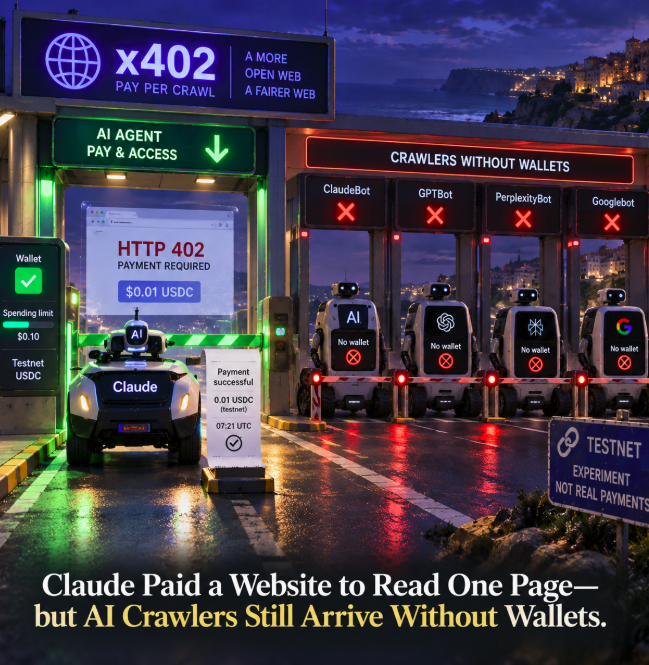
A website has now demonstrated something that still sounds slightly futuristic: an AI-assisted workflow encountered an HTTP payment requirement, checked its spending limit, paid for the page and continued its task with both the protected content and a transaction receipt. The price was one cent. The buyer was a Claude Code workflow. The payment protocol was x402.
But the experiment comes with an important qualification. Suganthan Mohanadasan's working x402 test did not show ClaudeBot, GPTBot, PerplexityBot or Googlebot autonomously buying access to publisher content. Every payment in the experiment came from agents he controlled, and the transactions used testnet USDC with no real monetary value. The experiment proves that the payment loop can work. It does not prove that today's major web crawlers have wallets.
A web page returned HTTP 402 and asked an agent for $0.01
Mohanadasan built the experiment on a Cloudflare Worker and protected a research page behind HTTP status 402 Payment Required. Instead of simply denying access, the response included x402 payment requirements describing what the client needed to pay to retrieve the resource.
The offer requested 0.01 USDC on Base Sepolia, a test network. Because USDC uses six decimal places, the payment amount in the machine-readable offer was represented as 10,000 units. The buyer could read that offer, authorize the exact amount and retry the request with the required payment signature.
A facilitator then verified and settled the transaction. Once payment succeeded, the server returned the protected content together with a payment response containing the settlement receipt. The result is effectively a machine-readable toll booth: access is withheld until the payment condition is satisfied.
The most interesting part was not the payment—it was the budget
An autonomous payment system becomes dangerous very quickly if an agent accepts every price it encounters. Mohanadasan therefore gave his buyer explicit spending constraints: a maximum of $0.05 per request and a $0.25 daily allowance stored in a local spending ledger.
The buyer decoded the x402 offer before signing anything. If the requested amount exceeded either limit, the process stopped without producing a payment signature. If the price fit the budget, it authorized the payment, retrieved the content and recorded the spend.
That guardrail is arguably more significant than the one-cent transaction. Machine payments become practical only when agents can make bounded purchasing decisions rather than receiving unrestricted control over a wallet.
Claude Code encountered the paywall and the hook handled it
Mohanadasan then connected the payment client to Claude Code through a hook around web fetching. When Claude attempted to access the protected page and encountered the 402 response, the hook fetched the payment offer, checked the price against the configured cap, paid when permitted and returned the purchased content and settlement receipt to Claude as additional context.
Claude could then continue the original task without requiring the human operator to manually interrupt the workflow and complete a checkout. Mohanadasan reports that one successful transaction settled at 07:21 UTC, with the public transaction hash recorded alongside the other test payments.
This wording matters: Claude Code did not spontaneously develop a wallet and negotiate with the website. Mohanadasan built and funded the payment mechanism, configured its limits and attached it to Claude through a hook. The experiment demonstrates how an agentic workflow can be equipped to pay, not that Anthropic's ordinary crawler infrastructure has begun paying websites.
All of the payments were Mohanadasan's own test agents
The experiment produced five testnet payments on September 15, according to Mohanadasan's published record. He is explicit about their origin: all came from agents he controlled. The USDC was testnet currency, so the transactions did not represent real publisher revenue.
That distinction prevents a technically successful demo from becoming an exaggerated claim about a new crawler economy. Blockchain settlement can prove that a wallet transferred a token. It does not automatically prove that an independent AI company decided to purchase a publisher's content.
Mohanadasan also warns against treating aggregate x402 transaction volume as equivalent to autonomous agents purchasing useful resources. Automated scripts, tests and transactions between accounts controlled by the same party can all generate blockchain activity that resembles agent commerce from a distance.
ClaudeBot, GPTBot, PerplexityBot and Googlebot still arrive without wallets
The immediate SEO implication is less futuristic. The crawlers publishers care about today are not generally equipped to encounter an arbitrary x402 price and pay it. Mohanadasan specifically cautions that GPTBot, ClaudeBot, PerplexityBot and Googlebot should not be expected to arrive with wallets capable of purchasing access.
If a publisher places important public content exclusively behind a mandatory x402 payment today, those crawlers can simply fail to retrieve it. The publisher may collect no payment and simultaneously lose access to the crawling systems that can contribute to discovery, indexing, training, retrieval or citations.
The exact consequence depends on the crawler. Googlebot participates in conventional web crawling and indexing, while AI-specific crawlers can have different purposes and controls. They should not be treated as interchangeable. The common problem is simpler: an HTTP paywall only creates a market when the client on the other side knows how to pay.
x402 turns the old HTTP 402 placeholder into a payment handshake
HTTP 402 has existed for decades as “Payment Required,” historically reserved for future use. x402 supplies a practical protocol around that status code so a server can tell a machine client what a resource costs and how to pay for it.
In Mohanadasan's implementation, the sequence is straightforward. The client requests a resource and receives a 402 plus payment requirements. It signs authorization for the requested USDC amount and retries. A facilitator verifies and settles the transaction. The server then returns the resource and settlement information.
Unlike robots.txt, which communicates crawler preferences that compliant bots choose to honor, a server-side 402 gate can actually withhold the protected resource. That makes payment enforcement technically stronger, but it also makes incompatibility more consequential. A crawler that cannot complete the handshake gets no content.
Pay per crawl and pay per use solve different problems
The experiment also lands in the middle of a broader debate over what publishers should actually be paid for. A crawl is observable by the website owner: the server sees the request, sees the payment and can verify the receipt. But downloading a page does not prove that its information influenced an AI answer.
Pay-per-use systems attempt to move compensation closer to the moment content creates value. The drawback is that the publisher generally cannot independently observe what happens after content leaves the server. If an AI platform says a page materially contributed to an answer, the publisher has to rely on the platform's attribution and accounting mechanisms.
Pay per crawl reverses that trust relationship. The publisher can verify access and settlement directly, but the buyer may end up paying for resources that are retrieved and never used. Neither model fully solves the attribution problem.
The obvious publisher strategy is unlikely to be “charge for every page”
Mohanadasan does not recommend putting an x402 gate across an entire public site today. General informational pages may still generate value by being discoverable, indexable and citable. Blocking those pages until every crawler learns how to pay could sacrifice distribution before a functioning market exists.
Original datasets, proprietary research, specialized tools and high-value machine-readable resources are more plausible candidates. An agent attempting to complete a specific task may have a clearer reason to spend a cent—or considerably more—to obtain a resource it actually needs.
This creates the possibility of a hybrid publishing model. Discovery content remains open, while resources with measurable agent utility carry explicit machine prices. The open pages create reach; the paid resources create transactions.
Machine-readable pricing could become another layer of the agentic web
The larger significance of the experiment is that websites may eventually expose economic rules alongside technical access rules. Today's machine-readable web tells crawlers where pages are, what they contain and, through mechanisms such as robots directives, whether automated access is permitted. An agentic commerce layer can add another question: what does access cost?
For that model to become routine, however, both sides need compatible infrastructure. Publishers need reliable payment gates, identity controls and pricing policies. Agents need wallets, spending limits, settlement support and rules for deciding when a resource is worth buying. Major crawler operators would also have to decide whether autonomous per-page payments fit their economics at web scale.
Mohanadasan's demo shows one implementation of the buyer side with explicit spending guardrails. It does not establish that the major search and AI platforms will adopt the same model.
For GEO, paid access creates a new visibility trade-off
GEO discussions often focus on making information easier for AI systems to retrieve and cite. A machine paywall introduces the opposite optimization: intentionally restricting retrieval unless an economic condition is met.
That can make sense when the value of the resource exceeds the value of free distribution. But until mainstream crawlers support payment, publishers need to distinguish monetization experiments from visibility strategies. Charging an agent that has a wallet can create revenue. Charging a crawler that does not have one is functionally a block.
This is why x402 should not yet be treated as a drop-in replacement for open crawling, licensing agreements or emerging platform revenue-sharing programs. It is a different mechanism with a different unit of exchange and a different risk profile.
The experiment proves the transaction loop, not the market
Mohanadasan's test is valuable precisely because its limitations are visible. A protected page returned a machine-readable price. An agent-side workflow checked its budget. A payment settled. The page and receipt returned to Claude, and the task continued. That is a functioning technical loop.
But the seller and buyer infrastructure were both part of the experiment, the tokens were testnet USDC and ordinary production crawlers did not independently choose to purchase the content. The next milestone is therefore not another test transaction. It is an independent agent with real funds deciding that a third-party resource is worth its price.
Claude can be equipped to pay a website, but the crawlers shaping search and AI visibility still largely arrive without wallets. Until that changes, x402 sits in an intriguing middle ground: technically operational enough to demonstrate a machine-payable web, but early enough that putting valuable public pages behind it can turn a monetization experiment into a crawl and citation problem.