
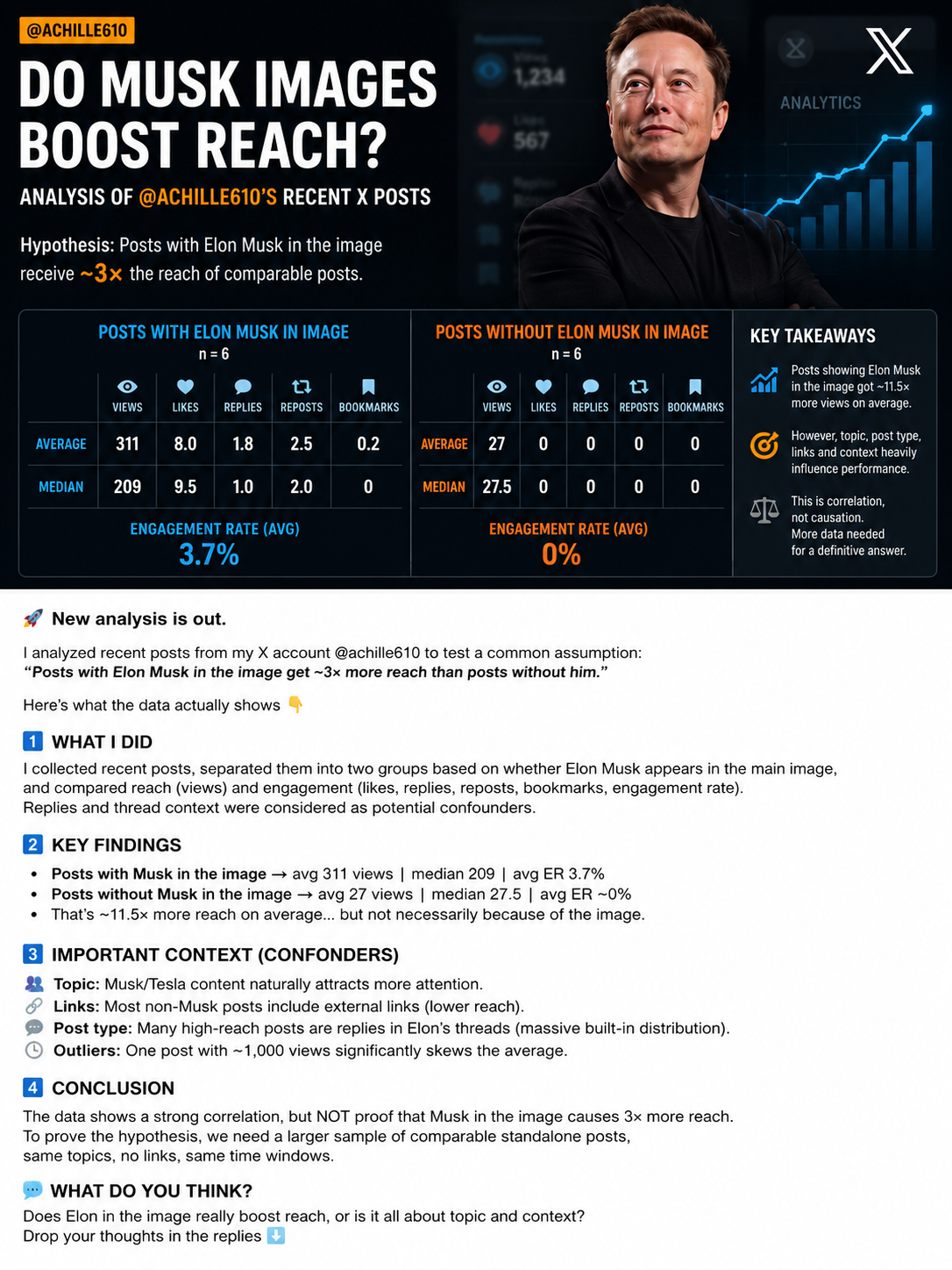
Does putting Elon Musk in an image make an X post travel further? It is an appealing hypothesis, particularly for accounts publishing technology, Tesla and AI content, but the available data needs to be interpreted carefully. A review of recent activity from @achille610 shows a striking difference in reach between the sampled Musk-related observations and a group of recent standalone SEO and AI-search posts. The gap is large enough to deserve attention, but not clean enough to establish that the image itself caused the additional distribution.
A large difference in reach appears in the sample
In the observations collected for this comparison, the higher-reach group averaged roughly 311 views, with a median of 209. The comparison group of recent standalone content posts averaged about 27 views, with a median of 27.5. On the surface, that is a much larger difference than the original hypothesis of approximately three times the reach.
That headline comparison, however, hides a major methodological problem. Several of the higher-reach observations were replies inside Elon Musk conversations rather than equivalent standalone posts whose only meaningful difference was the person shown in the main image. Replies can inherit exposure from an already enormous conversation, while standalone posts must generate their own distribution. Comparing the two directly therefore mixes the potential effect of imagery with the effect of post format and thread context.
Topic, links and distribution are major confounders
The lower-reach sample was dominated by specialist SEO and AI-search subjects, including search visibility, AI citations, Google updates and publisher issues. Most of these posts also contained an external link. The higher-reach observations, by contrast, were associated with Elon Musk, Tesla or EV conversations and generally did not contain an external link. Those differences matter because audience size, subject popularity, link behavior and the distribution available inside a major account’s thread can all affect impressions.
There was also an obvious outlier: one observation reached roughly 1,000 views. A post like that can pull an arithmetic average sharply upward, which is why the median is particularly useful here. Even the median remained substantially higher in the Musk-related sample, but that still does not isolate the effect of having Musk visually present in an image.
Correlation is not the same as an image effect
The most defensible conclusion is therefore narrower than the headline numbers might suggest. Musk-related content in the observed sample was associated with considerably greater reach, but the available public data does not establish that showing Elon Musk in the main image was responsible. Topic, replies, thread size, external links, publication timing and unusually successful posts are all plausible competing explanations.
A stronger test would use a larger set of standalone posts and classify each actual hero image as Musk or non-Musk. Posts should then be compared at the same age—such as 24 or 48 hours after publication—and ideally matched by topic, posting window and link status. Replies and reposts should be excluded or analyzed separately. Reporting both median reach and a trimmed average would further reduce the distortion caused by occasional viral posts.
What the experiment tells us so far
The early signal is interesting enough to justify a controlled follow-up, but not a causal claim. The available observations show that Musk-associated posts can dramatically outperform routine specialist posts on the same account, yet they also show exactly why social-media analytics can be deceptive when different formats and distribution environments are placed side by side.
The practical question is now testable: publish comparable standalone posts across similar topics and time windows, vary the creative rather than the distribution context, and measure them at a fixed age. If Musk imagery continues to produce a roughly threefold median-reach advantage after those controls, the original hypothesis will have much stronger evidence behind it. Until then, the correct finding is correlation, not causation.