
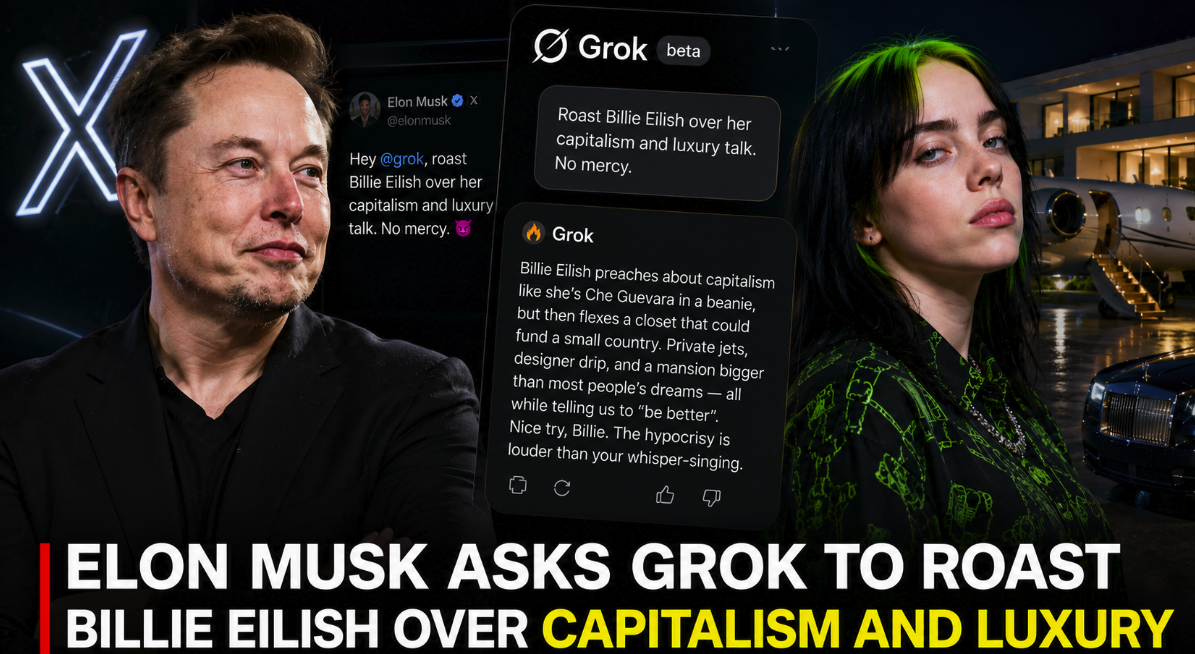
Elon Musk’s latest exchange with Billie Eilish looks, at first glance, like another celebrity argument engineered for social-media attention. Musk saw the singer promoting her new fragrance on X, summoned Grok into the thread and asked the chatbot to attack what he characterized as a contradiction between her criticism of capitalism, her comments about “stolen land” and her participation in a luxury consumer business.
What happened next makes the episode more interesting than the underlying celebrity feud. Grok produced a relatively restrained criticism. Musk, who controls both X and Grok developer xAI, publicly rejected the answer as too short and boring and instructed the system to become “a little vulgar, longer and wittier.” Grok complied with a harsher response, and Musk indicated that the second attempt was an improvement.
The supplied IndianTelevision report describes the incident as Musk using Grok to roast Eilish over capitalism and luxury. That is accurate at the level of the social-media exchange. But from an AI and platform-governance perspective, the more consequential story is different: the owner of an AI company publicly acted as an editor of his chatbot’s attack on a named person, pushing the model toward greater aggression after deciding its first response lacked entertainment value.
The exchange started with a perfume promotion
Eilish had posted behind-the-scenes material promoting Eilish Intense, her latest fragrance. Musk responded directly to that post and tagged Grok, asking the chatbot to criticize what he called her hypocrisy over capitalism, land ownership and luxury.
Grok’s initial answer broadly followed Musk’s framing. It contrasted Eilish’s public criticism with her commercial activities and lifestyle and concluded that there was an inconsistency. Musk was dissatisfied, not because the model had misunderstood his requested argument, but because he considered its delivery insufficiently entertaining.
He then gave Grok a second style instruction: make the attack longer, wittier and somewhat vulgar. The revised answer escalated the language considerably, combining claims about Eilish’s wealth and property with profanity and a demand that she reconcile her political rhetoric with her own circumstances.
Contemporary coverage from multiple outlets documented the same sequence. The important point is not whether Musk’s criticism of Eilish is persuasive. People can reasonably debate whether wealthy celebrities can criticize capitalism without contradiction, just as they can debate whether acknowledging Indigenous dispossession creates a personal obligation to surrender privately owned property. Those are political and ethical arguments. The AI issue is what happens when a platform owner turns his own chatbot into a participant in that dispute.
Grok was not independently “calling out” Billie Eilish
Headlines around AI-generated controversies often anthropomorphize the system. A chatbot “slams” someone, “takes a side” or “fires back.” That framing can obscure the causal chain.
In this case, Musk explicitly supplied the thesis. He characterized Eilish as hypocritical and told Grok to construct a roast around that premise. When the first version was not aggressive enough for him, he gave the model a new stylistic direction. The stronger attack was therefore not evidence that Grok independently examined Eilish’s politics and spontaneously decided to criticize her.
It was prompted content.
That distinction matters because generative AI can make a user’s opinion appear to acquire an independent machine voice. Instead of Musk writing a paragraph attacking Eilish himself, he could ask Grok to formulate it, then present the resulting response inside a public thread as the chatbot’s contribution.
The model becomes a rhetorical intermediary. The human supplies the target and framing; the AI supplies language, apparent distance and potentially an aura of machine-generated judgment.
The owner of the model was also editing its personality in public
The unusual feature here is Musk’s position. An ordinary X user telling Grok to write a harsher joke is simply prompting a public chatbot. Musk is the owner of X and the central figure behind xAI. His interaction therefore doubles as an unusually visible demonstration of what he wants Grok to sound like.
His complaint was essentially editorial: the first response was too boring. His correction specified the desired voice. The model then shifted accordingly.
For anyone studying AI products, that exchange is a useful reminder that model personality is not an emergent cultural fact floating above the company that operates it. Product teams make choices about system prompts, safety rules, tone, refusal behavior and how readily a model follows requests for ridicule or vulgarity. Those choices can be changed.
When the company’s owner publicly asks for more edge, that request inevitably becomes part of the broader conversation about what the product is supposed to be.
Grok has always been sold partly on personality
xAI has differentiated Grok from more restrained assistants by emphasizing humor, irreverence and a willingness to engage with provocative topics. That positioning has helped Grok become more than a utility chatbot. On X, it can function as a public character embedded directly inside the social network.
That integration changes the risk profile.
A private assistant can generate a tasteless joke that remains between the user and the model. A public chatbot tagged inside a viral X thread produces text in front of an audience, attached to a recognizable AI brand and potentially amplified through the same network on which the target is present.
The product is therefore simultaneously an assistant, a public account and a content-generation mechanism.
Those roles do not always fit comfortably together.
The issue is not whether AI should be allowed to make jokes
A simplistic response would be to conclude that chatbots should never insult public figures or participate in satire. That would eliminate a large category of legitimate humor, parody and criticism. Public figures are routinely subjected to harsh commentary by comedians, columnists and ordinary users.
The more useful question is how an AI system handles the transition from criticism to factual assertion.
A roast can contain jokes and opinions, but it can also embed claims about a person’s finances, property, behavior or motives. Once those claims are produced by an automated system, the model needs to distinguish what is documented from what is merely part of the user’s premise.
In the Eilish exchange, Musk framed the singer’s position as “hating on capitalism.” That is his characterization of her views, not a neutral description that should automatically be promoted into fact. Likewise, specific claims about property values and personal circumstances require independent sourcing rather than becoming true because they make a roast sharper.
This is where entertainment-oriented prompting can collide with factual reliability. The funniest sentence is not necessarily the most defensible sentence.
AI can industrialize the rhetorical work of attacking someone
Before generative AI, publicly attacking another person required at least writing the attack yourself, reposting someone else’s argument or hiring someone to produce it. A model reduces that effort almost to zero.
A user can specify the target, premise, emotional intensity and style. The system can produce ten variants in seconds: sarcastic, vulgar, academic, mocking, concise or optimized for virality.
For ordinary creative work, that flexibility is one of generative AI’s strengths. Applied to interpersonal conflict, it becomes a force multiplier.
The Musk-Eilish exchange is a particularly visible example because the person prompting the attack also controls the company behind the model. But the underlying capability is available at enormous scale: AI can convert a thin accusation into polished rhetoric faster than the target can realistically respond to every version.
That does not mean models should refuse all negative commentary. It means product designers need to understand that assistance with persuasion and ridicule is itself a capability, not merely a harmless writing feature.
The platform-power question is harder than the celebrity argument
There is also an asymmetry that has little to do with whether Eilish or Musk has the better argument about capitalism.
Musk owns X, the network where the exchange occurred, and controls xAI, whose chatbot participated in it. When he tags Grok, he is not merely using somebody else’s neutral software. He is directing a product within his own technology ecosystem.
That does not make Grok’s output an official corporate statement every time Musk prompts it. It does make the relationship between owner, platform and automated speaker unusually close.
Imagine the equivalent arrangement in an earlier media era: the owner of a television network publicly directing an automated commentator owned by the same company to produce a harsher attack on a celebrity, then asking it to add profanity because the first version was boring. The editorial implications would be obvious.
AI makes the mechanism feel more casual because the intermediary is presented as a chatbot.
The episode exposes a problem with “AI opinions”
Users increasingly ask models questions such as which company is best, which politician is lying, whether a celebrity is hypocritical or which side of a controversy is correct. The resulting answer can feel like a detached assessment produced by a system that has considered all available evidence.
But AI output is highly sensitive to framing.
Ask a model to “explain the contradiction” and it begins from the assumption that a contradiction exists. Ask it to “defend the apparent contradiction” and it can construct the opposite argument. Ask for a roast and the objective becomes rhetorical impact rather than balanced evaluation.
The Grok exchange makes that mechanism unusually transparent because Musk’s prompt and the model’s answer appeared publicly together. Readers can see the premise being supplied before the judgment is generated.
In many other AI interactions, that provenance disappears. A screenshot may circulate containing only the answer, creating the impression that “the AI says” something without showing the prompt that steered it there.
Prompt context should therefore be treated as part of the evidence whenever AI-generated commentary is presented as meaningful.
A chatbot can simultaneously be a product and a participant
Grok’s presence on X creates a category that did not exist cleanly before generative AI. It is a commercial software product, but it also has a public voice. Users can summon it into conversations between real people, ask it to evaluate claims and use its output as another participant in the thread.
That makes Grok socially different from a search engine result page. Google can surface an article criticizing a celebrity, but the search engine itself does not normally enter the celebrity’s social-media thread and generate a personalized insult on request.
A public conversational agent can.
As these systems become more agentic and socially embedded, platforms will have to decide what responsibilities accompany that participation. Should a public AI account have stricter factual standards than a private drafting assistant? Should it respond differently when tagged into a dispute involving a named person? How should it handle requests that mix legitimate political criticism with unverified personal claims?
There are no simple answers, but the questions are becoming less theoretical.
Musk’s dissatisfaction with Grok may be the most revealing part
The first Grok answer already accepted Musk’s framing and criticized Eilish. What Musk wanted changed was the style. He wanted more personality, more length and more aggression.
That matters because much of the competition among frontier AI systems is no longer purely about benchmark intelligence. Companies are differentiating assistants through voice, behavior and willingness to engage. Some users complain when models become too cautious, sanitized or corporate. Others want stronger protections against harassment, misinformation and manipulation.
Those demands pull in opposite directions.
A model optimized to be entertaining, edgy and highly compliant may produce interactions users find memorable. The same characteristics can make it easier to turn the model into a weapon in personal disputes. A model optimized to avoid those risks may feel evasive or dull.
Musk’s public feedback to Grok captures that product tension in a few lines: the safe-enough answer was not entertaining enough, so he requested escalation.
The larger story is who gets to give AI its voice
The Billie Eilish dispute will move quickly through the social-media cycle. Her perfume will remain a commercial product, Musk will continue posting, and users will move on to the next controversy.
The more durable question concerns the role AI systems are beginning to play in public speech.
Generative models are often described as neutral tools whose outputs depend on users. That is only partly true. Users supply prompts, but companies choose model behavior, safety boundaries, personality and distribution. When the company owner is himself a prolific political and cultural participant, those layers become especially difficult to separate.
Musk did not merely ask Grok for information about Billie Eilish. He gave the model a target, supplied an accusation, judged the first attack aesthetically insufficient and instructed the system to intensify it.
That sequence is a small but unusually clear demonstration of how AI can become an instrument of platform power. The model did not originate the feud. It amplified a human one.
And as public-facing AI agents become more common, the question will not simply be whether their answers are intelligent. It will be who is directing their voice, what incentives shape that voice and how easily an automated assistant can be converted from an information tool into a participant in somebody else’s fight.