
Local search used to offer businesses a relatively understandable objective: become one of the strongest results for an important query in a specific market. Generative AI is making that idea considerably less stable.
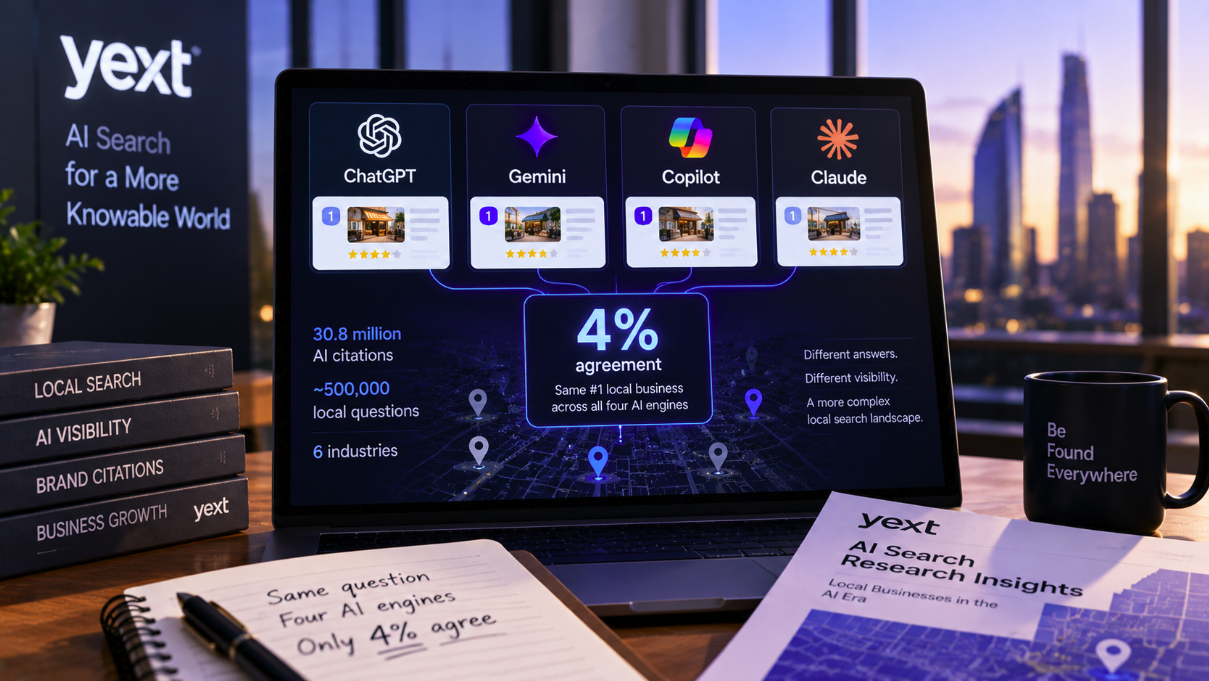
New research previewed by Yext on September 8 suggests that four major AI engines agree on which local business deserves the number-one recommendation in only 4% of cases. The analysis covers 30.8 million AI citations, six industries and nearly 500,000 identical local questions, according to the company’s advance disclosure.
The full methodology and results are being presented on September 8 through Yext’s webinar program, so the findings should currently be treated as preliminary vendor-reported research rather than a fully published dataset available for independent inspection. Even with that caveat, the headline result points to an important problem for local marketers: there may be no single AI ranking to win.
If four systems receive the same local question and choose the same top business just 4% of the time, visibility in one AI engine tells a company remarkably little about its visibility in another.
The same local question can produce four different winners
Yext’s preview of the research focuses on a deceptively simple experiment: ask multiple AI engines identical questions about local businesses and compare the recommendations and citations they produce.
That matters because marketers often talk about “AI visibility” as though it were one channel. In practice, ChatGPT, Gemini, Copilot, Claude and other AI products can rely on different retrieval systems, indexes, source sets and ranking logic. Even when users express the same intent, the systems do not necessarily arrive at the same businesses.
The reported 4% agreement rate makes that fragmentation unusually concrete. A restaurant, healthcare provider, retailer or service business could theoretically be the preferred answer in one environment while remaining absent or secondary in another.
For local SEO teams accustomed to monitoring Google rankings and map-pack positions, that introduces an entirely new measurement problem.
Thirty million citations reveal a much larger discovery layer
The scale of the research is part of what makes the preview notable. Yext says it analyzed 30.8 million citations across six industries and almost half a million identical local questions.
Citations matter because AI systems frequently build local recommendations from information distributed across the web rather than simply reproducing a conventional ranked results page. Business websites can be part of that evidence, but so can directories, review platforms, publishers, structured listings and other third-party sources.
A local business therefore has at least two visibility questions to answer. Does the AI engine recommend the business, and which sources gave the engine enough confidence to make that recommendation?
Those questions are related but not identical. A company may be recommended because its own website is authoritative, because third-party profiles consistently describe it, because review ecosystems provide strong evidence or because the engine has access to a particular local data source.
Until Yext publishes the complete methodology and source-level findings, the study should not be used to infer which of those factors caused the reported differences. The 4% figure describes agreement in observed recommendations, not a universal explanation for why the engines disagreed.
Local AI search may be more fragmented than traditional rankings
Traditional local search already varies by location, device, query wording and personalization. AI adds another layer of variability because the system can interpret the question before deciding what information to retrieve.
A request for the “best Italian restaurant near me” is not necessarily processed as a fixed keyword. The model may infer that “best” means highly reviewed, convenient, upscale, family-friendly or appropriate for a particular context. Another engine may interpret the same wording differently or retrieve a different mix of sources.
The generated response can also impose its own selection logic. Instead of displaying ten ranked links and leaving the choice to the user, an AI assistant can directly recommend one business and explain why.
That makes the number-one position more powerful conceptually while making it harder to define operationally.
There may be no universal number-one AI ranking
The 4% agreement figure challenges one of the most tempting ways to simplify AI search reporting.
Marketing dashboards increasingly attempt to produce a single AI visibility score. Such scores can be useful summaries, but they risk hiding platform-level differences if the underlying engines frequently recommend different businesses.
A local brand could improve its aggregate score while losing visibility in the AI system most commonly used by its customers. Conversely, poor performance in one engine could make a broad score look weak even when the business dominates another strategically important platform.
The practical response is not to abandon aggregate metrics. It is to preserve the engine-level data underneath them.
Local marketers need to know where the brand appears, where it does not, which competitors replace it and which sources are repeatedly cited in each environment.
AI visibility makes business data consistency more strategically important
Local SEO has always depended on reliable business information. Names, addresses, phone numbers, hours, categories, services and location pages need to remain accurate across the web.
Generative AI gives that principle a new purpose.
An AI engine trying to recommend a nearby business must construct an understanding of the entity before it can confidently describe or recommend it. Conflicting opening hours, inconsistent categories, outdated addresses or weak location information can create uncertainty.
That does not mean data consistency alone guarantees an AI recommendation. The Yext preview does not establish such a causal relationship. Reviews, authority, relevance, proximity, source quality and many other factors may influence different engines in different ways.
But clean entity information becomes foundational when multiple AI systems are independently assembling answers from distributed sources.
The website is only one part of the local AI evidence graph
Another consequence of AI-driven local discovery is that optimizing the company website alone may be insufficient.
When a model synthesizes recommendations, it can use evidence about a business from sources the business does not directly control. A restaurant’s website might say it is family-friendly, while reviews, travel publications and local directories provide the external evidence that makes the description credible.
This turns reputation management, digital PR, listings management and local SEO into increasingly overlapping disciplines.
The goal is not to manufacture identical language everywhere. It is to create a sufficiently consistent and authoritative information ecosystem that different retrieval systems can understand what the business is, where it operates and why it may be relevant to a particular user.
A citation is not the same as a recommendation
The research’s 30.8 million citation count also highlights an important distinction in AI visibility measurement.
An AI engine can cite a source without recommending the business associated with that source. It can mention a company without ranking it first. It can recommend a business while citing a third-party publication rather than the company’s own website.
Those outcomes should not be collapsed into a single metric.
Local teams increasingly need to distinguish brand mentions, source citations, recommendation frequency, recommendation position and referral traffic. Each measures a different stage in the AI discovery process.
The most commercially meaningful metric may also vary by business. A hotel could care deeply about recommendation frequency for destination-planning prompts, while a healthcare network may prioritize factual accuracy and location coverage across thousands of queries.
Identical prompts do not guarantee identical search environments
Yext’s use of nearly 500,000 identical local questions creates a useful basis for comparison, but marketers should resist interpreting the result as a pure head-to-head ranking test until the full methodology is available.
AI platforms can differ in their web indexes, retrieval partners, geographic context, model versions and source availability. Answers may also change over time.
Even identical prompt text therefore does not necessarily mean every engine receives identical evidence before producing an answer.
That is not a weakness unique to this research. It is one of the defining challenges of studying AI search.
Unlike a static database query, generative answers can be probabilistic and dependent on systems that update frequently. Serious AI visibility measurement needs repeated observations rather than one-off screenshots.
Local businesses should test the questions customers actually ask
The fragmentation suggested by Yext’s preview also makes query selection more important.
Businesses should not monitor only their brand name or a small collection of traditional keywords. Conversational discovery includes questions about use cases, attributes and situations: where to take children, which clinic offers a particular service, what store is open late, which provider serves a neighborhood or which restaurant suits a dietary requirement.
Those prompts can expose different competitors and different source requirements.
A useful AI visibility program therefore starts with customer intent rather than an arbitrary list of prompts designed to make the brand appear.
The objective is to understand whether the company is present when an AI system is asked to solve the kinds of local problems that generate real-world visits, calls and bookings.
Marketers should resist optimizing for one model’s current behavior
A 4% agreement rate creates an obvious temptation: reverse-engineer each engine separately and produce four different optimization playbooks.
Some platform-specific analysis is necessary, but extreme tactical optimization could become fragile very quickly. Models change, retrieval systems change and source partnerships change.
The more durable strategy is to strengthen the underlying evidence that multiple systems can consume: accurate structured business data, useful location pages, clear service information, strong reputation signals, credible third-party coverage and technically accessible content.
Platform-level monitoring can then identify where that foundation is failing to translate into visibility.
This approach is less exciting than chasing a secret LLM ranking factor, but it is more resilient to the volatility of AI search.
The 4% figure needs the full methodology before it becomes a benchmark
Yext’s headline statistic is powerful enough that it will likely be repeated widely. It should be repeated with context.
The company is releasing the complete methodology and findings on September 8. Until those materials are available for examination, important questions remain about the six industries, geographic coverage, exact engines and versions tested, how “number one” was defined, how location context was controlled and over what period the observations were collected.
Those details determine how broadly the 4% result can be generalized.
The appropriate conclusion today is therefore narrower but still significant: in Yext’s large-scale preview, four AI engines rarely selected the same top local business when asked identical questions.
That is evidence of substantial cross-engine fragmentation. It is not yet evidence that every local category, geography or prompt will produce a 4% agreement rate.
AI search is turning local visibility into a portfolio problem
For years, a local business could devote most of its search attention to Google because Google overwhelmingly dominated the discovery journey. AI assistants are creating a more fragmented environment in which several systems can independently influence the same customer decision.
Yext’s preview suggests those systems may disagree far more often than marketers assume.
If the complete research supports the advance findings, the strategic implication is straightforward. Businesses cannot treat “ranking in AI” as a single position. They need a portfolio view of visibility across engines, prompts and source ecosystems.
The winner in ChatGPT may not be the winner in Gemini. The strongest recommendation in Copilot may not appear first elsewhere. And the sources that influence one engine may not carry the same weight in another.
Four AI engines agreeing only 4% of the time would make local AI search less like one new ranking system and more like several competing maps of the same commercial world.
For local marketers, being number one is no longer the complete question. The question is: number one where?