
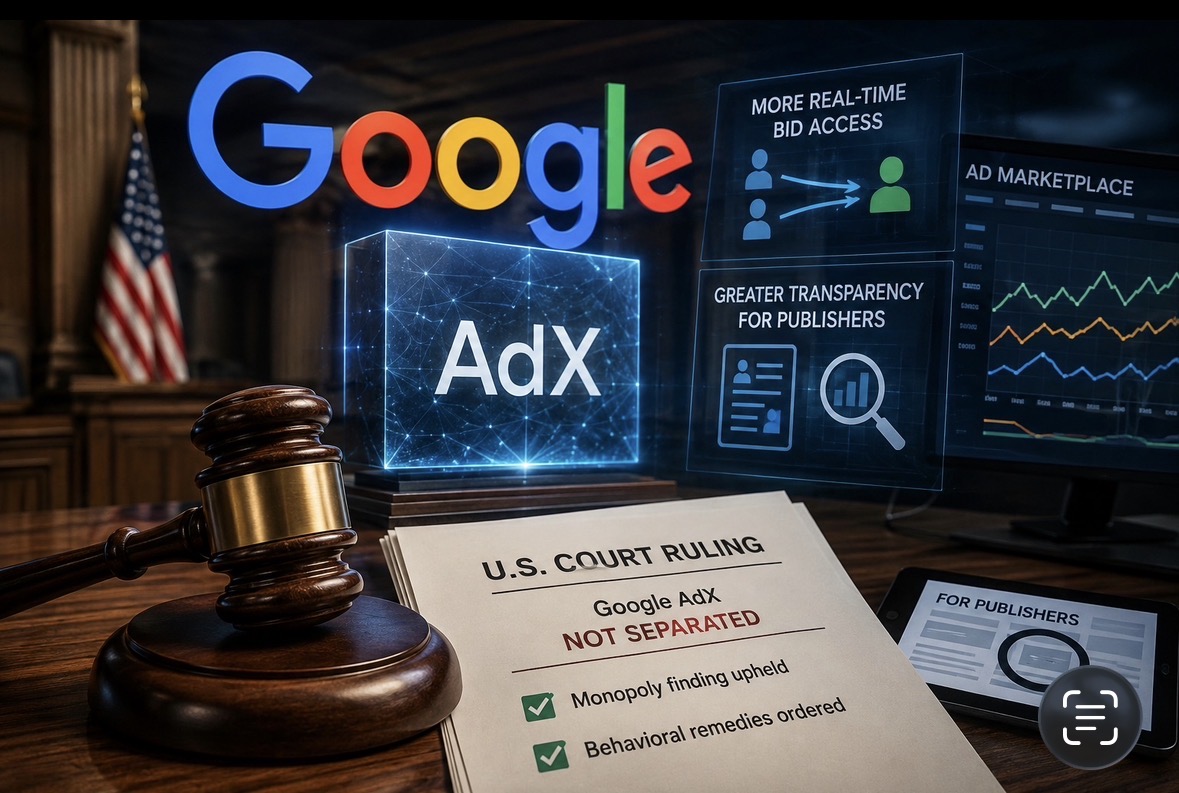
Google has avoided another forced breakup, but the company’s victory in the latest U.S. ad-tech antitrust ruling is not a clean escape. According to Reuters, U.S. District Judge Leonie Brinkema declined to order Google to sell AdX, the ad exchange at the center of the Department of Justice’s remedy request. The court instead moved toward behavioral remedies after previously finding that Google had unlawfully maintained monopoly power in key parts of the online advertising technology market.
The decision matters because AdX sits deep inside the machinery that connects publishers, advertisers and automated bidding systems. For years, publishers have argued that Google’s control over both the publisher ad server and the exchange allowed the company to shape auctions in ways that competitors could not easily challenge. The ruling leaves that structure intact, but it also keeps alive the court’s core finding that Google’s conduct harmed competition in the publisher ad server and ad exchange markets.
As Search Engine Roundtable noted in Barry Schwartz’s coverage, the judge rejected divestiture while ordering Google to end practices that depress ad rates for web publishers. Reuters reported that the remedies include giving competitors greater access to real-time bids and providing more transparency to publishers, two measures that could become meaningful if they are implemented with enough detail and enforceable oversight.
A breakup denied, not a monopoly erased
The distinction is important. Google did not persuade the court that the monopoly case had disappeared; it persuaded the court that selling AdX was not the appropriate remedy at this stage. That makes the outcome part win for Google and part warning shot. The company keeps the asset, avoids the operational and commercial disruption of divestiture, and can argue that a court recognized the risks of breaking apart a complex advertising system. At the same time, the court’s refusal to impose structural separation does not undo the legal finding that Google’s conduct crossed antitrust lines.
The Associated Press reported that the judge ordered changes to Google’s digital advertising business while sparing it from a breakup, with some details of the remedy process still not fully public. AP’s account also underlined the broader significance of the case: regulators have been seeking more aggressive remedies against dominant technology platforms, but courts have repeatedly shown caution when asked to dismantle major parts of those companies.
That caution has now appeared twice around Google in a matter of remedies. In a separate search antitrust case, Google also avoided the most dramatic structural outcomes sought by the government. The pattern does not mean regulators are losing every argument, but it does show how difficult it remains to convert monopoly findings into breakups, especially when judges are asked to redesign highly technical markets that serve millions of businesses in real time.
Why publishers may care more about transparency than ownership
For publishers, the practical question is less whether Google owns AdX and more whether they can finally see and test how the market works. Real-time bidding happens in milliseconds, and small differences in access, data visibility, auction logic and interoperability can shift revenue across thousands of sites. A remedy that forces Google to expose more bid information, reduce preferential treatment and make competing ad-tech tools more viable could give publishers leverage they have lacked for years.
That is also why behavioral remedies can be both powerful and fragile. They can be tailored more precisely than a breakup, and they can be updated as market behavior changes. But they require monitoring, compliance rules and technical specificity. If transparency simply means broader reporting without the ability to verify auction mechanics or switch providers without penalty, publishers may see little real improvement. If the remedies create genuine interoperability and meaningful access to bid data, the decision could reshape the economics of open-web advertising even without a sale of AdX.
The Verge framed the ruling as another avoided breakup, while noting that the court accepted remedies aimed at changing how Google operates rather than who owns the tools. That captures the central tension of the decision: the legal system is trying to discipline platform conduct without dismantling the platform itself.
The next fight is enforcement
The ruling now shifts attention from courtroom theory to implementation. Google’s competitors will watch whether access to real-time bids becomes broad enough to let rival exchanges and publisher tools compete on equal terms. Publishers will watch whether transparency gives them actionable information about auction outcomes, fees and demand paths. Regulators will watch whether a behavioral order can restore competition without requiring the structural fix they originally sought.
Google can claim a major reprieve because AdX remains inside the company. Publishers, however, may still have gained something they have long demanded: a court-backed path toward more visibility into the ad-tech infrastructure that determines much of their digital revenue. The outcome is not the breakup antitrust advocates wanted, but it may become a more practical test of whether transparency and access can rebalance a market that has operated for too long as a black box.