
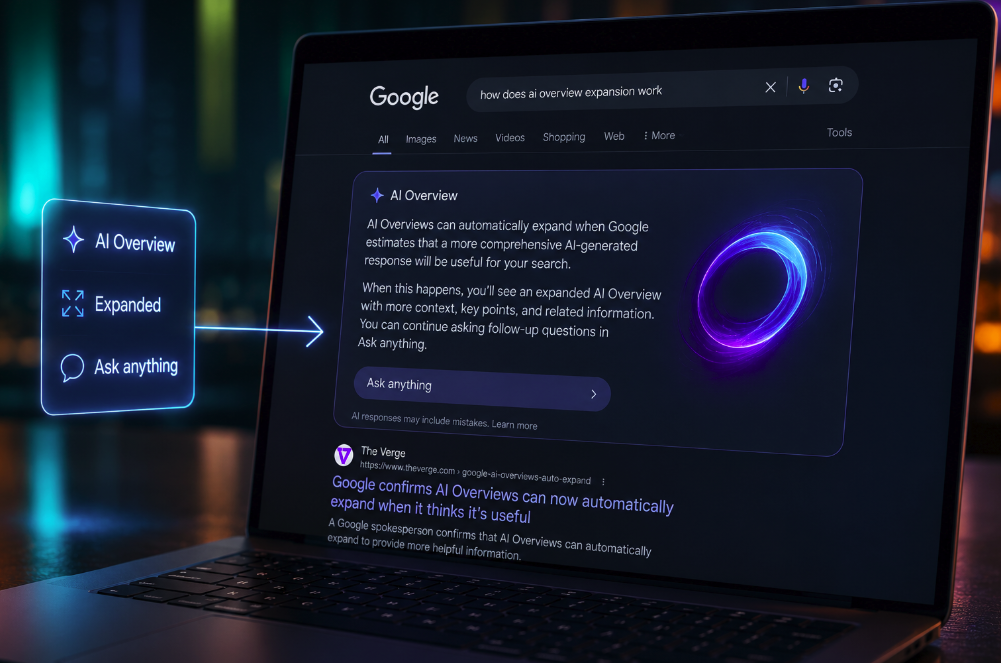
Google has confirmed that AI Overviews can now expand automatically for some searches, turning what might initially look like a familiar results page into a much larger AI-led experience without requiring the user to choose AI Mode. The change matters because it is more than a cosmetic adjustment to the AI Overview box: when the expanded response appears, traditional organic results can be pushed significantly farther down the page, while an “Ask anything” field encourages the searcher to continue interacting with Google’s AI.
The behavior was initially spotted in live search results and reported by Search Engine Roundtable, but Google has now confirmed the mechanism. In a statement reported by The Verge, Google spokesperson Jennifer Kutz said that AI Overviews may dynamically expand for some queries when Google’s systems determine that doing so would be particularly useful. Google also said its research indicates that users find the dynamic experience more helpful and engage more deeply with follow-up exploration.
That confirmation changes the significance of the story. This is not simply an isolated interface experiment observed by a handful of SEO professionals. Google is explicitly describing a system in which the amount of AI-generated material occupying the main Search interface can change dynamically according to the query and Google’s assessment of usefulness.
AI Overview is starting to look much more like AI Mode
The most important consequence may be the increasingly thin visual and functional boundary between AI Overviews and AI Mode. Traditionally, an AI Overview could appear as a relatively compact summary above the conventional results, with users choosing “Show more” when they wanted the longer answer. In the newly confirmed experience, Google can remove that extra step and display the fuller response automatically. The “Ask anything” field then provides a direct path into a conversational follow-up.
This direction is consistent with Google’s broader Search strategy. In January, the company announced that users could ask follow-up questions directly from AI Overviews and move into a conversational AI Mode experience while retaining the context of the original search. Google described the goal in its official announcement as creating a more seamless flow between a quick AI-generated snapshot and deeper conversation. Its current Search documentation similarly explains that users can transition from an AI Overview into AI Mode through the “Ask anything” interface.
Automatic expansion takes that convergence a step further. The user does not necessarily need to select a dedicated AI Mode tab or explicitly request a more immersive AI interface before Search begins behaving more like one. Google itself can decide that the query warrants a larger generated answer and place that answer, together with a conversational prompt, ahead of the standard results.
The real SEO issue is screen space and user choice
For publishers and SEO teams, the immediate concern is not merely whether AI Overviews appear. It is how much of the search journey Google completes before an organic result becomes visible. A compact overview already competes with conventional listings for attention. A dynamically expanded answer can consume considerably more vertical space, and adding a follow-up prompt creates another interaction point before the user reaches the traditional web results.
Search Engine Land noted that the behavior can replace the shorter AI Overview state with a detailed response and push core search results lower. Search Engine Roundtable likewise reported the disappearance of the previous “Show more” step in examples of the expanded interface. The practical implication is straightforward: ranking highly in the organic results does not guarantee the same visual prominence it once did, because the amount of Google-controlled AI content above those results is becoming more variable.
This variability also makes the change harder to evaluate through traditional rank tracking alone. Two pages could retain exactly the same organic position while receiving very different levels of exposure depending on whether an AI Overview appears, whether it expands automatically, how long the generated answer is, and whether the searcher begins a follow-up conversation instead of scrolling. Position remains important, but the physical and interactive distance between the query and the organic listing is becoming another critical part of search visibility.
A SERP that can reshape itself around the query
Google has not publicly detailed the exact criteria that determine when an AI Overview expands. The Verge reported inconsistent behavior across searches and browsers, which suggests publishers should be cautious about treating any single screenshot or query as representative of the entire Search experience. Google has also added an important safeguard: if a user has already started scrolling toward content below the AI Overview, the company says it cancels the expansion so the user does not lose their position.
Even with that limitation, the larger strategic direction is difficult to miss. Search is becoming a more adaptive interface in which Google can decide not only whether to generate an answer, but how much of that answer to expose before the user interacts with anything else. The distinction between “search results with an AI summary” and “an AI answer with web results underneath” is therefore becoming increasingly dependent on presentation rather than on a clearly separate product choice.
That is potentially more consequential for the web ecosystem than another Search redesign. AI Mode remains an explicit destination users can choose, but dynamically expanding AI Overviews allow elements of that conversational experience to arrive inside ordinary Search automatically. For publishers, the competitive surface is no longer limited to blue-link rankings or even inclusion in an AI Overview. It increasingly includes whether Google satisfies the query, invites the next question and keeps the user inside its AI interface before the organic results have had a meaningful chance to be seen.
What publishers should watch next
The next important question is how broadly Google applies dynamic expansion and to which classes of queries. If the feature remains limited to cases where a longer response clearly improves the experience, its traffic impact may be concentrated. If it becomes common across informational and research-heavy searches, however, publishers could face a structural reduction in above-the-fold organic visibility even when their rankings do not change.
For SEO teams, that means SERP monitoring needs to become more visual and behavioral. Tracking rankings alone cannot describe whether a result appears immediately beneath the search box or after a large generated answer and a conversational prompt. Publishers will also need to pay closer attention to citations and links inside AI experiences, branded demand, direct audience relationships and the types of queries where users still have a strong reason to visit the underlying source.
Google’s confirmation makes one point clear: the expansion of AI inside Search is no longer only about adding a new mode alongside the traditional results. The traditional results page itself can increasingly transform into an AI-first experience. As that happens, the line separating AI Overview from AI Mode may matter less to users — while the consequences of that blurred boundary matter considerably more to publishers.