
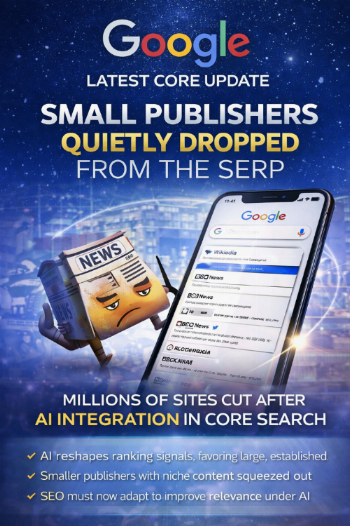
Google’s latest core update appears to be pushing millions of small publishers out of traditional search results. What’s really happening, why AI-driven ranking is reshaping visibility, and how SEO must evolve toward GEO and AEO to survive in 2026.
In recent months, Google’s behavior toward search results has been changing in a structural way. According to multiple reports, including a recent article published on InformazioneScuola.it, Google’s latest algorithm update has had a significant impact: millions of small publishers have been excluded from traditional SERPs following the introduction of new AI-based signals in search.
The scale of this phenomenon goes beyond simple ranking instability. It challenges what has until now been the paradigm of organic visibility on Google, especially for niche sites and local media. To understand what is happening and how to respond, it is useful to start from a key point: Google is not “punishing” small publishers for bad SEO practices, but is rethinking the mechanism through which it assigns relevance to online content.
-
The core of the change: the AI-based algorithm
Since June 2025, Google has begun integrating artificial intelligence components more deeply into its search system. This does not simply mean filters to fight low-quality content, but a real shift in ranking priorities, where AI technology directly influences which content is shown or excluded in traditional SERPs.
In essence, Google is condensing answers, summarizing results, and surfacing content that AI considers more reliable based on usage patterns, perceived authority, and the ability to serve users immediately, reducing the importance of individual URLs as landing points. This paradigm shift is what is causing the marginalization of many smaller or less established sites.
-
Why small publishers suffer more than others
Until a few years ago, organic ranking on Google was about combining solid on-page SEO signals, links, and relevant content. Today, complexity has increased. With AI integrated into the core of search, the signals that determine visibility are no longer exclusively technical or based on crawling and indexing behavior, but depend on how content is interpreted, understood, and synthesized by AI models.
This evolution naturally favors large editorial sites with consolidated content volumes, strong global reputations, and massive user engagement datasets, in other words, mainstream brands. Small publishers, often operating with limited resources and niche content, lose weight in the relevance scale perceived by these new AI systems, becoming overshadowed in ranking layers or fully excluded.
-
Volatility and backlash: the community reaction
The response to this new algorithmic configuration has been mixed. On one side, many web publishers and SEO specialists have reported drastic traffic drops, with tangible economic consequences such as layoffs and reduced freelance collaborations. On the other side, there is skepticism about the long-term effectiveness of an AI-based approach, especially if small publishers fail to regain positions despite producing valid and original content.
It is important to note that this is not the first time Google has introduced deep algorithm changes. Over the years we have seen core updates, spam policy adjustments, and ranking signal revisions, all impacting those dependent on organic traffic. However, the current phase is different because AI is not an additional layer, but is becoming a primary factor in how results are built, synthesized, and displayed. This does not only alter the balance of SERPs, it changes the nature of what Google considers a “relevant answer” to a user’s query.
-
Impact on SEO, AEO, and GEO: a new visibility map
For years digital professionals have viewed SEO as the discipline focused on improving organic rankings on Google. In recent years, AEO (Answer Engine Optimization) has emerged, aiming to serve immediate answers to users, and more recently GEO (Generative Engine Optimization), focused on being cited and present within AI-generated responses. These concepts, once theoretical, are becoming essential for any visibility strategy.
With Google’s algorithm pushing small publishers out of traditional SERPs, the lesson is clear: exclusive reliance on organic ranking is decreasing. If visibility is determined by how an AI model interprets your content, then optimization must go beyond queries and keywords, toward semantic understanding, contextual clarity, citability in synthesis models, and perceived relevance across different digital geographies. This requires a paradigm shift in content creation and SEO strategy.
-
Strategies that work in the post-algorithm ecosystem
In the face of this shift, traditional SEO tactics are not obsolete, but must be integrated into a broader digital visibility framework.
a) Optimization for intent and AI context
It is no longer enough to satisfy classical search intent. Content must be structured so that AI models can easily interpret it to generate answers, semantic mappings, and citation patterns.
b) Strengthening authority and contextual signals
Quality links, citations within relevant content, and high-quality structured data become even more important because they help AI models understand where and how your content fits within the broader conversation.
c) Diversifying traffic channels
As Google reduces reliance on traditional organic ranking, tools such as social search, personalized feeds, newsletters, and AI discovery surfaces can restore direct traffic. This reduces dependency on traditional SERP metrics.
d) Internationalization and local segmentation
Given the increasing centrality of geographic data in ranking, localized content may carry more weight in results relevant to specific markets or regions.
-
Fairness, competition, and regulatory perspectives
Criticism of the algorithm update does not come only from SEOs or small publishers, but also from broader editorial groups and industry bodies. In the past, Google’s spam policies have attracted attention from European antitrust authorities, with accusations of market power abuse and discrimination against legitimate monetization and visibility methods.
The discussion around balancing result quality, ecosystem diversity, and visibility for publishers of different sizes is likely to intensify. While Google maintains that changes aim to improve user experience, many publishers perceive the new configuration as favoring large brands while penalizing independent voices. This has led to calls for greater transparency in ranking criteria and potential regulatory oversight.
Conclusion: a new balance for digital visibility
Google’s algorithm update that pushed millions of small publishers out of SERPs is not an isolated event. It signals a broader evolution of the search engine toward AI integration and direct content synthesis. For content and SEO professionals, this moment requires rethinking traditional strategies.
From a practical perspective, those who learn to optimize content to be cited and used by AI systems, rather than simply climbing organic rankings, will have an advantage in 2026 and beyond. Even small publishers must face this reality without rhetoric: visibility is no longer just a ranking position, it is being part of the response network that AI builds for the end user.