
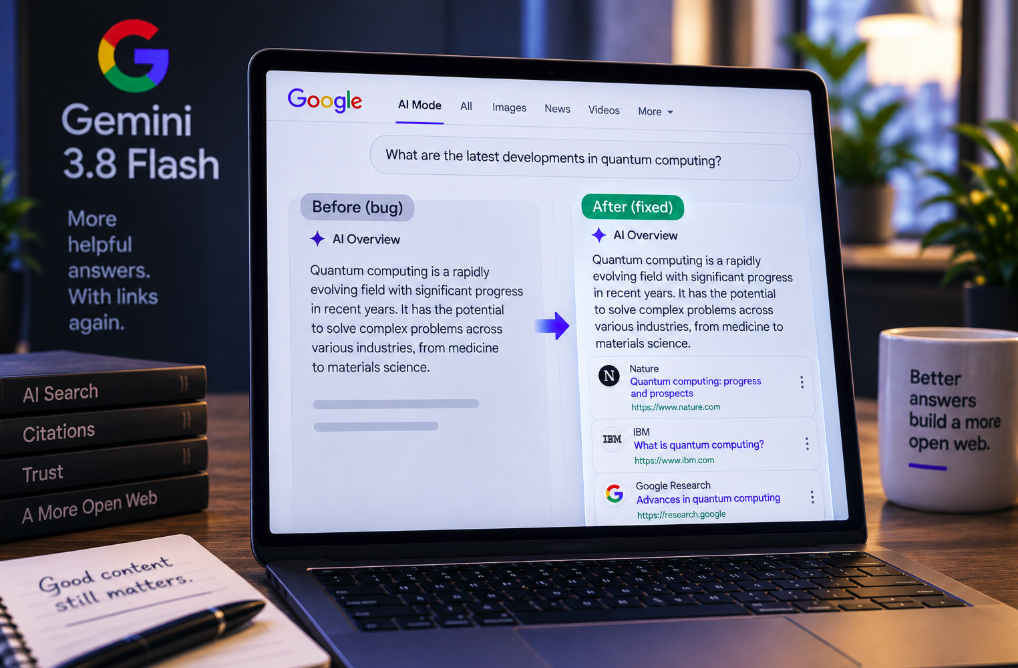
Google has fixed the Gemini 3.8 Flash bug that caused AI Mode to return almost no links or citations, closing a short but consequential episode for publishers watching how Google's newest search model attributes information.
The problem surfaced immediately after Gemini 3.8 Flash began powering AI Mode for subscribers. Early tests shared by Gagan Ghotra and Glenn Gabe showed generated answers with few or no source links even when Google's default AI Mode model returned citations for comparable queries. Barry Schwartz documented the issue in a September 3 Search Engine Roundtable report.
Google confirmed on September 4 that the behavior was unintended. Robby Stein, Google's vice president of product for Search, said the feature was not working as intended and that a fix would roll out soon. Search Engine Roundtable subsequently added a third update: the issue had been resolved, and fresh tests showed links appearing again in Gemini 3.8 Flash responses.
That changes the interpretation of the original story. The disappearance of citations was not evidence that Google had intentionally made Gemini 3.8 Flash less willing to link to the open web. It was a product bug.
The first tests looked like a major citation-policy change
Google's rollout of Gemini 3.8 Flash to AI Mode was notable because Flash models are designed to deliver fast responses while supporting the kinds of reasoning and synthesis users increasingly expect from generative search.
Almost immediately, however, search observers noticed an unusual difference between the new model and the default AI Mode experience. Top-of-funnel informational prompts that would ordinarily generate source links were returning answers without visible citations.
Ghotra shared multiple examples, and Gabe compared the Gemini 3.8 Flash experience directly with the default model. The contrast was strong enough to raise a legitimate question about whether Google's latest model had changed how aggressively AI Mode linked to sources.
For publishers, that possibility mattered more than a normal interface bug. AI search can already satisfy a query without requiring a visit to the underlying website. Removing source links would further weaken the path from generated answer to publisher.
Google said the behavior was not intentional
The uncertainty narrowed when Stein responded publicly to the reports. He said the citation behavior was not working as intended and that Google would deploy a fix.
That statement established an important baseline: Google expected Gemini 3.8 Flash in AI Mode to provide links. The almost link-free answers were not the desired product behavior.
This distinction is critical when interpreting rapid changes in generative search. A model rollout can alter answer length, layout, citation placement and retrieval behavior without every visible change representing a strategic policy decision.
In this case, the strongest early evidence looked like a meaningful shift in attribution. Google's response reframed it as a defect.
The fix is now live
The final update arrived quickly. Schwartz added an Update 3 to the original Search Engine Roundtable article stating that the issue had been resolved the following morning.
Gabe retested Gemini 3.8 Flash and reported that the model was again providing links. His new example showed citations returning to the AI Mode response after the near-absence seen during the initial rollout.
The appropriate conclusion is therefore narrower and more reassuring than the first screenshots suggested: the bug that removed almost all links has been fixed, and source citations are appearing again.
That does not establish that Gemini 3.8 Flash will produce exactly the same number of citations as Google's default model on every query. Citation behavior varies with the question, retrieved evidence and generated response. What has been resolved is the abnormal near-total disappearance that triggered the original reports.
This is the conclusion to the “fix coming” story
The timeline moved unusually quickly. Gemini 3.8 Flash reached Search, users noticed the citation problem, Google acknowledged it, promised a fix and then restored links within roughly a day of the public escalation.
For anyone tracking the story in stages, the sequence matters. The first observation was that Gemini 3.8 Flash appeared dramatically less citation-friendly. The second update was Google's confirmation that the behavior was unintended and a repair was coming. The current update closes that loop: the repair has landed.
That means publishers should not continue using the original no-link screenshots as evidence of Gemini 3.8 Flash's normal citation behavior. They document a rollout bug, not the current state of the product.
The incident still matters for publishers
A quickly repaired bug can still reveal how sensitive publisher visibility has become to small product changes inside AI search.
Traditional search results make the link structurally central. A result is normally a destination. Generative search separates the answer from the source, which means citation design becomes a product decision layered on top of retrieval and generation.
If that layer fails, the user may still receive a complete answer while the source effectively disappears from the interface. The product can continue functioning from the searcher's perspective even while publisher attribution deteriorates dramatically.
That asymmetry explains why the Gemini 3.8 Flash bug attracted immediate attention. The absence of citations did not necessarily make AI Mode unusable. It made the economic and attribution relationship with the open web much weaker.
Citation monitoring needs model-level granularity
The episode also demonstrates why measuring “Google AI Mode citations” as one stable metric is becoming difficult. AI Mode can run different models, and those models can behave differently even inside the same search product.
A site might appear frequently when users are routed through one model and less often under another. A temporary bug can create a sudden citation collapse without any change to the publisher's content, technical SEO or authority.
Monitoring systems therefore need to record more than whether a brand was cited. Where possible, they should also capture the model or mode being tested, the date, the prompt and the structure of the answer.
Otherwise, a product-side defect can look like a publisher-side visibility loss.
One screenshot is useful evidence, not a durable benchmark
The initial reports were valuable precisely because multiple observers could reproduce the missing-link behavior. But the speed of the fix also shows why screenshots from AI search age quickly.
A result captured on Thursday can describe a bug that no longer exists on Friday. A citation study conducted across a model transition can combine two different product states. An apparent visibility trend can be caused by an interface rollout rather than a change in retrieval.
For publishers conducting AI visibility research, timestamps and repeated testing are increasingly essential. The question is not only “what did AI Mode cite?” but “which version of AI Mode produced this answer, and can the behavior still be reproduced?”
That standard is especially important when drawing conclusions about Google's willingness to send traffic to publishers.
The fix does not settle the broader citation debate
Restoring links in Gemini 3.8 Flash resolves this specific defect. It does not resolve the larger debate over how often AI search should cite sources, how visible those citations should be or how much traffic they generate.
A response can contain citations and still produce fewer external clicks than a traditional list of search results. Links can appear below generated text, inside expandable source panels or in inline placements that users engage with differently.
Publishers therefore need to distinguish citation presence from referral value. The first is a prerequisite for attribution and discoverability; the second determines whether that attribution turns into measurable traffic.
The Gemini bug temporarily damaged the first layer. Google's fix restores it, but it does not guarantee the economics of the second.
Google's response is itself a useful signal
Stein's acknowledgement is notable because it establishes that source links remain part of Google's intended AI Mode experience. When observers reported that Gemini 3.8 Flash had almost stopped citing, Google did not defend the behavior as a new design direction.
Instead, it classified the outcome as incorrect and repaired it.
For the open-web ecosystem, that is a meaningful distinction. It does not promise a particular click-through rate or citation density, but it indicates that a version of AI Mode that broadly stops providing links is not, at least in this case, the target state Google wanted.
Future changes will still need to be evaluated independently. The fact that this incident was a bug does not mean every future reduction in links will also be accidental.
The current state: links are back
The final status of the Gemini 3.8 Flash citation story is now straightforward. The model rolled into AI Mode, early users found that answers were returning almost no citations, Google said the behavior was unintended, and a fix followed.
Fresh tests reported by Gabe show source links appearing again. Search Engine Roundtable has updated its original article accordingly.
Publishers should therefore update their own interpretation as well. Gemini 3.8 Flash's missing citations were a temporary rollout failure, not evidence of a confirmed strategy to remove attribution from AI Mode.
The broader challenge remains unchanged: AI search is a fast-moving product where models, retrieval systems and interfaces can change publisher visibility overnight. This time, the disappearance was a bug — and Google put the links back.