
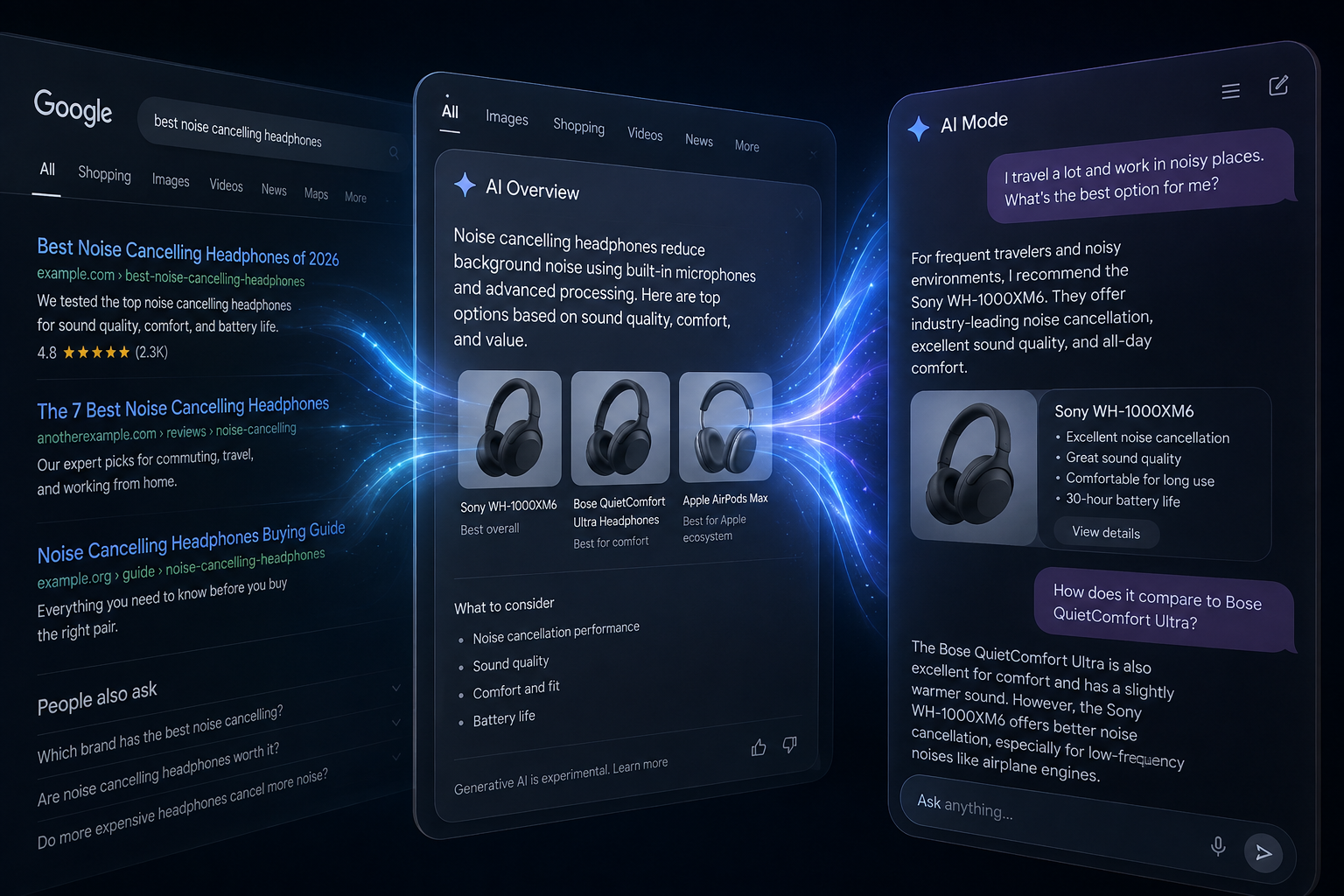
Google’s latest Search experiment looks, at first glance, like a small interface change. For some queries, the company is now testing AI Overviews that expand automatically at the top of the results page, removing the familiar “Show more” step and placing a fuller AI-generated answer in front of the user before the standard list of links appears. But the more important story is not simply that organic results move farther down the screen. It is that Google is making the path from search query to AI answer to AI conversation feel increasingly seamless.
The test was documented by Search Engine Roundtable and later confirmed directly by Google in a statement to The Verge. Instead of showing a shorter AI Overview with a button to expand it, Google may now load a more complete answer by default. Beneath that answer, users can see an “Ask anything” box, a prompt that resembles the conversational entry point of AI Mode more than the old search-results page. Google spokesperson Jennifer Kutz told The Verge that, for some queries, AI Overviews may dynamically expand when Google’s systems determine the experience will be useful, and that the expansion is cancelled if the user has already started scrolling so their reading position is not disrupted.
That last detail matters because it reveals the direction of travel. Google is not only testing how much AI content can fit above the fold; it is testing how much of the search journey can be absorbed into an AI-native flow. Traditional search was built around retrieval: a user asked a question, Google ranked documents, and the user chose where to go next. AI Overviews changed that bargain by putting a synthesized answer above the documents. Auto-expanded AI Overviews go further by making the answer feel less like a preview and more like the default destination.
The presence of the follow-up box is the real strategic signal. In the older model, the next user action was usually a click. In the emerging model, the next action may be another prompt. The search results page becomes less of a directory and more of a conversation launcher, with web links serving as supporting material rather than the main interface. This is why the distinction between AI Overviews and AI Mode is beginning to blur. AI Mode may still be a separate product surface, but its logic is increasingly visible inside ordinary Search.
For publishers, retailers, software companies and service brands, this shift changes the meaning of visibility. Ranking well remains valuable, but ranking is no longer the only front door to attention. If a user receives a complete AI answer and continues the session inside the AI interface, the decisive question becomes whether a brand, page, product or expert source is cited, summarized, recommended or otherwise selected by the system. The page that ranks third in traditional results may still matter, but the source that shapes the AI response may matter more in the moment when the user forms an opinion.
This creates a more difficult optimization problem than classic SEO. Search visibility has long depended on crawlability, relevance, authority, technical quality and user satisfaction signals. AI search adds another layer: content must be easy for systems to understand, compare, attribute and reuse responsibly. A page that is technically indexed but poorly structured may be present in Google’s web index while still failing to become part of the answer that a user actually reads. Conversely, a clear explanation, original data point, expert comparison or well-supported buying guide may gain influence if the AI system treats it as a useful source for synthesis.
The commercial implications are especially strong for query types where users expect recommendations, comparisons or decision support. A blue-link ranking for “best project management software” or “how to choose a heat pump” used to be the main prize. In an AI-led search experience, the prize may become inclusion in the short list, quotation as a source, or selection as the example the assistant carries into follow-up questions. The user may never restart the search; they may simply refine the same AI conversation until they are ready to act.
Google presents the change as a way to make Search more helpful and to encourage deeper follow-up exploration. That framing is consistent with the company’s broader push to integrate generative AI into its search products, but it also raises a hard question for the open web. If more answers are completed inside Google’s interface, the incentive structure for creating original content becomes more fragile. The websites that inform the answer still bear the cost of research, testing, reporting and expertise, while the interface increasingly captures the user’s attention before a click occurs.
The response from SEO professionals should not be panic, but it should be a reset. Measuring only ranking positions and click-through rates will give an incomplete picture of performance in AI-shaped search. Brands will need to monitor where and how they appear in AI Overviews, whether competitors are being named more often, whether their content is cited for high-intent questions, and whether their pages provide the kind of structured, trustworthy evidence that an AI system can confidently surface. The new battleground is not just the results page; it is the answer layer.
Google has not said how broadly this auto-expansion test will roll out, and the behavior appears inconsistent across queries and browsers. That uncertainty is itself part of the challenge. Search is no longer a fixed layout that marketers can easily model. It is becoming a dynamic interface where the form of the answer can change according to the query, the user’s behavior and Google’s own confidence that an AI-led experience will be useful.
The removal of “Show more” is therefore more than a button disappearing. It is a small product decision that points to a larger strategic redesign: Google Search is being pulled toward AI Mode one query at a time. The winners in that environment will not be the sites that treat AI Overviews as a temporary obstruction above the organic results. They will be the sources that understand that selection, citation and trust inside the AI answer are becoming as important as the ranking itself.