
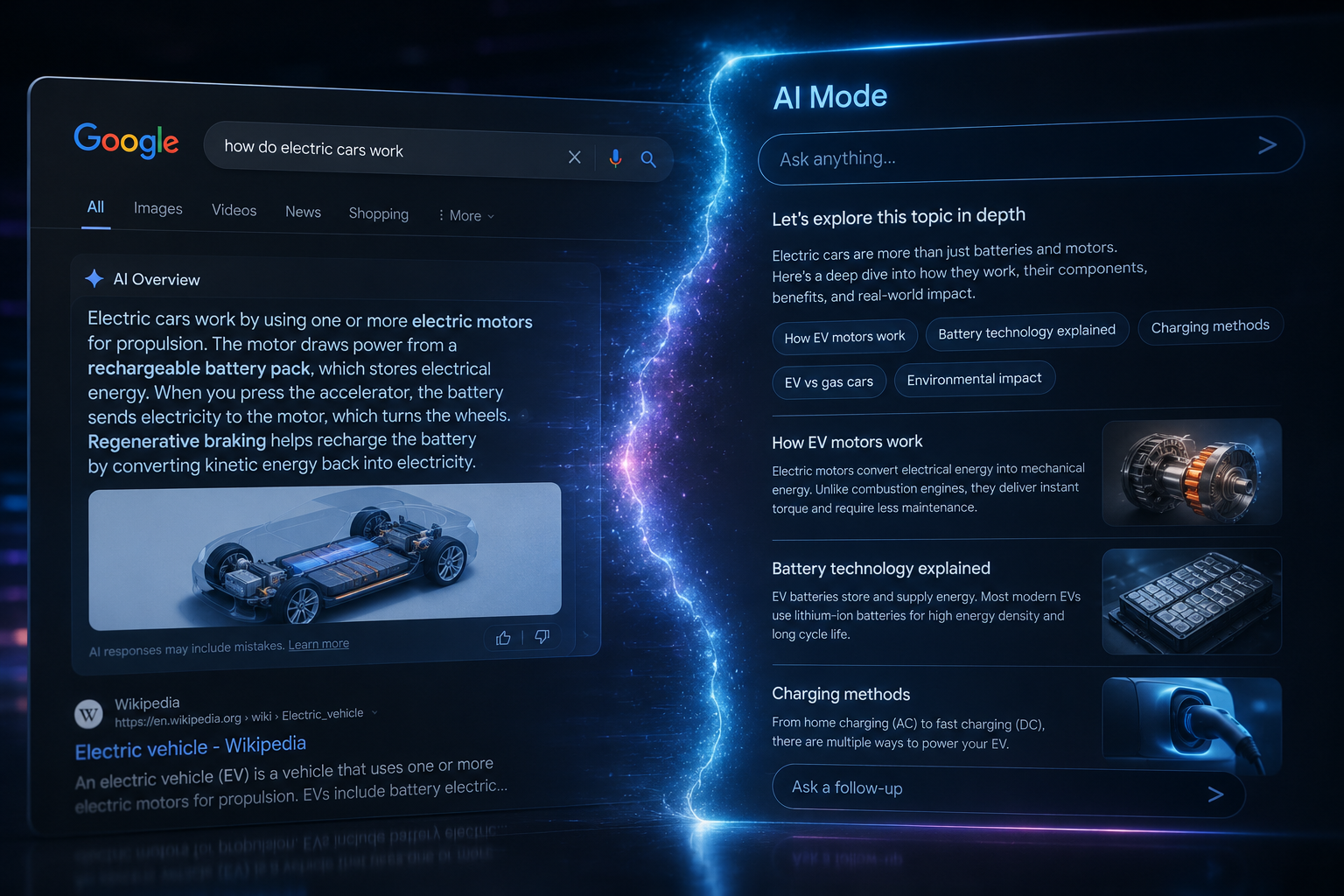
Google’s AI search interface is no longer behaving like a layer placed on top of classic search. It is beginning to look like the default path through which many searches will be answered, expanded and continued. The latest sign is subtle but important: AI Overviews are reportedly auto-expanding for some queries, turning what used to be a compact summary with a “Show more” control into a fuller answer block that can push the familiar list of links further down the page.
That change matters because it narrows the practical difference between AI Overviews, Google’s AI-generated snapshots inside standard search results, and AI Mode, the more conversational search experience built for follow-up questions, deeper reasoning and broader query exploration. Google still describes them as distinct products, but the user experience is moving in one direction: search results are becoming less like a ranked directory and more like an AI-mediated answer session.
The AI Overview Is Becoming the Entry Point, Not the Add-On
The reported interface change, first spotted by the search industry and covered by The Verge, shows Google automatically expanding AI-generated summaries for some searches. Instead of leaving users to click “Show more,” the page may open with a fuller AI answer, an “Ask anything” prompt beneath it, and only then the traditional web results. Google told The Verge that the dynamic expansion appears for topics where its systems determine the experience is useful, and that it is designed not to interrupt users who have already begun scrolling.
On paper, this may sound like a minor interface experiment. In practice, it is another step toward collapsing the distance between a search engine results page and an AI assistant. The old model presented ranked links and asked the user to choose. The new model increasingly synthesizes, frames and extends the query before the user reaches the open web. That does not mean links disappear, but it does mean their position, context and value are being redefined.
Why “Ranking First” Is No Longer the Whole Game
For publishers, brands and SEO teams, the strategic implication is clear: ranking still matters, but ranking alone is no longer enough. In the classic search model, the goal was to appear as high as possible in the visible list of organic results. In the AI search model, visibility depends on whether content is selected, summarized, cited, linked, previewed or bypassed by an AI-generated layer that may satisfy the query before a user clicks anything.
Google’s own explanation of AI Mode makes this shift explicit. The company says AI Mode can divide a question into subtopics and search for each one simultaneously, a technique it calls query fan-out, before assembling an AI-powered response with links for further exploration. In other words, the competition is no longer only for one keyword position on one results page. It is also for inclusion in the passages, entities, explanations and source clusters that Google’s AI systems decide are useful enough to ground an answer.
Google has also been updating how links appear inside its AI search features. In a May 2026 post, the company said it was adding ways for users to find relevant websites, original content, perspectives and subscription sources from inside AI Mode and AI Overviews. That framing is important: Google is not presenting links as the page itself, but as supporting routes inside a broader AI-generated experience. For publishers, the question becomes not just “Where do we rank?” but “When Google answers, are we part of the answer?”
The Publisher Problem Is Getting Harder to Ignore
The traffic implications are no longer theoretical. Recent research on AI search has found signs that generative results can reduce publisher referrals, while another large-scale measurement study of AI Overviews reported that Google’s AI-cited sources do not always mirror the traditional first page of results. Those findings point to a difficult reality for the web economy: a site may create the content that helps answer a query and still receive fewer visits when the answer is consumed directly inside Google’s interface.
Regulators are paying attention. Reuters reported that European Union antitrust regulators have been asking publishers for feedback on Google’s proposal to let them opt out of AI search features without affecting ordinary search rankings. Google has also introduced a Search generative AI control in Search Console, allowing site owners to decide whether their links and content can appear in AI Overviews, AI Mode and other generative AI features in Search. Crucially, Google says excluding a site from those generative features is not used as a ranking or inclusion signal for other parts of Search.
That control may ease one concern, but it does not resolve the underlying tension. Opting out may protect content from AI summaries, but it also removes the site from a growing surface where users may increasingly spend their attention. Staying in may preserve the chance of being cited or linked, but it also risks contributing to an answer that reduces the need for a click. This is the new bargain of AI search, and it is much more complicated than the old trade-off between crawlability and ranking.
SEO Has to Move From Positions to Presence
The practical response is not to abandon SEO, but to broaden it. Technical accessibility, structured information, clear authorship, original reporting, first-hand expertise and topic-level authority all become more important when AI systems synthesize answers from multiple signals. Pages built only to capture a keyword may struggle in a search environment that breaks questions into subtopics and assembles answers from fragments of relevant evidence.
This also changes how performance should be measured. A top organic position may no longer guarantee attention if an expanded AI Overview occupies the opening screen. At the same time, a page that is not ranked first may still gain influence if it becomes a cited or surfaced source in AI-generated results. Search visibility is becoming less linear, and analytics teams will need to watch impressions, citations, AI search referrals, zero-click patterns and brand recall alongside classic rankings.
Google’s direction is understandable from a product perspective. Users often want faster answers, simpler comparisons and the ability to keep asking follow-up questions without restarting the search process. But for the open web, the risk is that discovery becomes increasingly mediated by a small number of AI interfaces. If Google is both the doorway and the explainer, the economics of creating the information behind those explanations become harder to sustain.
The Boundary Is Fading
The auto-expanding AI Overview is not just a design tweak. It is a signal that the standard results page is absorbing behaviors that once belonged to AI Mode: fuller answers, conversational prompts and guided exploration. The labels may remain separate for now, but the user journey is converging.
For anyone relying on search traffic, the lesson is blunt. The future of Google visibility will not be won only by ranking above competitors in a list of blue links. It will be won by becoming useful, trusted and machine-readable enough to be selected inside the answer layer itself. In the age of AI Overviews and AI Mode, ranking is still a foundation, but presence inside the generated experience is becoming the new front page.