
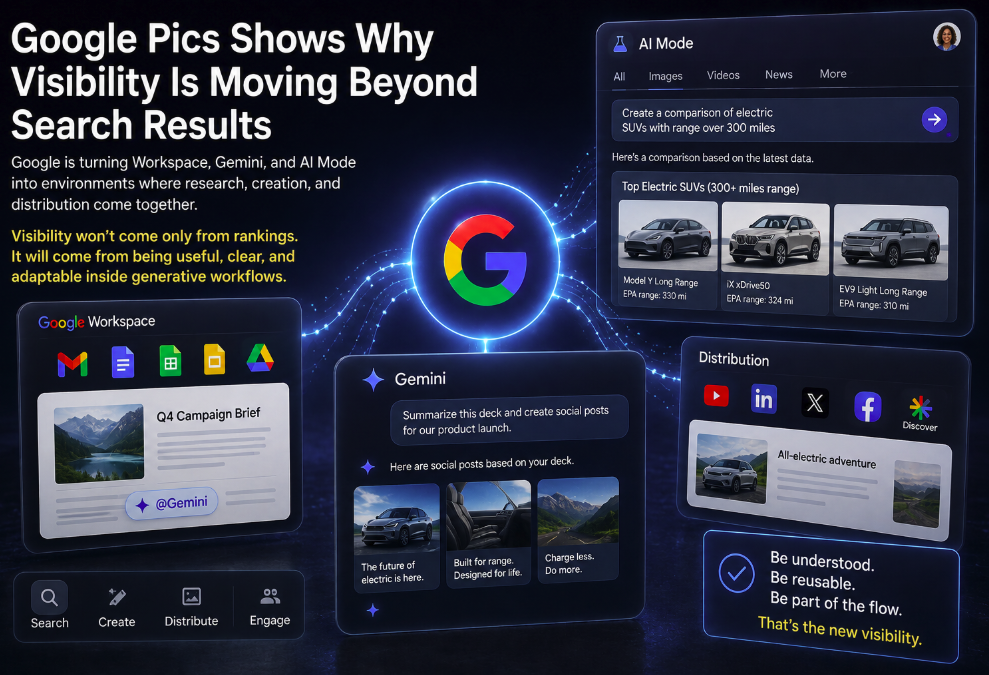
Google Pics looks, at first glance, like a new AI design tool. Launched on September 1, it lets users generate images, isolate and transform objects, edit or translate text inside visuals, collaborate on designs and create multiple variations from a prompt. But the more important story for publishers and brands is not another image generator. It is where Google is putting it.
According to Google's official launch announcement, Pics is both a standalone product and an integrated part of Google Workspace. The integration starts with Docs and Slides, with Drive following in the coming weeks. Google's stated goal is explicit: users should be able to create and edit images where they are already working, without copying, pasting or switching between applications.
That product philosophy points toward a broader change in digital visibility. Search, research, creation and distribution are becoming less separate. As Gemini spreads across Google's products and generative interfaces increasingly act on information rather than merely returning links to it, brands and publishers may need to think beyond whether a page ranks. The next visibility question is whether their information and assets are understandable, trustworthy and adaptable enough to become useful inside an AI-mediated workflow.
Google Pics is not just another image generator
Google first introduced Pics at I/O in May as an AI-powered image creation and editing application built on its Nano Banana models. The September launch expands access to Google AI Pro and Ultra subscribers and most Workspace business customers, with availability rolling out over the coming weeks.
The feature set is deliberately workflow-oriented. Pics can isolate individual objects and modify them without rebuilding the entire image. Users can change or translate text directly inside an existing design, generate multiple options from one prompt, collaborate with colleagues and move assets through familiar Workspace environments. Google says millions of users interact with billions of images across Workspace products every month, making integration more important than treating image generation as a destination of its own.
That is the strategic signal. AI creation is moving closer to the documents, presentations, files and conversations where people already make decisions and produce content.
Google is collapsing search and action into the same environment
Pics is only one piece of a larger pattern. Google has been embedding Gemini throughout Workspace, while AI Mode changes the Search experience from a list of results into an environment where users can ask follow-up questions and complete more of the research process conversationally. Meanwhile, Workspace itself is becoming increasingly agentic.
Google's August Workspace updates provide a useful example. The company introduced Ask Gemini in Chat as a unified interface that can search across Gmail, Drive and Calendar, generate content, summarize discussions, manage tasks and help users take action without leaving the conversation. In other words, the same AI layer can move from finding information to transforming it and then acting on it.
Pics extends that logic to visual assets. A user can work on a document or presentation and manipulate imagery with generative AI inside the same productivity ecosystem. The boundaries between retrieval, creation and distribution become thinner.
For SEO, that matters because the traditional model assumes a relatively clean handoff: a user searches, sees a result, clicks a website and then consumes or uses the information there. Generative workflows can interrupt that sequence. The system may retrieve information, synthesize it, transform it into another format and help the user produce an output before a conventional website visit ever occurs.
The new visibility question is not only “Did we rank?”
This does not mean rankings stop mattering. Search remains a major discovery mechanism, and Google's AI systems still depend on accessible, useful information from the web. But ranking is increasingly one stage in a longer machine-mediated process.
Imagine a marketer researching a market inside an AI interface. The system finds information from multiple sources, summarizes the competitive landscape, helps draft a campaign brief in Docs, generates presentation material and then creates or edits supporting visuals. The user may experience that as one continuous task even though the underlying system has moved through multiple information and creation layers.
In that environment, visibility can take several forms. A publisher might be visibly cited in the research stage. A brand might be recommended as an entity. A product specification might be extracted and incorporated into a comparison. A visual asset might become useful input for a creative task. Some of those events produce a visible link; others may influence the workflow without resembling a conventional search result.
This is why measuring AI visibility exclusively as “rank in ChatGPT” or “citation count” risks becoming too narrow. The larger competition is for inclusion in the information and asset layer that generative systems can use.
Content may need to become more reusable by machines
Google has not announced that Pics automatically searches publisher websites for assets or that images optimized in a particular way will receive preferential treatment. There is no basis for turning this launch into a new Google ranking-factor checklist.
The strategic implication is broader. As AI tools become capable of transforming content directly inside workflows, machine usability becomes more valuable. Information that is clearly structured, entities that are unambiguous, product details that are consistent, images that have understandable context and assets that can survive adaptation across formats are better suited to an environment where AI systems continually retrieve and repurpose information.
For publishers, this reinforces a principle already emerging from GEO experiments: create content that can be decomposed without losing meaning. A strong article should contain clear factual units, identifiable entities, useful explanations and sourceable claims. A strong visual asset should have meaningful surrounding context and a clear relationship to the subject it represents. A brand should be described consistently enough across its own properties and external sources that AI systems can identify what it is and when it is relevant.
These are not replacements for SEO fundamentals. They are an extension of them into a world where the consumer of content may initially be an AI system acting on behalf of a human.
From “clickable” content to “workflow-ready” content
The web has historically rewarded content that attracts a click. Search snippets, headlines, metadata and ranking improvements all serve, in part, to win that transition from a results page to a publisher's property.
Generative interfaces create another possibility: content can be valuable because it is usable before the click. A well-defined statistic can support an AI answer. A clear product comparison can inform a recommendation. A structured explanation can become part of a research summary. A visual concept can potentially be adapted into a presentation or campaign workflow where the relevant tools permit it.
That changes the optimization target. “Clickable” remains important because publishers still need audiences and traffic. But “workflow-ready” may become an additional property worth engineering for: information and assets designed so their meaning remains intact when an AI system retrieves, summarizes, reformats or combines them with other material.
This creates a new measurement problem for GEO
The difficulty is that conventional analytics can barely see these interactions. Search Console can measure impressions and clicks on Google's search surfaces, and emerging AI visibility reports can expose parts of generative search. But if a source contributes information to a workflow that continues inside an AI environment, the publisher may have little or no visibility into what happened next.
This suggests a useful expansion for AI visibility dashboards. Instead of tracking only mentions and citations, we should eventually distinguish at least three layers: discovery, selection and reuse. Discovery asks whether an AI system can find the content. Selection asks whether the source or entity is chosen for an answer or recommendation. Reuse asks whether the information or asset can meaningfully participate in a downstream generative task.
The third category is currently the hardest to measure, and in many systems it may remain opaque. But Google Pics helps make the direction visible: the output of one information task increasingly becomes the input of the next creative task.
A NetContentSEO experiment: test for adaptability, not just citation
This also gives us a new experimental direction. We can create equivalent pieces of information in different formats and test how reliably AI systems can transform them while preserving meaning. For example, the same product dataset could be published as dense prose, a structured comparison, a clearly labeled table and a page with strong entity markup and contextual images.
We can then ask AI systems to retrieve the information and perform downstream tasks: summarize it, compare products, produce a campaign brief, generate social copy or create instructions for a visual asset. The metric would not simply be whether the page receives a citation. We would measure whether the correct information survives the transformation, whether the source remains attributable and which content structure is most consistently selected.
A similar experiment could be run with images and surrounding text. If two equivalent visual assets have different levels of contextual clarity, filenames, captions, structured metadata and page-level explanation, does one become easier for multimodal systems to understand and describe accurately? That would move GEO testing from pure answer visibility toward content portability.
Google Pics is a clue about where visibility is going
Google Pics does not replace Search, and it is not itself evidence of a new ranking system for publisher content. Its importance is architectural. Google is making generative creation native to the same ecosystem where billions of users already search for information, write documents, build presentations, store files and collaborate.
As those environments connect more tightly through Gemini, the distinction between discovering content and doing something with content becomes less obvious. The user may not think in terms of Search, Workspace and AI as separate products. They may simply ask Google to help complete a task.
That is why visibility is moving beyond search results. The brands and publishers that succeed in generative environments may not be only those that rank highest. They may also be those whose entities are easiest to recognize, whose information is easiest to extract accurately and whose content can move cleanly from discovery into creation.
The old visibility objective was straightforward: be found. The emerging one is more demanding: be understood, be reusable and be useful inside the flow.