
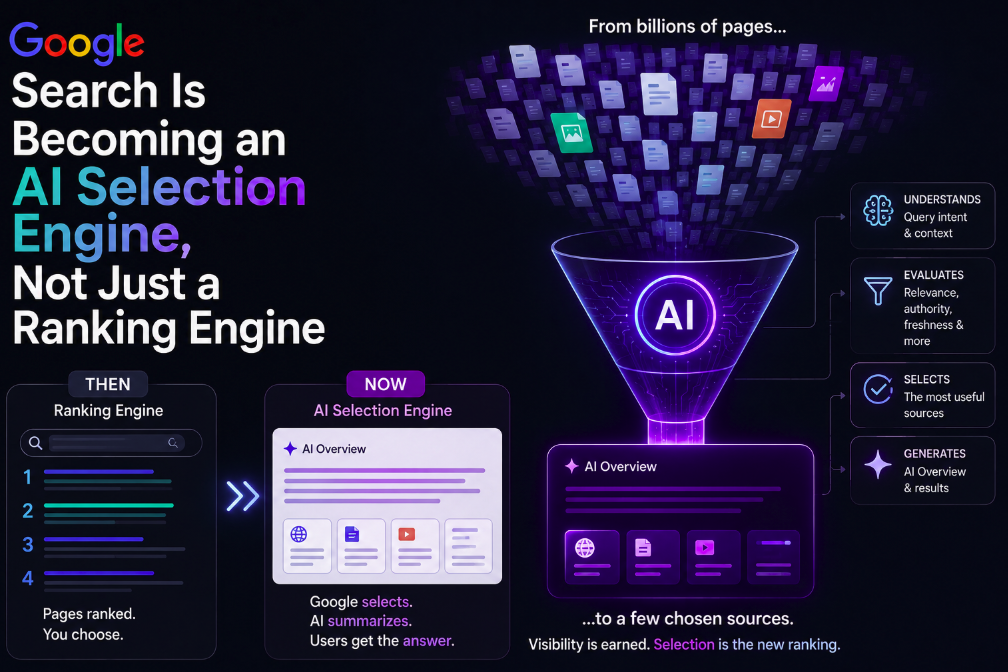
For most of its history, Google Search could be understood through a relatively simple abstraction: a user submits a query, Google retrieves relevant documents, ranks them and presents a list from which the user chooses. The reality was always more complicated, but the visible competition was clear. Pages fought for positions.
AI Mode and AI Overviews are changing that interface and, more importantly, the decision process behind it. Google can now decompose a user's request into multiple searches, retrieve information across subtopics and data sources, identify supporting pages, synthesize an answer and decide which links deserve to be exposed alongside that answer. The user is no longer the only party selecting among ranked documents. Google itself increasingly performs a selection step on the user's behalf.
That is why it is becoming useful to think of Google Search as an AI selection engine, not only a ranking engine. Rankings still matter. Traditional Search is not disappearing. But in generative Search, visibility depends on surviving a longer pipeline: being discovered, being judged useful for a particular sub-question, being selected as supporting evidence and then being surfaced in the generated experience.
AI Mode does not perform just one search
The architectural shift is visible in Google's own documentation. Google's AI Mode help documentation explains that the system divides a question into subtopics and searches for each one simultaneously. Google calls this query fan-out.
Google described the mechanism in more detail when it introduced AI Mode, saying the system can issue a multitude of searches concurrently across subtopics. In its AI Mode update, Google said this allows Search to go deeper into the web than a traditional Google search and find hyper-relevant content matching different parts of the user's request.
This changes the unit of competition. A publisher is no longer necessarily competing against ten blue links for one literal query. Its page may be competing to answer one hidden sub-question generated by the model as part of a much broader task.
A user might ask for the best laptop for travel, video editing and long battery life under a particular budget. AI Mode can turn that into separate retrieval problems around battery tests, weight, performance, pricing, product availability and perhaps expert recommendations. The final response is assembled from that larger information search.
For SEO, the important point is that publishers do not directly observe most of those intermediate searches.
Google now selects supporting pages while generating the answer
Google's Search Central documentation makes the selection layer unusually explicit. Its guidance for AI features and websites says AI Overviews and AI Mode may issue multiple related searches across subtopics and data sources and that, while responses are being generated, Google's models identify additional supporting web pages.
This is more than a semantic change from ranking. In a classic result page, the primary output is the ranked set itself. In an AI response, the primary output is an answer, comparison, recommendation or explanation. Links become supporting components inside that output.
Google has also said it is continuing to improve how it shows and ranks links inside generative AI Search. That wording is useful because it shows that ranking has not vanished. Instead, ranking is now nested inside a broader generative process.
The model searches. Retrieval systems return candidates. Google evaluates and organizes information. The generated response takes shape. A subset of sources becomes visible.
The SEO question therefore moves from only “Where did my page rank?” to “At which stage did my page stop being selected?”
A page can rank without becoming part of the answer
This creates a distinction that conventional rank tracking is poorly equipped to measure. A page can be highly relevant to a topic and perform well in traditional Search without necessarily appearing as a supporting source in a generative response. Conversely, AI query fan-out can uncover a specialized page that would never have ranked for the user's original broad wording but is highly relevant to one of the model-generated subqueries.
Google itself frames fan-out as a way to discover a broader and more diverse set of useful links than a classic search might expose. That means AI Search can create new visibility opportunities while simultaneously making them harder to predict from a single keyword position.
This is one reason the old habit of testing AI visibility by typing a target keyword into Google and comparing the cited domains with the top ten organic results is insufficient. The AI system may have reached those sources through queries the user never typed.
The hidden variable is the retrieval path
Consider two publishers with equally strong pages about the same subject. Publisher A ranks higher for the obvious head term. Publisher B has clearer sections answering several narrower questions related to the topic.
In traditional Search, Publisher A may have the advantage because its document wins the main query. In AI Mode, the model might fan the request into six or twelve searches. Publisher B could be retrieved repeatedly for specific subtopics and become a more useful source for constructing the final answer.
That does not mean headings or question-based content mechanically cause AI citations. Google has not published such a rule. It means the retrieval environment rewards usefulness across a network of possible intents rather than only performance for one visible keyword.
The strategic object is therefore expanding from the keyword to the query neighborhood: the cluster of questions, entities, comparisons, constraints and follow-up intents an AI system may generate around a user's task.
Search Console confirms that generative visibility is becoming its own measurable layer
Google's product changes are also making this conceptual distinction visible in analytics. In June, Google introduced dedicated generative AI performance reports in Search Console for Search and Discover. Google updated the announcement on August 31 to say the insights had rolled out to websites worldwide.
The reports expose impressions in generative Search experiences such as AI Overviews and AI Mode. That matters because Google is effectively acknowledging that appearing inside generative Search is a distinct visibility event worth measuring separately from the conventional performance view.
Google also rolled out a worldwide Search generative AI control that allows website owners to choose whether their links and content can appear in Search generative AI features and help ground AI responses.
The language is revealing. A publisher's content can do at least two related things: appear as a link and help ground an AI response. That is a richer relationship than occupying position four on a results page.
Ranking and selection are different optimization problems
A ranking engine primarily asks which documents deserve the highest positions for a query. A selection engine has an additional task: which pieces of evidence should be used to construct the output?
Those objectives overlap, but they are not identical. A page may be authoritative and relevant yet add little unique evidence to an answer already supported by other sources. Another page may contain a specific statistic, first-hand test, original quote or precise explanation that makes it particularly useful for one part of the generated response.
This suggests that generative visibility may reward what we could call selection value: the reason an AI system should choose this source rather than another plausible source when building an answer.
Selection value can come from originality, specificity, freshness, first-hand evidence, clear entity relationships, unique data or unusually strong explanatory utility. None of these should be treated as a confirmed AI ranking-factor checklist. They are properties that make a source more useful when an answer must be assembled from evidence.
Preferred Sources makes selection even more explicit
Google has also started giving users more influence over which publishers enter this process. In May 2026, Google announced that Preferred Sources would expand into AI Overviews and AI Mode, allowing users to identify websites and creators they want to see more prominently in AI-generated Search experiences.
This introduces another layer that traditional rank tracking cannot fully describe. Source selection can depend not only on general relevance and Google's systems, but also on user preference and personalization.
The same underlying query may therefore produce different source opportunities depending on the user, context and AI workflow. Visibility becomes probabilistic rather than a fixed coordinate.
The result page is becoming an answer assembly process
The most consequential change is that Google increasingly performs work that previously belonged to the searcher. A user once opened several results, extracted information, compared claims and synthesized a conclusion. AI Mode can perform much of that process before the click.
Google's current AI Mode product page explicitly positions the experience around research, comparisons, recommendations, follow-up questions, multimodal input and interactive outputs. Search is no longer merely directing users toward documents. It is organizing information into a usable response.
That makes source inclusion more valuable in one sense and potentially less valuable in another. Being selected can place a publisher's information directly inside the answer. But if the answer satisfies the user, selection does not necessarily produce a visit.
This is why AI visibility and traffic must be measured separately. A publisher can gain influence inside the answer while losing the click that historically made that influence economically visible.
SEO needs a selection funnel
A useful model for generative Search is a four-stage funnel: eligible → retrieved → selected → visited.
Eligibility asks whether Google can access and use the content in its generative Search features. Retrieval asks whether the page appears among the candidates surfaced by the original query or fan-out searches. Selection asks whether the page becomes supporting evidence or a visible link in the generated answer. Visited asks whether the user ultimately clicks through.
Traditional SEO tooling is strongest at the first and last edges of that system. We can inspect crawlability and indexing, and we can measure many visits. The middle — retrieval and selection — remains much more opaque.
Google's new AI impression reporting begins to illuminate selection, but it still does not expose the complete fan-out path that led to the appearance. That missing layer is where much of the next generation of GEO research should focus.
A NetContentSEO experiment: selection rate versus organic rank
We can test the difference between ranking and selection directly. Start with a controlled set of informational and commercial queries. Record the top traditional organic results, then run the same tasks repeatedly through AI Mode and capture every visible source used in the response.
For each domain and page, calculate a selection rate: how often the source appears in the AI response across repeated runs. Then compare that rate with its traditional organic position.
The most interesting cases will be the outliers. Which pages rank first but are rarely selected? Which pages rank outside the top ten yet appear repeatedly in AI answers? What characteristics distinguish those two groups?
A second phase could map likely fan-out queries around each task and test whether the AI-selected pages rank more strongly for those narrower subqueries than for the user's original prompt. If they do, we would have direct evidence that measuring only the visible head query systematically misses the retrieval path responsible for AI visibility.
This would give us a more useful metric than “AI rank.” It would measure the probability of being chosen.
Selection may become the new scarce resource
There can be ten organic results on the first page and hundreds more within easy reach. A generated answer has far less room. Even when Google exposes multiple links, the system still has to decide which sources deserve to be attached to particular claims, recommendations or sections of the response.
As AI Search grows, that selection step becomes a scarce distribution layer. The competition is no longer only to outrank another URL. It is to become one of the sources the system considers useful enough to carry into the answer.
This does not make classic SEO obsolete. Google still needs crawling, indexing, relevance, quality and a healthy web ecosystem to power its AI experiences. The better interpretation is that SEO is acquiring another layer on top of ranking.
For twenty years, the central question was: Can Google rank us?
In AI Search, the more revealing question may be: When Google has thousands of possible sources and is building the answer itself, why would it select us?