
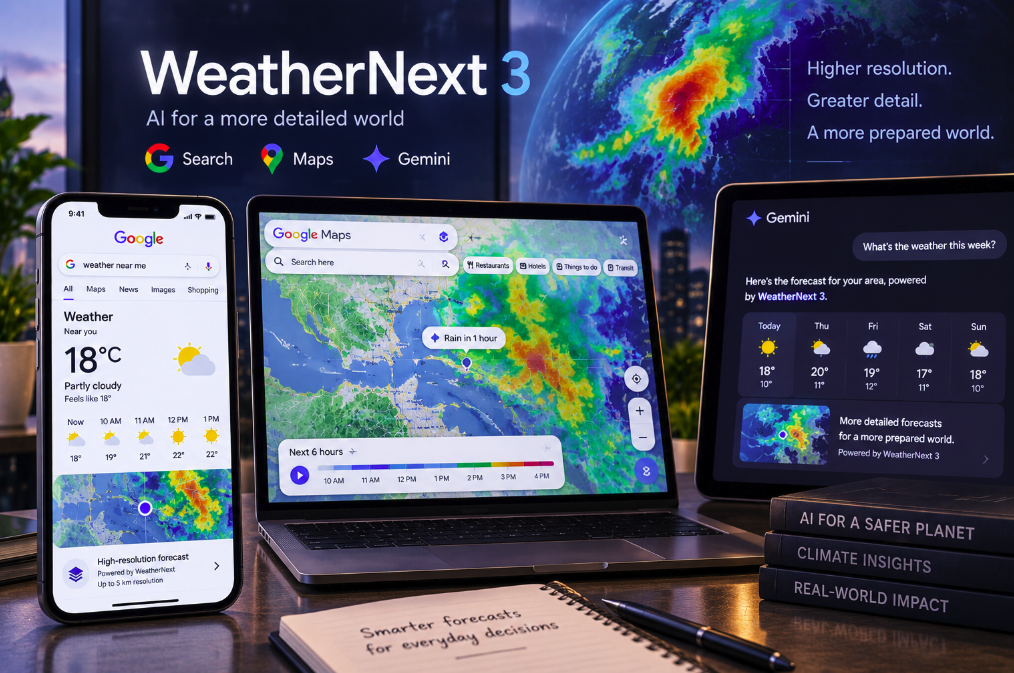
Checking the weather in Google Search is becoming an AI inference task at much higher resolution. Google DeepMind and Google Research have introduced WeatherNext 3, a new global forecasting model that generates fresh predictions every hour, resolves some surface conditions at up to five-kilometer resolution and is beginning to power weather experiences across Google Search, Maps and the Gemini app.
The September 3 announcement from Google describes WeatherNext 3 as the company’s most advanced and accurate global AI weather model to date, citing independent live evaluations by Brightband. The upgrade is significant not only because the underlying model is more detailed, but because Google is moving it directly into consumer products used at enormous scale. Weather AI is no longer just a research demonstration; it is becoming part of the answer people receive when they search for tomorrow’s forecast or ask Gemini whether they need an umbrella.
WeatherNext 3 moves from six-hour blocks to hourly forecasts
The clearest improvement is temporal and spatial resolution. WeatherNext 2 produced forecasts on a 25-kilometer grid at six-hour increments. WeatherNext 3 can generate a new forecast every hour and supports multiple spatial resolutions depending on the variable being predicted.
Google says key surface variables such as temperature and moisture can be represented at five-kilometer resolution, while other surface variables operate at 10 kilometers and atmospheric variables such as wind speed at 25 kilometers. Taken together, the company describes the global weather picture as roughly five times sharper than WeatherNext 2.
That extra detail matters because weather is intensely local. Coastlines, mountains, valleys and urban geography can produce meaningful differences over relatively short distances. A 25-kilometer grid inevitably smooths over some of those variations. Moving key variables to a five-kilometer grid gives the model a better opportunity to represent local topography and surface conditions instead of treating a broad region as meteorologically uniform.
The model learns from live satellite observations
Resolution is only part of the change. WeatherNext 3 also changes the information entering the forecasting system. Google says most AI weather models, including WeatherNext 2, have relied heavily on data derived from numerical weather prediction systems. Those physics-based systems remain fundamental to meteorology, but the analysis data used for AI training and initialization can introduce latency for variables that change rapidly.
WeatherNext 3 ingests hourly mosaics from geostationary satellites alongside historical analysis, giving the model a continuously refreshed view of atmospheric conditions. Google says the approach allows every new forecast to be grounded in recent satellite observations rather than waiting for a slower update cycle.
This is particularly important for precipitation, temperature and rapidly developing weather systems. A forecast generated from observations several hours old can miss changes that occurred after the previous analysis. Hourly updates cannot eliminate atmospheric uncertainty, but they shorten the distance between what the model has observed and what is happening outside.
Rain and snow are a major focus of the upgrade
Precipitation remains one of the hardest variables for global weather models to predict. Rain and snow depend on cloud processes that develop at scales difficult to capture in coarse global simulations, and forecasts can become spatially blurred around storm boundaries.
Google says WeatherNext 3 was trained using NASA’s Integrated Multi-satellite Retrievals for GPM, or IMERG, alongside Google’s own satellite-radar-based global precipitation reanalysis. In medium-range evaluations, the company reports improvements in Continuous Ranked Probability Score of up to 60% against IMERG, 30% against MRMS and 10% against rain-gauge measurements at early lead times.
Those percentages describe specific evaluation settings rather than a universal promise that every rain forecast will improve by the same amount. More relevant to ordinary Google users is the company’s product-level claim: for forecasts one or more days ahead, Google says people can see precipitation predictions that are up to 50% more accurate, with the largest gains in regions where forecasting has historically been less reliable.
Google Search becomes a distribution layer for AI weather science
The most consequential part of WeatherNext 3 may be where it is going. Google says the model begins powering weather experiences in Google Search, the Gemini app and Google Maps from September 3, alongside Google Maps Platform’s Weather API and Google Earth Engine.
That turns a research advance into a consumer-facing search feature almost immediately. Someone searching Google for the weather is unlikely to think about mesh transformers, satellite mosaics or probabilistic scoring systems. They simply see a forecast. WeatherNext 3 changes the machinery behind that familiar result while preserving the simplicity of the interface.
The rollout is another example of AI becoming embedded inside Search without necessarily appearing as a conversational AI feature. Not every AI-driven search experience looks like an AI Overview. Machine-learning systems increasingly determine the information Google can calculate, predict and present directly, and weather is a particularly visible example because the answer depends on continuous real-world data rather than a static web document.
Gemini can turn the forecast into a planning conversation
The Gemini integration creates a different experience. A conventional weather card answers questions such as temperature, rain probability and wind. A conversational assistant can combine those conditions with a user’s intended activity: whether Saturday is better for hiking than Sunday, when rain is most likely during a trip or what clothing makes sense for an outdoor event.
Higher-resolution weather data gives that reasoning layer better inputs. The assistant is still responsible for interpreting the forecast correctly, but the underlying prediction can be more local and more frequently refreshed. This illustrates a broader pattern in AI products: model quality increasingly depends on specialized systems supplying reliable domain data rather than expecting a general-purpose language model to know everything itself.
For Google, WeatherNext 3 therefore sits beneath Gemini as a scientific forecasting capability rather than merely another language-model feature. The conversational interface can explain and contextualize the weather, while the specialized model handles the atmospheric prediction.
Maps gains weather intelligence tied to location
Google Maps is another natural destination for higher-resolution forecasting because location is already central to the product. Weather can influence route choices, travel plans, outdoor activities and decisions about when to visit a destination. More localized forecasts make that information more useful than a broad regional prediction detached from the place a user is viewing.
The same underlying data is also being exposed to developers through Google Maps Platform’s Weather API and to researchers and businesses through BigQuery, Earth Engine and Google Cloud Storage. That expands WeatherNext 3 beyond consumer interfaces into applications where weather can affect logistics, agriculture, travel, insurance, energy and other operational decisions.
Google specifically highlights renewable energy as a target. WeatherNext 3 includes forecasts for 100-meter wind speeds, roughly corresponding to turbine height, alongside cloud cover and solar-radiation variables relevant to estimating renewable generation. For grid operators, predicting tomorrow’s wind and sunlight is not a convenience feature; it can affect how electricity supply is balanced against demand.
High-resolution global forecasting can matter most where local models are scarce
Regional high-resolution weather forecasting has traditionally required substantial computing infrastructure. Wealthier countries and major meteorological agencies can run sophisticated local numerical models, but equivalent capability is not evenly distributed worldwide.
Google argues that WeatherNext 3 can help narrow that gap because its global architecture provides localized forecasts without requiring every region to operate its own expensive high-resolution modeling system. The company points particularly to parts of Latin America, Africa and Asia-Pacific that have historically been underserved by high-resolution forecasting.
That potential is important, but model availability should not be confused with an official warning system. Local meteorological agencies combine models with radar, observations, forecaster expertise, emergency procedures and regional knowledge. Google itself explicitly tells users to rely on local meteorological agencies or national weather services for official forecasts, severe-weather warnings and public-safety advisories.
WeatherNext is becoming a broader extreme-weather platform
WeatherNext 3 arrives after a series of Google DeepMind advances focused on extreme weather. In August, the company reported state-of-the-art performance for WeatherNext in cyclone forecasting, including track, intensity and wind structure, and released the model openly. Google has also documented how WeatherNext forecasts were used by the U.S. National Hurricane Center when analyzing Hurricane Melissa’s historic 2025 landfall in Jamaica.
The new model broadens the emphasis from specialized extreme-event forecasting toward continuous global weather intelligence. Cyclones remain an important test because prediction errors can have enormous consequences, but most people encounter WeatherNext through much more ordinary decisions: commuting, travel, outdoor plans or whether rain is likely in the next few hours.
That combination of high-stakes science and everyday distribution is unusual. A forecasting model can help researchers study tropical cyclones and, through the same Google ecosystem, influence the weather card displayed to a person planning a weekend trip.
AI weather forecasting is moving from benchmark to infrastructure
The larger story is not simply that Google has another AI model with better scores. WeatherNext 3 shows how quickly specialized AI research can move into mainstream information products. Search, Maps and Gemini are becoming interfaces to a forecasting system trained on live observations, capable of producing a refreshed global prediction every hour.
That raises the standard by which weather AI should be evaluated. Speed and benchmark accuracy matter, but so do calibration, reliability across regions, behavior during rare extremes and communication of uncertainty. A five-kilometer grid looks more precise on a map, yet spatial precision does not mean the atmosphere itself has become deterministic. Users still need to understand that forecasts express probabilities about a chaotic system.
Google acknowledges that limitation directly: the atmosphere will always retain a degree of unpredictability. WeatherNext 3 does not eliminate uncertainty. It gives Google a faster, more localized and more observation-driven way to estimate it.
For everyday users, the result may look deceptively simple: a better weather forecast in Search, a more useful layer in Maps or a more informed answer from Gemini. Behind that interface is a significant shift in how Google produces weather intelligence. Search weather is no longer just displaying a forecast. Increasingly, Google’s own AI is helping generate it.