
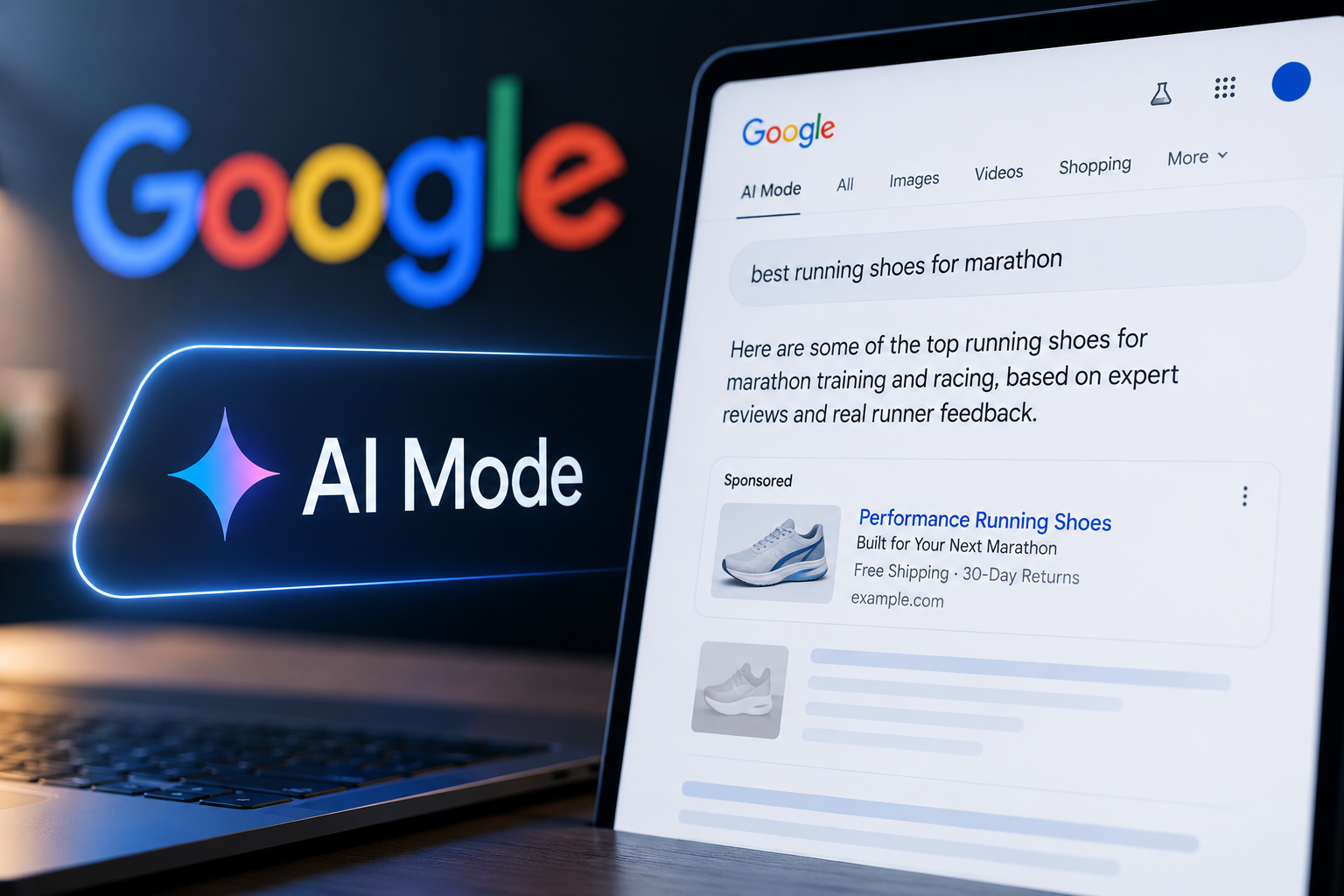
Google is testing a small but notable change to how Search ads can appear inside AI Mode, according to a September 4, 2026 report attributed to Barry Schwartz. The experiment allows standard Search campaigns using exact match and phrase match keywords to show ads in AI Mode when Google determines that the user’s intent is explicit and direct. That may sound like a narrow technical adjustment, but for paid search teams it touches one of the biggest questions raised by Google’s AI search transition: whether keyword-led campaign structures still have a role in conversational search environments.
Until now, the practical direction from Google has pushed advertisers toward broader AI-powered matching if they want to participate fully in AI search surfaces. In its own documentation on ads and AI Overviews, Google says ads are matched not only against the user’s query but also against its understanding of the AI-generated answer and the commercial intent behind the journey. Google’s guidance has framed these placements around AI-powered targeting solutions such as broad match, AI Max for Search campaigns, Performance Max, Shopping campaigns and Dynamic Search Ads. The newly reported experiment therefore matters because it suggests Google is testing a more selective path for conventional Search campaigns to enter AI Mode without requiring advertisers to loosen every campaign into broader matching.
The key phrase is “explicit and direct intent.” AI Mode is built for longer, more conversational queries, and many of those queries are exploratory rather than immediately commercial. A user asking for a broad explanation, comparison or planning framework may not map neatly to a traditional keyword, which is why Google has emphasized intent modeling and AI-powered matching. But some AI Mode searches are also highly actionable: a person may ask for a specific type of software, a nearby service, a product category with clear purchase criteria or a direct brand-related task. In those cases, exact and phrase match campaigns could be relevant without relying on the wider eligibility of broad match or AI Max.
This test also lands against the backdrop of Google’s broader AI advertising strategy. Google announced in 2025 that it was starting to test ads in AI Mode, describing placements that could appear below or integrated into AI Mode responses when relevant. It also introduced AI Max for Search campaigns as a suite of targeting and creative enhancements designed to help advertisers expand into new queries and prepare for evolving Search experiences. The company’s direction has been clear: Search is becoming more intent-driven, more conversational and more automated, while advertisers are being asked to trust Google’s systems with more of the matching logic.
For advertisers, the exact and phrase match test could be read in two ways. On one hand, it may reassure brands that Google is not abandoning keyword precision altogether. Exact and phrase match still matter for compliance-sensitive categories, brand protection, budget control and accounts where advertisers want more steering over which queries can trigger ads. On the other hand, a limited AI Mode experiment does not mean the old keyword model is returning unchanged. Google’s current keyword matching documentation already defines match types around meaning and intent rather than only literal text, and AI Mode pushes that shift even further because the system must interpret a conversation, not just a typed query.
The immediate operational question is reporting. Advertisers will want to know whether AI Mode impressions from exact and phrase match campaigns are broken out clearly, how search terms are represented, whether the match type is visible in standard reports and how performance compares against broad match, AI Max and Performance Max traffic. Without that transparency, the test could increase reach but also blur the lines between carefully controlled keyword traffic and AI-inferred demand. That distinction matters for advertisers trying to diagnose wasted spend, protect brand terms, assess incrementality and explain results to clients or finance teams.
There is also a strategic tension for Google. The company needs to monetize AI Mode without making the experience feel like a traditional results page with a chatbot attached. Ads must be useful, clearly labeled and close to the user’s intent, especially when they appear inside a generated answer environment that users may treat as more advisory than a list of links. Allowing exact and phrase match campaigns in highly direct cases could be one way to bring more familiar Search inventory into AI Mode while preserving relevance. It may also give advertisers a reason to keep refining their keyword portfolios instead of moving entirely toward keywordless automation.
The experiment should not be treated as a broad rollout or a guarantee that exact and phrase match will become fully eligible across AI Mode. Google appears to be testing a narrow condition: ordinary Search campaigns, limited match types and only queries where intent is clear enough for the system to connect the ad without broader inference. Still, even a small test is a meaningful signal. It shows Google is still negotiating the balance between automation and advertiser control as AI search becomes a commercial surface, not just a new answer format.
For PPC teams, the sensible response is not to rebuild accounts overnight, but to prepare measurement frameworks now. Campaign managers should review high-intent exact and phrase match keywords, maintain disciplined negative keyword coverage, monitor any available AI Mode or AI search reporting and compare performance against campaigns using AI Max or broad match. The future of Search advertising is increasingly shaped by AI’s interpretation of intent, but this test suggests that well-structured keywords may still earn a place inside that future when the user’s need is specific enough.