
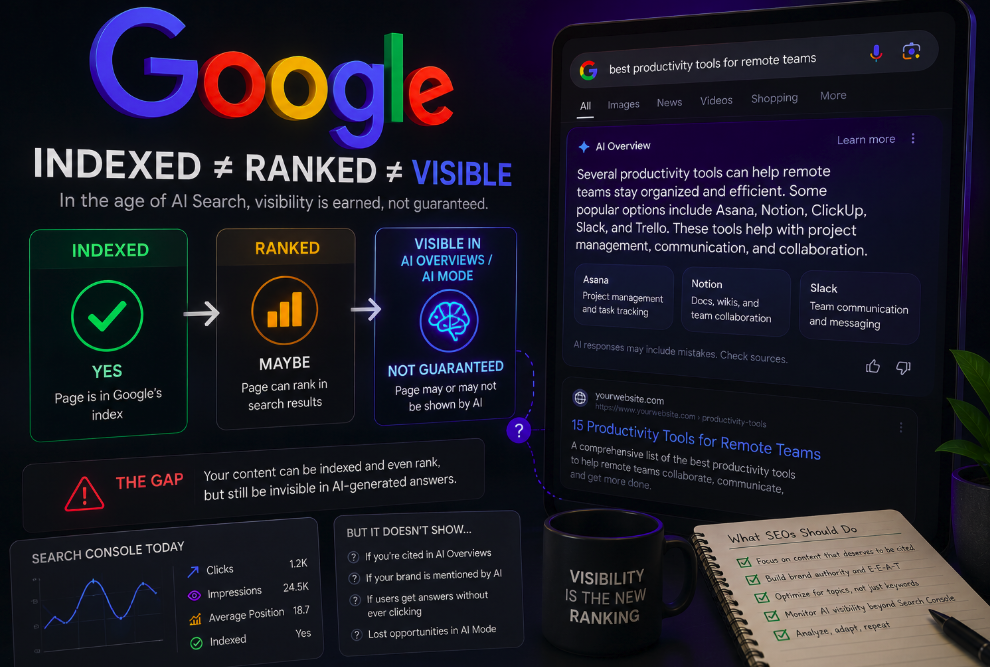
For most of SEO’s history, the path from publication to visibility could be understood as a relatively simple sequence. Google discovers a page, indexes it, evaluates it against a query and, if the page is competitive enough, ranks it somewhere in the search results. Search Console then gives the publisher a reasonably familiar set of signals: impressions, position, clicks and click-through rate.
Google’s AI search experiences are adding another layer to that sequence. A page can be indexed. It can rank in conventional search. It can even be highly relevant to the question a user is asking. None of those things guarantees that the page will become visible inside an AI Overview or AI Mode response.
That distinction is becoming one of the most important measurement problems in modern SEO. Indexation tells us whether Google has a page available. Ranking tells us how that page performs in a particular search context. AI visibility introduces a third question: when Google synthesizes an answer, does the site actually become part of what the user sees?
Indexed has never meant visible
Google’s own Search Console documentation has always made an important distinction that is easy to forget. The Page Indexing report explicitly says that the fact a page is indexed does not guarantee it will appear in search results. An indexed URL is eligible to appear; it is not promised exposure.
Traditional SEO teams understand this intuitively. A website may have 50,000 valid indexed URLs while only a fraction generate meaningful impressions. Indexing is infrastructure. Visibility comes later.
AI search makes the gap wider because the final interface is no longer simply a ranked list of eligible documents. Google can use multiple sources to construct an AI-generated response, decide which supporting links deserve exposure and present those sources in formats that do not map neatly onto the familiar ten-blue-links model.
A publisher can therefore solve every obvious indexing problem and still have an AI visibility problem.
Ranking and AI visibility are not the same thing
This is where the new SEO model becomes more complicated. In conventional search, improving ranking usually increases the probability that a user will see the result. The relationship is not perfect, but position remains a useful proxy for exposure.
Inside AI Overviews and AI Mode, the interface is different. Google is assembling an answer rather than simply ordering documents. A page may be useful as supporting information without becoming one of the links visibly surfaced to the user. Another source may be selected because it answers one part of the question more directly, provides a primary source, contains clearer evidence or complements other sources already used in the response.
This means SEO teams increasingly need to think in three separate states: discoverable, rankable and citeable or visible within an AI-generated experience.
The first two remain essential. Google cannot surface information it cannot effectively access and understand. But they no longer describe the entire distribution problem.
Search Console is starting to acknowledge the gap
Google has begun rolling out a dedicated Generative AI performance report in Search Console, a significant development for publishers trying to understand this new layer. According to Google’s current documentation, the report shows impressions generated when links to a site appear in supported generative-AI features on Google Search, currently including AI Overviews and AI Mode.
The report can show how generative-AI impressions change over time, which pages receive those impressions and how visibility differs by country and device. Google says the feature is still being rolled out to a subset of site owners for testing, so not every Search Console property has access yet.
This is an important improvement because it begins to separate AI exposure from the much broader Search performance picture. Until recently, AI Overview and AI Mode activity was largely folded into standard Web search reporting, making it difficult for publishers to understand how much of their apparent search performance came specifically from generative interfaces.
But even the new report does not turn AI search into traditional rank tracking. It focuses on impressions. It does not provide a simple universal AI position for every query, nor does it reveal the complete reasoning process through which Google selected one source over another.
Search Console still cannot tell the whole AI story
The limitation is partly structural. Traditional search measurement assumes a visible result that can be counted. AI systems can influence users in ways that are harder to reduce to a click or position.
A user may see a brand mentioned in an AI answer without clicking it. A source can contribute information while another source receives the prominent citation. A user can research a category in AI Mode, learn a company name and later perform a branded search. Search Console will capture parts of that journey, but not necessarily the relationship between them.
Even the new generative-AI report measures what Google can expose as a defined impression event. It does not answer every strategic question publishers increasingly care about: How often is our brand recommended? Which competitors appear when we do not? Are we cited for high-intent questions? Does AI visibility later create branded demand?
Those questions require a broader measurement layer around Search Console rather than a replacement for it.
The data itself is still maturing
Publishers should also remember that Google’s AI reporting infrastructure is new. Google’s Search Console data-anomalies documentation records a logging error that reduced reported impressions in the Generative AI performance report for August 13 through August 17, 2026. Google says the issue affected logging rather than actual search visibility.
That is not a reason to distrust the report. Search Console has documented reporting anomalies in many areas over the years. It is, however, a useful reminder not to treat every movement in a new AI dashboard as evidence that Google suddenly stopped showing a site.
If generative impressions fall sharply, the first question should be whether visibility actually changed. The second should be whether reporting changed. As AI measurement matures, separating those two will be important.
AI visibility requires a different content question
Traditional SEO often asks whether a page deserves to rank for a keyword. AI search adds another question: does this page contain information that deserves to be used in an answer?
That can shift editorial priorities. A broad article may rank because it satisfies the overall intent of a query, while an AI system may prefer a source containing a precise statistic, a clear definition, original research or a concise explanation of one specific subproblem.
This does not mean publishers should start writing robotic blocks designed only for extraction. It means information quality becomes increasingly granular. Strong sourcing, explicit claims, original evidence, clear entity relationships and sections that remain understandable outside the full article can all make content easier for both humans and machines to use.
Brand authority matters as well. AI-generated search experiences often synthesize multiple sources rather than awarding one page the entire result. Being a credible source in the broader information ecosystem may therefore matter alongside the ranking strength of an individual URL.
SEO dashboards need a third visibility layer
For publishers, the practical response is not to abandon indexing or rankings. It is to stop treating them as sufficient evidence of visibility.
A modern search dashboard increasingly needs three layers. The first is technical availability: crawling, indexing and canonicalization. The second is conventional search performance: impressions, queries, rankings, clicks and CTR. The third is generative visibility: AI Overview and AI Mode impressions, citation or source presence, brand mentions and visibility across strategically important question sets.
Those layers diagnose different problems. If important pages are not indexed, the issue is technical. If they are indexed but receive no traditional impressions, relevance or ranking competitiveness may be the problem. If they rank well but rarely appear in relevant AI experiences, the publisher may have an AI visibility problem that conventional SEO metrics do not explain.
Visibility is becoming the real unit of SEO
Google Search is not abandoning the index. AI Mode and AI Overviews still depend on Google’s ability to discover, understand and retrieve useful information from the web. Technical SEO remains foundational.
What is changing is what happens after eligibility.
Being indexed once meant entering the competition for rankings. Ranking well meant a relatively predictable opportunity to earn attention. AI-generated search introduces another editorial and algorithmic decision between the page and the user: whether the information becomes part of the generated experience at all.
Search Console is beginning to give publishers better visibility into that layer, and the new Generative AI performance report is a meaningful step. But SEO teams should resist the temptation to compress AI search into another familiar chart too quickly.
The strategic question is getting broader. It is no longer simply, “Can Google index this page?” or even, “Where does this page rank?” It is increasingly, “When Google answers the question itself, are we part of the answer?”
For publishers, that may become the most important definition of search visibility in the AI era.
Sources: Google Search Console Help, “Generative AI performance report (Search)” and “Page indexing report”; Google Search Central documentation updates and Search Console data-anomalies documentation, accessed August 27, 2026.