
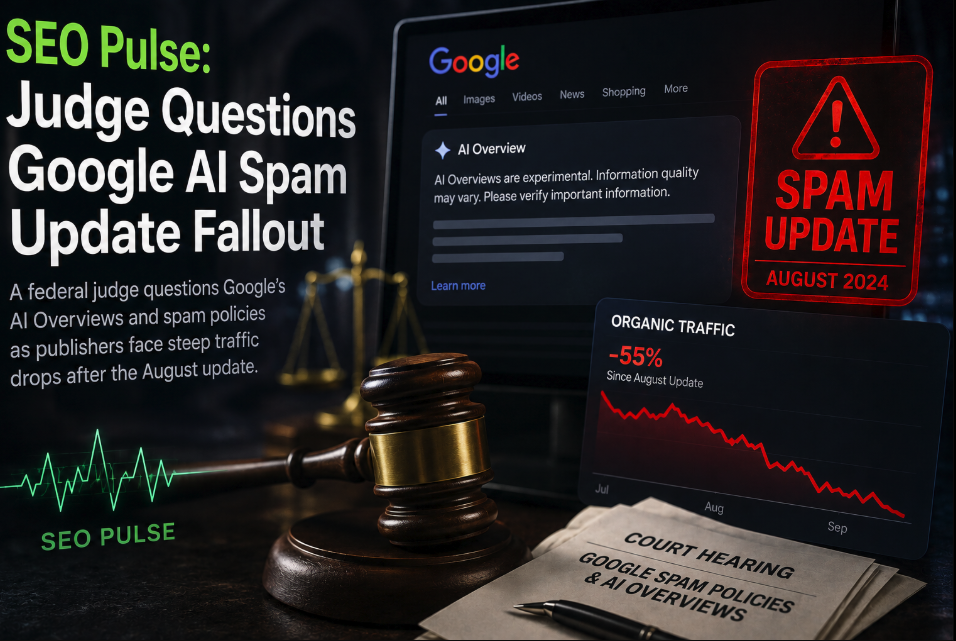
Two apparently separate Google Search stories are converging on the same question: who gets to create value from web content, and under what rules? In one, a federal judge is scrutinizing Google’s ability to use publisher material inside AI Overviews while publishers remain heavily dependent on conventional Search traffic. In the other, reports from the August spam update are putting large-scale AI publishing under renewed pressure, with some automated sites seeing sharp visibility losses.
The latest Search Engine Journal SEO Pulse brings those developments together alongside the continuing GEO debate and new evidence about AI citations. The stories are different in legal and technical terms, but they expose a broader transformation of search. Publishers are being asked to accept increasingly strict rules about how they create content for Google while simultaneously confronting a Google interface that can retrieve, summarize and answer from publisher content before a user ever reaches the underlying page.
That tension is becoming more important than any single ranking update. The emerging contest is not simply over position one versus position five. It is over whether publishers retain meaningful control over the economic value of the information they produce once search becomes generative.
A federal judge is questioning Google’s AI Overview bargain
The most consequential development comes from Penske Media’s antitrust case against Google. At a hearing this week, U.S. District Judge Amit Mehta questioned Google’s characterization of AI Overviews as a normal “product improvement” to Search. According to reporting and accounts from Digital Content Next CEO Jason Kint, who attended the hearing, Mehta described aspects of the situation as appearing “really unfair” and questioned whether Google’s product improvement was being developed on the backs of publishers.
The dispute centers on a long-standing exchange that has underpinned the open web: publishers allow search engines to crawl and index their pages, while search engines send users back to those pages. AI Overviews complicate that exchange because Google can use information retrieved from publishers to generate a direct answer that may reduce the need for a click.
Google’s legal position, as summarized in Search Engine Journal’s detailed coverage of the hearing, is that AI Overviews are part of the evolution of Search rather than a separate product. Publishers can opt out of Google indexing and now have controls affecting their participation in AI features. Penske’s argument is that this theoretical choice is constrained by Google’s dominant position: refusing access to Google can also mean giving up the search visibility on which publishers depend.
Mehta has not ruled on Google’s motion to dismiss, so his questions should not be treated as a judgment against the company. They are significant because Mehta is the same judge who previously found Google maintained an illegal monopoly in general search. The new question is whether that established market power can also matter when Google changes the economic terms of the publisher-search relationship through generative AI.
The AI input market changes the antitrust argument
One of the more interesting issues raised at the hearing is that a market for high-quality content used by generative AI systems is already developing. Other AI companies have entered licensing agreements with publishers and content providers. Penske argues that Google’s control of the search gateway allows it to obtain similar inputs on terms competitors cannot easily replicate.
This creates a potentially important distinction between crawling content to index it and using that content as part of a generated answer. Google’s position is that these activities belong within the continuing evolution of Search. Publishers increasingly see them as economically different uses because an AI answer can substitute for part of the visit that search historically delivered.
The issue becomes sharper as AI Overviews grow more capable and more visually dominant. A publisher may technically remain cited while receiving less practical visibility because the generated response has already answered the question. The old metric of “Google indexed and ranked my page” therefore says less about the value that ultimately reaches the publisher.
That shift is especially relevant for smaller sites. NetContentSEO’s own experiment on whether LLMs can recognize a small publisher before conventional Google authority develops separates machine recognition from ranking strength. The same separation is now becoming important economically: being retrieved, understood or cited by an AI system does not automatically mean receiving traffic proportional to the value contributed.
At the same time, Google is tightening the other side of the equation
While publishers debate how Google can use their content, the August spam update has triggered a different discussion about what kinds of publisher content Google is willing to reward. Reports collected by Search Engine Journal show some fully automated, AI-driven publishing operations losing substantial search visibility, while some sites using AI with stronger human editorial involvement appear to have held up better.
There is an essential caveat: Google has not said the August spam update specifically targeted AI-generated content. The examples are observations from affected site owners and SEO practitioners, not confirmation of the update’s underlying systems. Small samples can also produce misleading narratives after any ranking change because sites differ in links, intent, quality, reputation and hundreds of other factors.
Google’s published policy is technology-neutral. Its spam policies define scaled content abuse around the purpose and value of content rather than simply whether AI wrote it. Producing many pages primarily to manipulate search rankings can violate policy regardless of whether the pages were generated by AI, written by humans or produced through a mixture of both.
Google’s spam-update documentation similarly explains that its automated systems continuously detect search spam and that SpamBrain itself is AI-based. Sites affected by a spam update are advised to review Google’s policies, and recovery can take months as automated systems reassess whether a site complies.
The lesson is not “AI content is dead”
The temptation after a volatile spam update is to reduce the outcome to an easy rule: AI-generated content was targeted, therefore human-written content is safe. The evidence does not support that conclusion. Google’s policies have repeatedly focused on scaled production that exists primarily to manipulate rankings rather than on the writing tool used to create it.
A site can publish low-value content manually at scale, just as it can use AI inside a strong editorial process to research, structure or refine genuinely useful material. The more relevant questions are whether pages provide original value, whether the site is creating content for an audience rather than only for search queries, and whether hundreds or thousands of pages exist primarily because automation made them inexpensive to produce.
This is also why older SEO patterns are returning in new forms. NetContentSEO’s guide to doorway pages and scaled AI content describes how mass-generated pages can recreate classic spam structures even when the underlying technology is new. AI reduces the cost of producing those structures; it does not change the reason Google considers them manipulative.
Publishers are caught between contribution and compliance
Put the antitrust hearing and the spam-update discussion together and an uncomfortable asymmetry appears. Publishers must make increasingly careful decisions about originality, scale, automation and user value if they want continued visibility in Google. Google, meanwhile, is expanding a generative layer that can transform those publishers’ information into direct answers inside its own interface.
There are legitimate reasons for both sides of that system. Search quality would deteriorate if Google did not fight mass-produced spam, and users clearly benefit when a search engine can synthesize complex information quickly. The economic problem is what happens when the same platform both sets the rules for access to search demand and decides how much of the resulting publisher content can be consumed without leaving Google.
That is why Mehta’s questions matter beyond Penske. The legal question is not whether AI Overviews are useful. It is whether a dominant search platform can redefine the exchange with publishers unilaterally and still characterize the result as an ordinary product improvement. If publishers cannot realistically withdraw their content without sacrificing access to the search market, the meaning of “choice” becomes central.
Google says GEO does not require a separate optimization playbook
The same SEO Pulse also highlights comments from Google’s John Mueller that complicate the industry’s growing GEO narrative. Mueller said that, from Google’s perspective, there is nothing particularly special publishers need to do for generative AI responses in Search. The core implication is that good SEO fundamentals remain the basis for appearing in Google’s AI features rather than a new layer of technical tricks.
That claim is compatible with Google’s current documentation, which says its spam policies apply across Search, including generative AI responses. But Mueller’s qualifier matters: he was speaking about Google. ChatGPT, Perplexity and other systems can use different retrieval stacks, indexes and source-selection processes.
This means the debate is increasingly about measurement rather than magical optimization. A publisher can follow familiar principles — crawlability, useful content, clear entities, strong sourcing and original information — while still needing new ways to measure whether an AI system retrieves the page, mentions the brand, cites the publisher or sends a click. Those are separate outcomes.
AI visibility is splitting into different kinds of value
Search Engine Journal’s strongest observation may be that “AI visibility” is becoming too broad a label. New citation research discussed in the Pulse found that brands can be recommended in AI answers while third-party publications receive the citations. Likewise, a source can be retrieved heavily during an AI system’s research process without appearing among the final visible citations.
The traditional search funnel made these concepts easier to connect. Ranking produced an impression; an impression could produce a click; the click arrived on the publisher’s site. Generative search can break that chain into separate events. A page can contribute information without being cited, a brand can be mentioned without receiving the link, and a publisher can be cited without generating meaningful traffic.
That is the larger context in which both the Penske case and Google’s spam enforcement should be understood. Search is no longer only deciding which pages deserve visibility. It is increasingly deciding how information from those pages is recombined, presented and monetized before the user visits them.
The next SEO battle is over the terms of participation
For publishers, the immediate advice remains conservative: do not assume every August traffic loss proves Google targeted AI content, and do not rebuild a site around anecdotal patterns from a single update. Audit whether scaled pages genuinely stand on their own, whether automation has produced repetitive or search-first material, and whether the site would still make editorial sense without Google traffic.
The longer-term question is harder. Publishers need Google for discovery, but Google increasingly needs publisher information to make its AI answers useful. The relationship is becoming more interdependent at the same moment the distribution of value between the two sides is becoming less clear.
Judge Mehta has not decided whether Penske’s antitrust case survives, and Google has not confirmed that its latest spam update was an AI-content crackdown. Those uncertainties matter. Yet together, the stories reveal a direction that is already clear: the central SEO issue of the generative-search era will not be only how to rank. It will be how publishers preserve control, attribution and economic value when the search engine can increasingly answer on their behalf.