
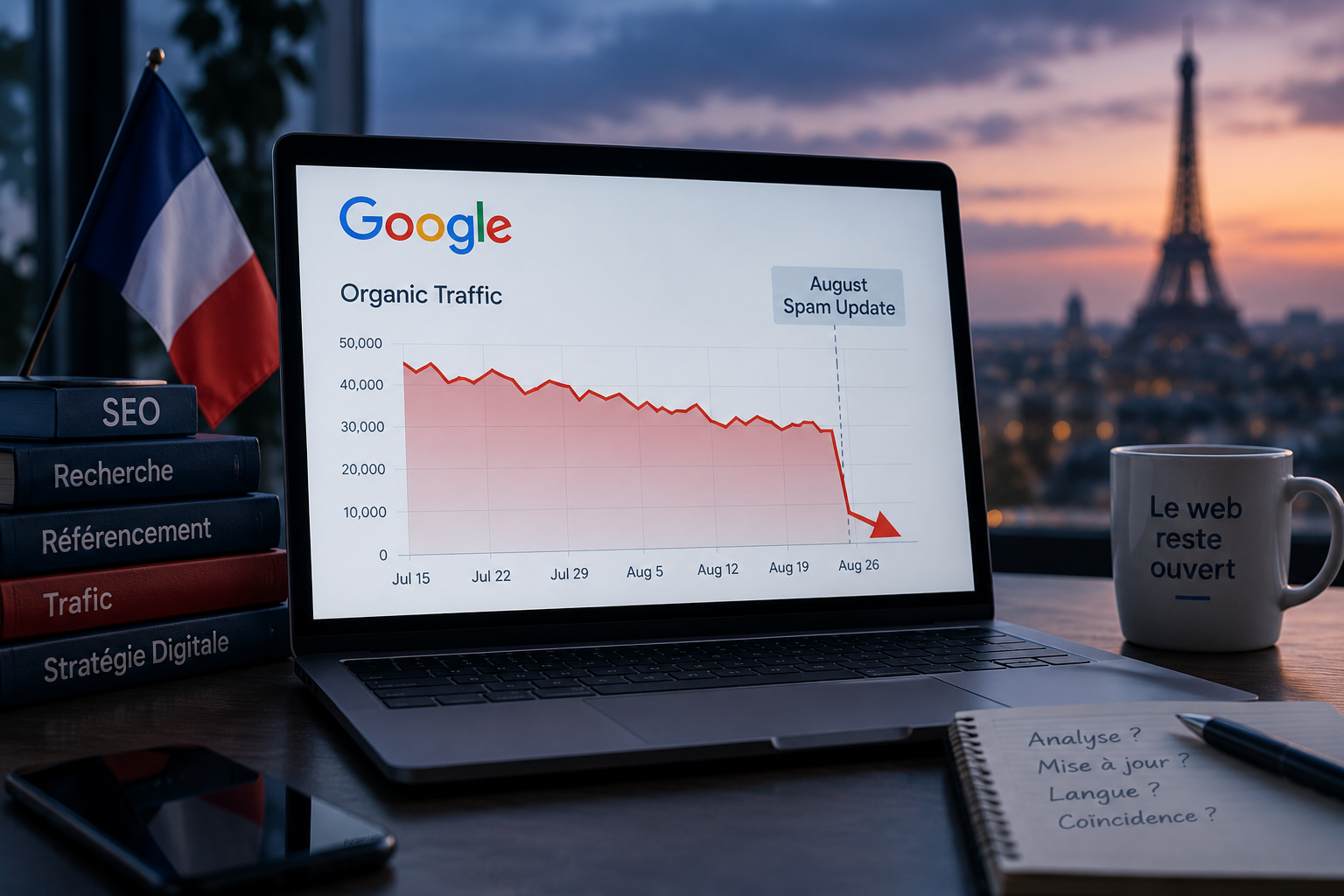
Google’s August Spam Update Hit French Sites Hard — Coincidence or Language-Specific Pattern?
Google’s August 2026 spam update was officially described as a global ranking change, but the loudest early anxiety may have come from one market in particular. A new Search Engine Watch report published on September 3 highlights a cluster of French SEO professionals who said their sites or client properties saw severe visibility and traffic losses during the rollout, including one claim of a site losing around 10,000 daily visits in a single day.
The story is notable not because it proves that Google’s systems treated French-language websites differently, but because it captures how algorithm updates are experienced on the ground. When several practitioners in the same market report sudden declines at the same time, a pattern can appear quickly. The harder question is whether that pattern reflects a true language-specific effect, a concentration of similar SEO tactics in one community, or simply the way public discussion clusters around high-profile examples.
What Google officially confirmed
Google’s own Search Status Dashboard lists the August 2026 spam update as beginning on August 18 and lasting 2 days and 16 hours. That timing matters because several of the reported traffic drops appeared around the update window, making the spam update a plausible point of investigation for affected publishers and SEOs.
However, Google did not announce the update as a France-focused or French-language intervention. Coverage from Search Engine Roundtable noted that Google described it as a normal spam update applying globally and across all languages and locations. That distinction is important: a global update can still produce uneven effects in specific markets, but uneven visibility losses are not the same thing as evidence of geographic or linguistic targeting.
French SEO chatter does not equal proof
The Search Engine Watch article points to several French SEO posts on X, including examples where practitioners shared graphs showing abrupt declines. One case cited in the report described a site with a long stable history losing roughly 10,000 visitors per day in one day, while another claimed a site with useful content was hit by what the poster called Google’s AI spam update. Those posts are useful signals of industry concern, but they remain individual testimonies rather than controlled data.
There are several reasons to be cautious. Public social-media reporting is self-selecting, because people who lose traffic are more likely to post than people who see no change or gain visibility. A sharp fall on one website also does not reveal whether the cause was spam classification, technical instability, lost SERP features, seasonality, deindexing, query mix, competitor movement or a separate change that happened at the same time.
That does not make the French reports meaningless. In SEO, anecdotal chatter often identifies issues before broader datasets can explain them. But the responsible interpretation is narrower: French-language practitioners appear to have seen and discussed significant losses during the update, while there is not yet public evidence that Google’s August spam update specifically targeted French-language content.
The broader data shows unusual volatility
The French reports also sit inside a wider picture of elevated ranking disruption. Search Engine Land, citing SE Ranking data, reported that Google’s August 2026 spam update produced an 82% increase in top-10 URLs dropping out of the top 100 compared with a period without a confirmed update. The same report said the volatility spanned 20 tracked industries, which supports the idea that the update was broadly disruptive rather than confined to one niche or country.
That broader volatility makes the French cases easier to contextualize. If a global spam update caused unusually large ranking movement across many industries, some markets would inevitably produce highly visible case studies. France may have been genuinely hard hit, but it may also have had a particularly vocal SEO community, a shared concentration of vulnerable tactics, or a few prominent examples that made the market appear more affected than it was in aggregate.
What affected sites should investigate before drawing conclusions
For publishers and site owners who saw a collapse around August 18 to August 21, the first step is not to assume a French-language penalty. The more practical approach is to compare affected and unaffected pages in Google Search Console, separate branded and non-branded queries, check index coverage, inspect manual action messages and review whether the lost URLs had relied heavily on thin programmatic content, scaled content patterns, expired-domain authority, doorway pages, aggressive internal search pages or other signals that could intersect with Google’s spam policies.
It is also worth checking whether the site’s decline came from a small number of pages losing major rankings or from a sitewide contraction. A page-level drop may suggest specific content or query-class exposure, while a broad domain-level slide may require deeper analysis of content quality, site architecture, link acquisition, template duplication and overall trust signals. In either case, the worst response is panic deletion without diagnosis, because removing large amounts of content can make recovery analysis harder.
Google’s spam documentation says sites affected by spam updates should review compliance with its policies and that recovery can depend on systems learning over time that the site is no longer violating them. That is a slower and less satisfying answer than most publishers want, but it reflects the reality of automated ranking systems: changes made after a spam update may not produce immediate reversals.
A warning for international SEO teams
The French reaction to the August update should remind international SEO teams that global algorithm changes rarely feel global in a uniform way. Language markets differ in publishing practices, affiliate models, domain reuse, media partnerships, content automation, regulatory pressure and community visibility. A policy-neutral system can still create concentrated impact when a market has concentrated tactics.
That is why the most useful question is not whether France was uniquely targeted, but whether French-language sites share patterns that made them unusually exposed. If many affected properties used similar templates, scaled content strategies, monetization structures or authority-leveraging tactics, the apparent language pattern could be a tactics pattern wearing a language label.
For now, the evidence supports a careful middle position. Google’s August 2026 spam update was officially global, independent industry data suggests unusually strong ranking volatility, and French SEO professionals have reported striking individual losses. What has not been shown is a confirmed French-language bias in the update. Until larger market-level data emerges, the French cases should be treated as a serious signal for audit and comparison, not as proof of a language-specific Google action.