
SEO’s next major problem may not be how to optimize for AI search. It may be how to measure whether any of that optimization is working.
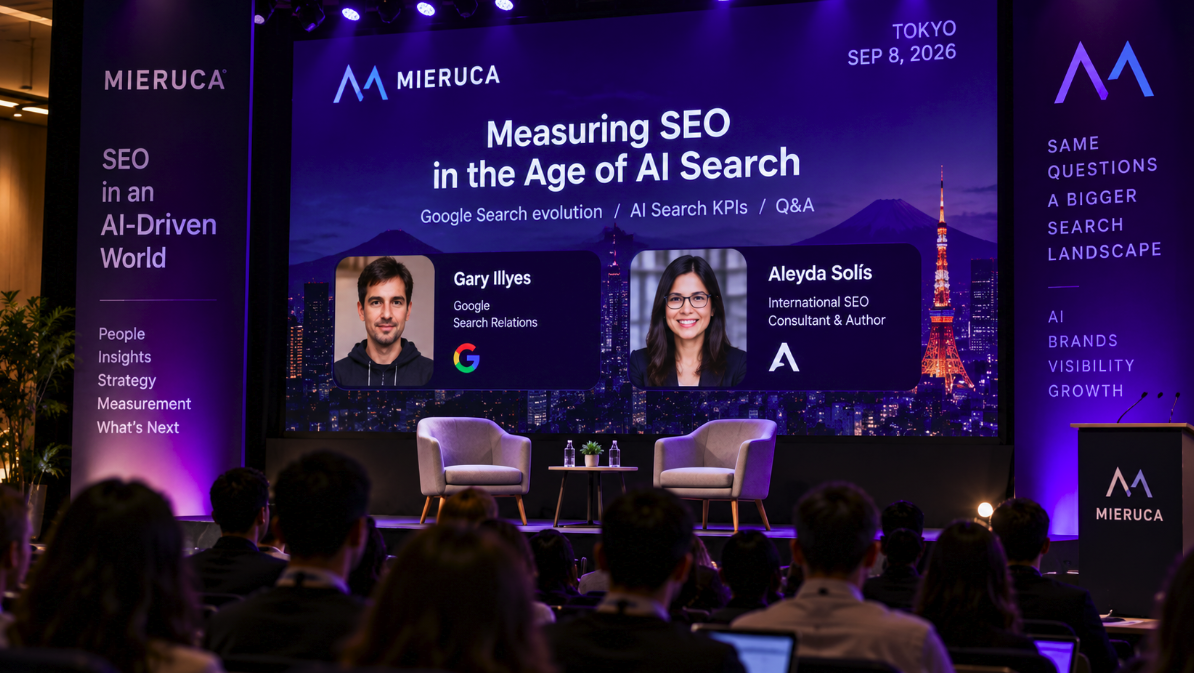
That question is explicitly on the agenda today at a MIERUCA seminar featuring Google Search Relations analyst Gary Illyes and international SEO consultant Aleyda Solís. The September 8 session, titled “The Forefront of SEO in the AI Search Era — The Evolution of Google Search and Future KPI Design,” brings together two complementary topics: how Google Search has evolved toward its latest AI functionality and how marketers should set appropriate KPIs for AI Search.
The official MIERUCA program lists Illyes presenting the evolution of Google Search, Solís covering KPI design for AI Search, followed by a short discussion moderated by Kenichi Suzuki. Solís also previewed the session on LinkedIn around a central question: how should SEO measurement evolve as Google Search integrates more AI features?
At the time of publication, no transcript, new statement from Illyes or post-event conclusions from the session are available. That distinction matters. The news today is the agenda itself—not an undisclosed Google recommendation about which new metrics SEOs should adopt.
AI Search has created a measurement problem before it has created a measurement standard
Traditional SEO has never been reducible to one number, but the industry has developed a familiar measurement stack. Search Console provides clicks, impressions, queries and average positions. Analytics platforms measure sessions and conversions. Rank trackers monitor visibility across keywords. Businesses then connect those signals to leads, revenue or other outcomes.
AI search breaks several assumptions behind that workflow.
A user can receive an AI-generated answer without clicking any source. A brand can be mentioned without receiving a citation. A page can be cited without receiving meaningful referral traffic. A company can influence an answer indirectly through third-party sources that would never appear in its own analytics.
Google’s AI Overviews and AI Mode further complicate the picture because AI-generated experiences are increasingly integrated into Search itself rather than existing as a completely separate channel.
The question facing SEO teams is therefore not simply which new metric to add to the dashboard. It is which parts of the old dashboard still represent user visibility accurately.
Gary Illyes is discussing how Google Search reached its current AI functionality
According to MIERUCA, Illyes’ portion of the seminar is focused on the evolution of Google Search leading to its AI features.
That historical framing is important because generative search did not replace the underlying search ecosystem overnight. Google’s AI experiences sit on top of decades of crawling, indexing, ranking, information retrieval and quality systems.
For SEO practitioners, this is one reason it is risky to treat AI Search as an entirely disconnected discipline. Websites still need to be discoverable and understandable. Content still needs to satisfy users. Technical accessibility, internal architecture, authority and relevance remain part of the information environment from which modern search experiences operate.
What has changed is the presentation layer and, increasingly, the path between discovery and the publisher’s website.
A generated answer can satisfy more of the user’s need directly inside Search. That makes the old assumption that visibility naturally leads to a click less reliable.
Aleyda Solís is putting KPI design at the center of the discussion
The second scheduled presentation is specifically titled around setting appropriate KPIs for AI Search.
Solís’ public preview of the event makes the problem explicit: as Google Search integrates more AI features, SEO measurement needs to evolve.
That does not mean Solís has endorsed a particular KPI framework in advance of the session. No such conclusion is available in the official materials at the time of writing. But the decision to devote a keynote segment to KPI design reflects a broader shift in the industry.
AI visibility tools are proliferating faster than agreement about what their numbers mean.
One platform may report citations. Another measures prompt coverage. Another estimates share of voice, brand mentions, answer sentiment or AI referrals. These can all provide useful signals, but none is automatically equivalent to the familiar relationship between ranking, click and conversion that shaped traditional SEO reporting.
Ranking position is becoming less complete as a visibility metric
One of the hardest questions for SEO measurement is what “position” means when the search experience generates an answer.
In a conventional results page, ranking position provides a relatively understandable hierarchy. Position one is above position two, which is above position three. The relationship between position and click-through rate is imperfect but measurable.
An AI answer can use several sources without presenting them in a comparable ranking order. It can cite a page in one response and omit it when the same user asks a slightly different question. It can surface a brand in the prose without linking directly to that brand’s website.
This means rank tracking remains useful for conventional results while becoming insufficient as a complete representation of search visibility.
The industry increasingly needs to measure presence inside generated answers separately from position in traditional listings.
Clicks alone can understate influence
AI search also creates a problem at the other end of the funnel.
If a user sees a company recommended inside an AI answer, remembers the brand and later visits directly, the original AI exposure may never appear as an AI referral in analytics. The same can happen when the user searches for the brand later, downloads an app or converts through another device.
That makes referral traffic an important but incomplete AI Search KPI.
At the same time, marketers should be careful not to swing too far in the opposite direction. A brand mention inside an AI answer is not automatically valuable simply because it occurred. Visibility without commercial relevance can become another vanity metric.
The measurement challenge is to connect AI exposure to meaningful user and business outcomes without claiming more attribution certainty than the available data supports.
Citations, mentions and referrals measure different things
A useful starting point for AI Search measurement is to stop treating all forms of visibility as interchangeable.
A citation tells a marketer that an AI system used or surfaced a particular source. A brand mention shows that the company appeared in the generated response. Referral traffic shows that a user actually followed a link. A conversion shows that some measurable business action happened afterward.
Those are four different events.
A page can earn many citations and few clicks. A brand can receive mentions while its own domain is never cited. AI referral traffic can be tiny while assisted influence is larger. Conversely, high visibility for irrelevant prompts can generate impressive-looking dashboards with little business value.
Any durable KPI framework will need to preserve those distinctions rather than compressing them into one universal “AI visibility score.”
Prompt tracking introduces a new denominator problem
Keyword-based SEO has a relatively mature concept of demand. Marketers can estimate search volume, segment queries and track rankings against a defined keyword universe.
Conversational AI makes the universe much harder to define.
Users can express the same need through thousands of natural-language prompts. AI systems can interpret those prompts differently, ask follow-up questions or reformulate the information need internally.
If a brand appears in 60 out of 100 tracked prompts, that 60% visibility figure only matters if the 100 prompts represent real customer demand. A hand-selected prompt list can make almost any brand look unusually visible or unusually absent.
That means AI Search measurement needs disciplined prompt selection, segmentation by intent and repeated testing rather than isolated screenshots.
Google Search itself is becoming harder to divide into “traditional” and “AI”
The seminar’s combination of Google Search evolution and AI Search KPIs is especially timely because Google increasingly integrates generative features directly into its core search experience.
For users, the boundary between “Google Search” and “AI Search” can therefore be artificial. A single journey can include conventional links, an AI-generated overview, follow-up questions and additional source exploration.
For marketers, however, separating those surfaces can be essential for understanding performance.
If AI features change click behavior while aggregate search impressions remain stable, a top-line SEO dashboard may hide the underlying shift. If AI-generated results introduce a brand to users without producing direct traffic, analytics may miss part of the discovery journey.
The measurement model needs enough granularity to detect those changes without pretending every interaction can be attributed perfectly.
Existing SEO KPIs are unlikely to disappear
Putting new KPIs on the agenda should not be interpreted as evidence that clicks, conversions, rankings or organic revenue are obsolete.
Those metrics remain valuable precisely because they connect search visibility to observable behavior.
The more likely evolution is an expanded measurement stack. Traditional performance metrics can sit alongside AI-specific indicators such as citation frequency, brand presence, source visibility and referral traffic.
The strategic question is how much weight each metric deserves for a particular business.
An ecommerce company may care primarily about revenue and product discovery. A publisher may focus on citations, referral loss and content attribution. A B2B company may value whether its brand appears in high-intent category recommendations even when the final conversion happens weeks later.
There may never be one universal AI Search KPI for every organization.
MIERUCA itself reflects the industry’s move toward AI-specific reporting
The event is also taking place against a broader shift in SEO software toward dedicated AI measurement.
MIERUCA has previously introduced an AI search traffic reporting feature that can separate visits from tools such as ChatGPT, Gemini and Perplexity when connected with Google Analytics 4.
That type of reporting solves one piece of the puzzle: measurable referral traffic from AI tools. It does not capture every brand mention or citation that produces no click, but it shows how established SEO platforms are expanding beyond conventional search-engine traffic.
The same pattern is occurring across the industry as rank-tracking and SEO platforms add AI citation monitoring, prompt tracking and cross-engine visibility reporting.
Measurement infrastructure is being built while the industry is still deciding which measurements deserve executive attention.
Today’s session should not be reported before it happens
The presence of a Google Search representative makes this event particularly susceptible to premature headlines.
At publication time, the official MIERUCA page provides an agenda, speaker biographies and session structure. It does not provide new statements from Gary Illyes about AI Search rankings, measurement methodology or Google’s preferred SEO KPIs.
Likewise, Solís’ preview explains what she plans to discuss but does not constitute the conclusions of her presentation.
Any specific recommendation attributed to either speaker should therefore wait until the session takes place and verifiable statements become available.
This distinction is especially important in SEO, where comments from Google representatives can quickly become simplified into supposed ranking rules that the original speaker never stated.
The agenda itself tells us where SEO is heading
No new Google quote is required to see why the MIERUCA program matters.
One of the industry’s most established Google Search representatives is appearing alongside one of its best-known international SEO consultants in a session that explicitly connects the evolution of Search with the redesign of SEO measurement.
That is a signal about the maturity of the problem.
AI Search is no longer only prompting questions about content optimization or whether a brand appears in ChatGPT. It is forcing search teams to reconsider how visibility, traffic, attribution and business outcomes fit together when the search engine increasingly answers the question itself.
The old KPIs will not vanish overnight. But the dashboard built for ten blue links is being asked to explain a search experience that no longer consists only of links.
Today’s MIERUCA session puts that measurement gap directly on the agenda. The conclusions should be reported when they are actually available; the fact that SEO leaders are now debating the KPI framework is already significant enough.