
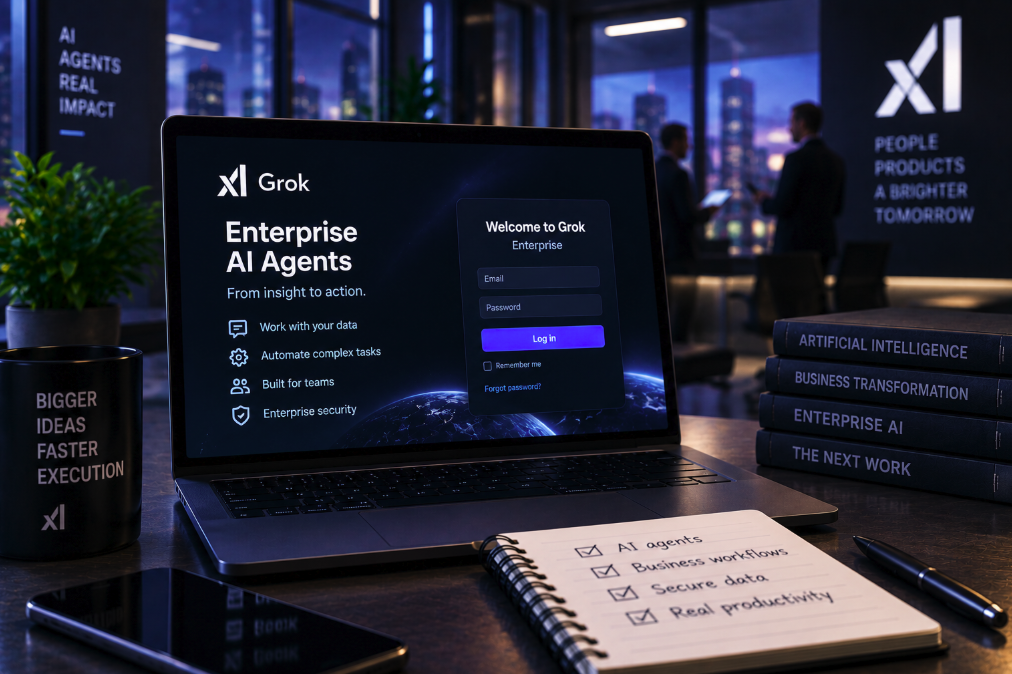
The enterprise AI race is moving beyond assistants that suggest what employees should do. xAI's Grok Bot is designed to do the work itself, operating continuously from cloud computers, navigating websites and business applications, and returning to a human only when a task is finished or a decision is required.
On September 3, xAI made Grok Bot available for enterprise customers, adding the access, network and audit controls needed to deploy persistent agents across organizations. Grok and Cursor Enterprise customers receive free usage for two weeks and can invite their broader organization, including employees who do not already hold individual seats.
The product is notable because its central capability is also its central security question. A useful enterprise agent needs access to real systems. Once an autonomous process can operate inside authenticated applications, the risk model is no longer limited to whether the model produces a bad answer. It includes what the agent can read, change, send and trigger while acting with a user's delegated authority.
Grok Bot is closer to a cloud coworker than a chatbot
xAI describes Grok Bot as a team of AI teammates. A user creates a Bot for a particular job, assigns work through conversation and allows the agent to continue independently until the task is complete or human input is needed.
Each Bot runs on a cloud computer and can interact with applications and websites in a manner closer to a human operator than a conventional API-only automation. That expands the range of workflows an agent can potentially handle, including software that was never designed with an AI integration in mind.
The distinction is important. A chatbot typically produces information for a person to act on. An agent operates a process.
Enterprise adoption therefore shifts the evaluation from answer quality toward execution quality, permissions and operational control.
The official examples are ordinary business workflows
xAI's launch announcement emphasizes practical tasks rather than futuristic demonstrations.
In recruiting, a Bot can contact candidates before interviews and submit scorecards from Gong calls afterward. In marketing, it can collect questions from a webinar and send account executives context and draft responses when their customers attended.
A procurement Bot can monitor vendor spending, usage and renewals and identify opportunities to reduce costs or negotiate. Engineering Bots can monitor pull requests for bugs, security findings, failed builds and merge conflicts, keeping tasks moving until they are ready for human review.
These examples show why persistent agents are commercially attractive. Much office work consists of moving information between systems, checking status, applying repeatable procedures and escalating exceptions.
The breakthrough is access, not intelligence alone
Language-model benchmarks dominate discussion about AI products, but enterprise agents depend on another capability: being able to reach the systems where work actually happens.
A highly capable model that cannot open the CRM, inspect a document, navigate an internal dashboard or interact with a legacy web application remains an adviser rather than an operator.
Grok Bot's architecture pushes the agent into that operational layer. The Bot has a computer, a browser and authenticated sessions to the applications the user has connected.
That increases usefulness without requiring every company application to expose a modern API or support an agent-specific integration.
Authenticated sessions change the threat model
Once an agent is operating inside a logged-in session, a compromised workflow can have consequences that a bad chatbot answer cannot.
A hallucination in a conversational response can mislead an employee. An autonomous agent with access to business applications can potentially act on incorrect information, expose data or perform an unintended workflow if controls fail.
This does not mean Grok Bot is insecure or that such an incident has occurred. It means enterprises need to model risk around delegated access rather than model output alone.
The relevant questions become familiar to security teams: what identities can the agent use, what resources can those identities reach, which actions require approval, how activity is logged and how access is revoked.
Prompt injection becomes an enterprise access problem
Persistent browsing agents also make prompt injection more consequential. An agent working on the open web can encounter instructions embedded in webpages, documents, messages or other untrusted content.
If the system interprets malicious external text as an instruction rather than data, an attacker may attempt to redirect the agent's behavior.
The severity of that failure depends heavily on permissions. An agent limited to reading a narrow public dataset presents a different risk from one operating inside email, customer records and procurement tools.
This is why the security principle of least privilege becomes fundamental to agent deployment. The agent should receive the minimum access required for the task rather than inheriting every capability available to the employee supervising it.
xAI says access starts closed
xAI's enterprise announcement says each user's Grok Bot work runs in a secure, isolated environment separated from other users. The company also says a Bot has no access by default and reaches only accounts into which the user signs it.
That default-deny model is important because persistent autonomy should not imply automatic access to the organization.
Official enterprise documentation positions identity, network access, approvals, privacy and computer management as administrative controls rather than individual convenience settings.
For enterprise security teams, the deployment decision should therefore focus not only on whether the product has controls but on how aggressively those controls are configured.
Identity-provider policy remains part of the security boundary
xAI's security FAQ says sign-in sessions inside a Bot's computer can disappear when the computer is recreated, for example after an image update or policy change. The documentation says those sessions ride the customer's identity provider, meaning existing session policies continue to apply.
This is a useful architectural point. Enterprise agents should not become a parallel identity universe detached from the controls companies already use for employees.
Short session lifetimes, conditional access, multifactor authentication, role-based permissions and account revocation can all reduce the amount of authority available to a compromised or malfunctioning agent.
The arrival of AI agents therefore increases the importance of mature identity infrastructure rather than replacing it.
Auditability matters because the agent works while nobody is watching
Grok Bot is designed to keep working autonomously around the clock. That means an employee may not be observing each intermediate step.
For enterprises, asynchronous execution creates a requirement for reconstructable activity. Security teams need to know which agent accessed which system, what it attempted, what changed and which actions received human approval.
xAI specifically identifies audit controls as part of the enterprise release. The value of those logs will depend on their granularity, retention and integration with the organization's existing security monitoring.
An agent that works continuously without strong auditability can turn productivity into opacity. An agent whose actions can be reconstructed becomes governable.
Network controls can reduce what an agent is able to reach
Enterprise deployment also introduces network-level controls. These matter because agent risk is determined partly by reachable infrastructure.
An organization may not want a general-purpose autonomous browser to have unrestricted access to every internal service simply because an employee account technically can.
Allowlisting, private-network configuration and egress restrictions can constrain the environment in which an agent operates.
This mirrors the architecture used for other sensitive automation: do not rely on the software to make the correct decision every time when infrastructure can make certain dangerous paths unavailable in the first place.
Grok Bot can automate systems that were never designed for agents
One of the strongest arguments for computer-using agents is compatibility with legacy software. Businesses contain enormous numbers of applications that have no useful API, no Model Context Protocol integration and no modern automation layer.
A computer-use agent can potentially interact with those systems through the same visual interface an employee uses.
That can unlock workflows traditional automation projects would consider too expensive to integrate. It can also bypass assumptions embedded in older systems about who is clicking the buttons.
A legacy application may have been designed on the assumption that an authenticated human manually performs a limited number of actions. An always-on agent can operate at a different speed and scale, so companies need to test how those systems behave under automation.
Enterprise agents create a new form of privileged identity
Organizations already manage human accounts, service accounts, API keys and robotic process automation identities. Persistent AI agents add another category.
They behave partly like employees because they navigate interfaces and respond to natural-language instructions. They behave partly like service accounts because they can operate continuously without a person present. And they behave partly like software agents because their actions can change dynamically based on unstructured information.
Traditional identity governance systems may need to represent those characteristics explicitly.
Security teams should be able to answer who owns an agent, which employee delegated authority to it, what permissions it has, when those permissions expire and how quickly the identity can be disabled.
The enterprise release is about governance as much as capability
Grok Bot itself launched in beta in August. The September enterprise release is important because organizations cannot safely scale autonomous agents through individual subscriptions alone.
Enterprise adoption requires centralized enablement, identity controls, network policies, auditability, data governance and security review.
xAI's current documentation says Anysphere holds ISO/IEC 27001 and ISO/IEC 42001 certifications and that Grok Bot is included in the current ISO scope. Enterprise customers can also engage account teams around residency commitments, egress ranges and security review support.
Certifications do not eliminate product risk, but they provide a governance framework that enterprise buyers expect before connecting software to business systems.
Start with low-consequence tasks
The sensible deployment pattern for persistent agents resembles the rollout of any powerful automation technology: begin where failure is observable and reversible.
Research, monitoring, document preparation and read-heavy workflows can provide value without immediately giving an agent authority to make payments, modify customer records or publish externally.
Once organizations understand the agent's behavior, they can expand permissions gradually and add approval gates around higher-impact actions.
The objective is not to eliminate autonomy. It is to match autonomy to consequence.
Procurement is a revealing enterprise use case
xAI highlights procurement as one of Grok Bot's applications, saying specialized Bots can monitor vendor spend, usage and renewals and identify opportunities for savings or negotiation.
This type of workflow demonstrates both the upside and the governance requirement. Procurement data is distributed across contracts, billing systems, SaaS dashboards, email and internal records. An agent capable of moving across those systems can assemble insights that would otherwise require substantial manual work.
At the same time, procurement can expose financial information, commercial terms and vendor relationships.
The ideal agent may therefore have broad read access while retaining narrow write authority, with humans approving cancellations, purchases and contractual actions.
Agent security is becoming a business-design problem
It is tempting to treat Grok Bot's security questions as the responsibility of the CISO. That would miss the operational side of the problem.
The person designing the workflow determines what the agent needs to see and which actions it should perform. The security team can constrain access, but business owners need to decide whether an autonomous action is appropriate in the first place.
This creates a new collaboration requirement between operations, IT, security, legal and the teams deploying AI.
Agent governance cannot be solved entirely by a security checkbox because the acceptable risk depends on the business process being automated.
Persistent memory and long-running work increase both value and exposure
The attraction of an always-on agent is continuity. It can remember the task, monitor changes and continue working after the employee closes the laptop.
That continuity also means more durable state. Conversations, files, authenticated sessions and task context can persist long enough to become valuable targets.
Organizations therefore need retention policies for agents just as they do for other enterprise systems. Data should not remain available indefinitely simply because persistence improves convenience.
The question “what does this Bot remember?” should become part of every enterprise AI security review.
The security conversation should avoid unsupported shortcuts
Secondary analysis of Grok Bot has raised concerns about a potentially broad “blast radius” when authenticated agents interact with multiple business systems. That is a useful risk concept, but architectural claims need to remain tied to documented behavior.
xAI's current public material says user environments are isolated and access is closed by default. The available documentation does not justify assuming that compromising one Bot automatically compromises every application or every other user's environment.
The appropriate security conclusion is narrower and stronger: any autonomous agent's blast radius is bounded by the systems and permissions it can actually reach.
Enterprises can therefore materially reduce risk through identity scoping, network restrictions, short-lived access, approval requirements and monitoring.
Always-on agents turn permissions into product strategy
Grok Bot represents the direction enterprise AI is moving: away from software that drafts work and toward software that completes it.
That transition changes what buyers should compare. Model intelligence still matters, but so do isolation, authentication architecture, audit logs, network policy, data retention and approval design.
The winning enterprise agent may not be the one capable of the most actions. It may be the one organizations can confidently allow to perform the largest number of useful actions without creating unacceptable exposure.
xAI's enterprise release makes that tradeoff concrete. Grok Bot can operate inside the applications where companies actually work, including systems that were never built for AI. That is exactly why it can automate more of the business — and exactly why every deployment needs to begin by defining what the agent is allowed to become.