
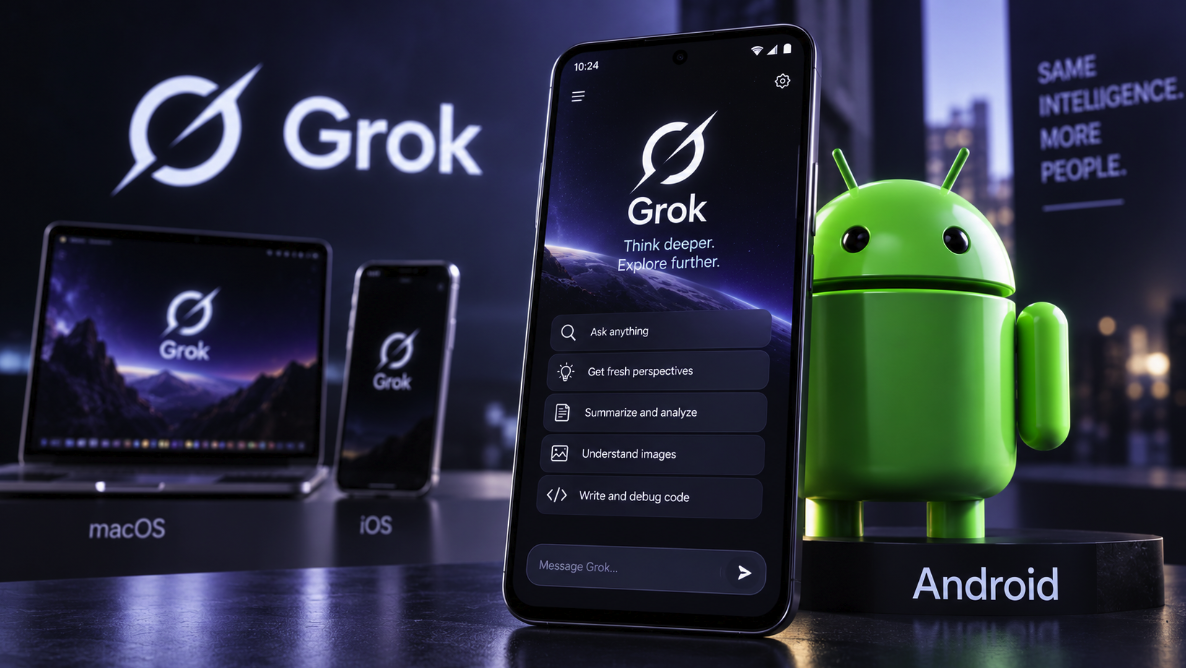
Grok’s expanding Android presence is another sign that the AI assistant race is becoming a distribution battle as much as a model-performance contest. The most capable chatbot in a benchmark has limited practical value if users have to leave their normal workflow to reach it; the next phase is about putting assistants directly on the devices people already carry all day.
A September 6 Voice of Emirates report highlights Grok’s expansion on Android after its presence on other platforms including iOS and macOS. The current official Google Play listing confirms that Grok is actively distributed on Android, where the store describes it as an AI assistant for answering questions, generating images and videos, voice conversations and understanding uploaded pictures, with real-time information from X.
Android turns AI reach into a scale problem
The strategic importance of Android is straightforward. AI companies are no longer competing only for users who deliberately visit a chatbot website. They are trying to become habitual utilities that sit beside messaging, search, email, maps, photography and productivity apps. A native mobile application shortens the distance between a question and an AI interaction, while notifications, voice input, camera access and file sharing create opportunities that a browser tab cannot reproduce as naturally.
Voice of Emirates frames the Android expansion as part of a broader effort to make Grok accessible wherever users are, and that interpretation fits the direction of the product. The Google Play listing shows more than 100 million downloads, indicating that Grok’s Android footprint is already substantial rather than experimental. The app is listed for phones, tablets, Chromebooks and XR headsets in the store, broadening the number of contexts in which the assistant can be reached.
That reach matters because Android is not merely another operating system checkbox. It represents an enormous and geographically diverse smartphone ecosystem, including markets where mobile devices are the primary way people access the internet. For an AI provider, competing seriously for mainstream consumer usage therefore requires more than a polished desktop or web experience.
The standalone AI app is becoming a platform
Grok’s mobile expansion also illustrates how quickly the definition of an AI app is changing. The original chatbot model was simple: users typed a prompt and received a text response. Current Grok product materials describe a much wider bundle that includes image and video generation, voice conversations, image understanding and access to real-time information from X.
SpaceXAI has also been pushing creation workflows onto mobile. In an August announcement about Grok Build, the company said users can describe an app, game, website or dashboard and have Grok build a working version directly in chat on the web, iOS and Android. That is a meaningful shift from treating the phone as a lightweight companion to the desktop. The mobile app is increasingly becoming an environment where users can create and execute more substantial work.
The same pattern is visible in newer agentic features. SpaceXAI’s mobile documentation describes Grok Bot support on Android and iPhone, allowing users to monitor tasks, inspect a shared computer screen, intervene for passwords or two-factor authentication and manage recurring work from a phone. Some advanced controls still require the desktop application, but the phone increasingly functions as the control surface for AI work happening elsewhere.
AI assistants are competing for the home screen
This creates a different competitive landscape from the early generative-AI boom. Chatbots once differentiated themselves primarily through model quality, context windows, response style and pricing. Those differences still matter, but consumer adoption is also being shaped by distribution: which assistant is installed, which one integrates with the operating system, which one receives shared files most easily and which one becomes the default place to ask a question.
Android is especially contested because Google already controls critical layers of the ecosystem and can integrate Gemini deeply into its own services and devices. A third-party assistant such as Grok therefore has to earn a place on the user’s home screen rather than relying on operating-system defaults. The same challenge applies to other independent AI apps competing against platform owners with built-in distribution.
That pressure helps explain why AI applications are accumulating features so quickly. Image generation, live information, voice, coding, document analysis and agentic actions are not merely demonstrations of model capability; they give users additional reasons to open the same app repeatedly. The strategic objective is to turn an occasional chatbot into a general-purpose interface for digital tasks.
Mobile distribution can matter as much as benchmark leadership
The wider lesson from Grok’s Android push is that AI competition is moving into a phase where model intelligence and product distribution reinforce each other. A technically stronger model can attract enthusiasts, but a sufficiently capable assistant that is easier to access may win more everyday interactions. Once users build habits, conversation histories and workflows around one assistant, switching becomes less frictionless than comparing two benchmark charts suggests.
That does not mean the standalone AI app will necessarily become the final interface. Assistants are also being embedded into browsers, operating systems, productivity suites, social networks and specialized software. But native mobile apps give AI companies a direct relationship with users while those larger platform battles are still being decided.
For Grok, Android is therefore more than another endpoint. It extends xAI’s assistant into one of the world’s most important computing environments and gives the company another surface from which to compete for daily usage. The AI race may still be discussed in terms of which model is smartest, but on smartphones the more immediate question is increasingly simpler: which assistant is already within reach when the user needs it?