
A comparative analysis of how news sites, forums, directories and authority content platforms in India react to algorithm updates, structural volatility and traffic shifts.
How Different Website Models React to Algorithm Updates: A Cross-Vertical Benchmark in India

When algorithm updates roll out, most conversations focus on winners and losers. But the more interesting question is not who gained and who dropped. It is how different structural models react under pressure. Looking at traffic behavior across four different website types in India — a news site, a forum, a vertical directory and an authority content platform — a pattern begins to emerge that is less about niche and more about architecture.
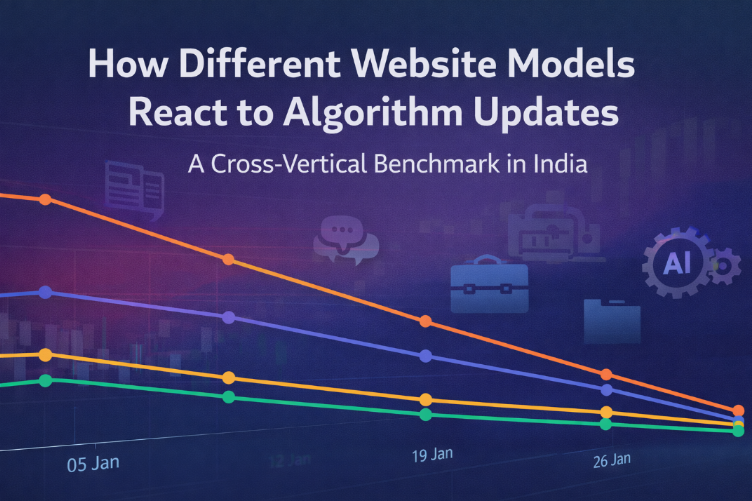
The graph above illustrates a clear divergence. The news site shows a sharp rise followed by an equally sharp decline. That volatility is not unusual. News platforms are velocity-driven systems. Their visibility depends heavily on freshness, recency signals and constant publishing cadence. When the algorithm recalibrates weighting around freshness or authority layers, the impact is immediate and often dramatic. Traffic is elastic, reactive and tightly coupled to temporal demand.
The forum behaves differently. It does not spike aggressively, but it does not collapse instantly either. Forums are density-driven ecosystems. Their strength lies in long-tail query coverage and user-generated depth. However, they suffer from crawl inefficiencies and index lag when thread structures become too fragmented. Algorithm updates that re-evaluate quality signals often compress weaker threads first, causing a gradual erosion rather than a sudden crash.
The directory model presents another pattern entirely. Instead of sharp volatility, we observe structural sensitivity. Directory platforms rely less on publishing frequency and more on internal linking logic, pagination depth and hierarchical clarity. When architecture is tight, traffic remains comparatively stable. When crawl paths become too deep or filtering parameters explode into thin pages, compression begins. In highly competitive Indian verticals, structured marketplace platforms such as https://akays.in demonstrate how internal linking density and city segmentation can influence indexation stability during turbulence. The niche itself is not the variable. The structural discoverability is.
Authority content sites, like NetContentSEO, follow a different curve again. Their traffic trend is not purely velocity-driven nor purely structural. Instead, it correlates with topical cohesion and semantic authority. When algorithm updates refine entity understanding and context weighting, authority platforms either consolidate visibility or slowly lose interpretative strength. They are less dependent on freshness and more dependent on how clearly they signal expertise across interconnected themes.
What becomes evident in this benchmark is that algorithm updates do not target categories. They recalibrate structural interpretation. News sites suffer when temporal weighting shifts. Forums soften under content compression. Directories respond to crawl depth logic. Authority sites respond to semantic clarity. The volatility is model-specific.
Another overlooked factor is crawl budget allocation. In directory ecosystems, especially those segmented by geography, the multiplication of city and category combinations can either strengthen discoverability or fragment it. If pagination and canonical signals are not tightly controlled, updates amplify inefficiencies. The traffic curve for directory models often reflects structural hygiene more than content quality. In contrast, news volatility correlates directly with trust layers and source authority recalibration.
The Indian market amplifies these dynamics due to high competition, dense query clusters and rapidly shifting search behavior. When updates prioritize contextual interpretation over raw keyword alignment, structurally coherent systems tend to stabilize faster than content-heavy but loosely interconnected ecosystems. The differentiation is architectural.
This benchmark reinforces a larger principle. The niche does not determine resilience. The model does. Velocity-driven systems, density-driven systems, architecture-driven systems and authority-driven systems each react according to their structural DNA. Observing them side by side makes it clear that algorithm turbulence exposes structural weaknesses before it punishes content categories.
For practitioners analyzing traffic drops or gains, the takeaway is not to compare yourself to competitors in your vertical alone. Compare yourself to different structural archetypes. Are you operating like a news site without velocity. Like a forum without density. Like a directory without crawl discipline. Or like an authority platform without semantic cohesion. Algorithm updates do not attack industries. They stress-test models.
The graph tells a simple story. The interpretation tells a more important one. Structure determines stability.