
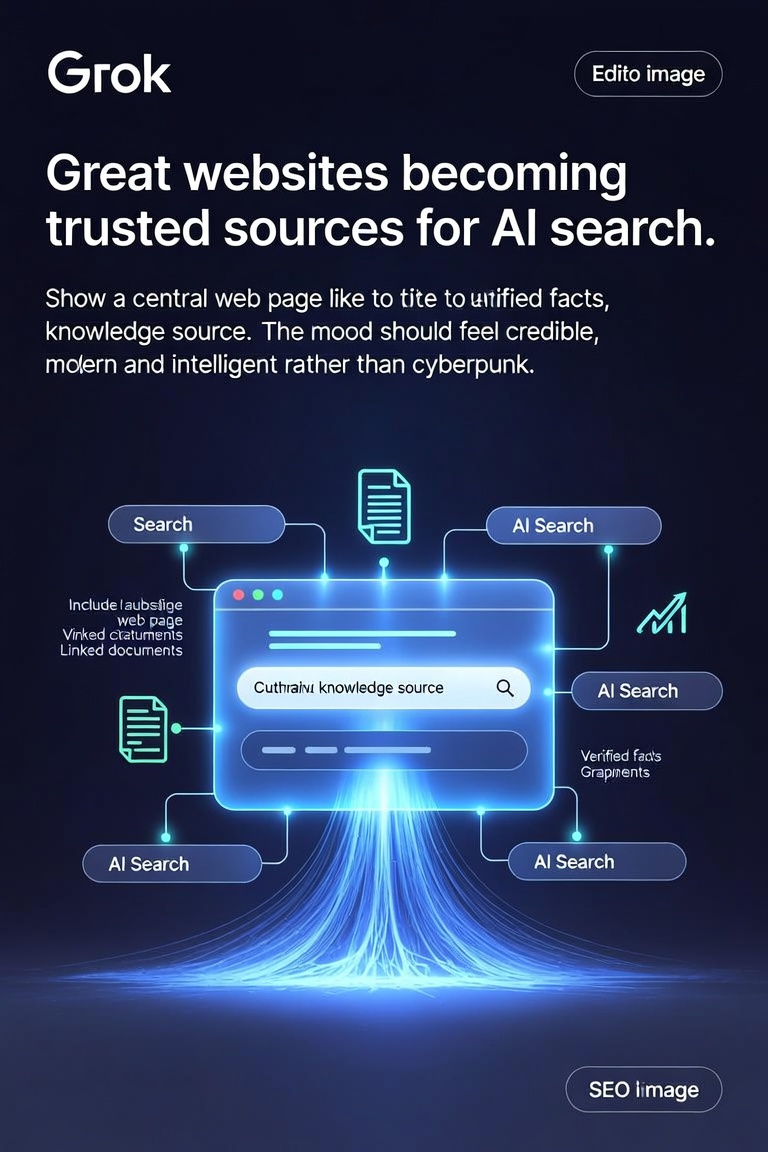
A practical, no-magic framework for turning ordinary web pages into sources AI systems can confidently reference.
SEO Title: How to Get Cited by ChatGPT, Google AI & Perplexity (2026 Guide)
Category: AI & Search
Author: Stefano Galloni — Verified Expert
Last updated: July 2026
How to Get Your Website Cited by AI Search Engines
There is a new SEO question showing up everywhere: “How do I get ChatGPT to cite my website?” The same question is asked about Google AI Overviews, AI Mode, Gemini, Claude and Perplexity. It sounds like a new discipline. In practice, it is a tougher version of an old one: become the most useful, trustworthy and retrievable source for a specific question.
The difficult part is that nobody can promise a citation. There is no submission form that guarantees inclusion, no schema type called “cite me,” and no single optimization that works across every AI product. The systems are different. Their indexes, retrieval methods, ranking layers, partnerships and user interfaces are different too.
Still, the pattern is becoming clear. AI search systems need information they can find, understand, verify and safely present. A page that is vague, copied, anonymous or technically difficult to access gives them little reason to use it. A page that answers the question directly, shows where its claims come from and adds something original is a much stronger candidate.
That is the real goal of AI-search optimization. Not manipulating a model. Reducing the number of reasons it has to ignore you.
The first reality: AI citations are not normal rankings
A traditional search result is a list of options. An AI answer is a synthesis. The system may inspect many documents, use several to construct the answer and show only a small number of visible citations. That means a page can help shape an answer without receiving a prominent link, while another page may be cited for one very specific sentence.
This is why tracking AI visibility is frustrating. A brand may appear for one wording of a question and disappear when the user changes two words. The answer may vary by location, freshness, model, subscription tier or whether live web search is triggered. Even repeated prompts can produce different sources.
Do not treat a single citation as proof that you have cracked the system. And do not treat one missing citation as proof that your content has failed. Look for patterns across groups of related questions. The useful metric is not “Did ChatGPT mention us once?” It is “Are we repeatedly visible when people ask questions we should legitimately own?”
A citation is an outcome. The work is building a source that deserves to be retrieved repeatedly.
What the platforms actually say
The official guidance is less exciting than most “GEO hacks,” but far more useful. OpenAI says ChatGPT Search can return timely answers with links to relevant web sources. Google says the same SEO best practices that apply to Search remain relevant for AI Overviews and AI Mode, with no special technical requirement to appear. Perplexity describes citations as a core part of its answer experience, linking users back to original sources.
That does not mean every system chooses sources in the same way. It means the fundamentals have not disappeared. Your page still needs to be discoverable. The content still needs to satisfy the question. Trust and clarity still matter. Technical SEO still matters. The difference is that your information may now be extracted into an answer instead of displayed as a conventional result.
Google has also been unusually direct about the kind of content it wants for AI search: unique, non-commodity material that genuinely helps users. That phrase — non-commodity content — deserves attention. If your page says exactly what fifty other pages say, it is interchangeable. Interchangeable sources rarely have a durable advantage.
|
Myth |
Reality |
|
You need special AI schema |
There is no universal schema that guarantees AI citations. |
|
Longer articles are cited more |
Length helps only when it adds useful coverage, evidence or clarity. |
|
Only giant brands can appear |
Large brands have advantages, but focused expert sources can win narrow questions. |
|
Ranking first guarantees a citation |
Traditional visibility helps discovery, but citations can differ from normal rankings. |
|
Publishing more is always better |
A smaller number of strong, maintained resources can outperform a large weak archive. |
1. Choose a question you can genuinely own
The weakest content strategy starts with a broad keyword and asks an AI to produce 2,000 words. The stronger strategy starts with a real question and asks whether your site can provide a better answer than the sources already available.
“How to do SEO” is not a realistic target for a small publication. “Why did a product page disappear from Google after changing canonical tags?” is narrower, more practical and easier to support with evidence. The same applies outside SEO. “Best CRM” is generic. “Best CRM for a five-person Italian construction sales team that needs WhatsApp integration” reflects an actual decision.
Specific questions create specific answers. Specific answers are easier to retrieve and cite. They also attract visitors with clearer intent.
Look for repeated pain, not just search volume
Keyword tools are useful, but they are slow to capture new behaviour. Search Reddit, specialist forums, support communities, product reviews, YouTube comments and X. Watch for the same complaint expressed in different words. Repetition is the signal.
A good NetContentSEO topic should pass a simple test: people ask it repeatedly, the existing answers are incomplete, and we can contribute something concrete. If the answer can be copied from the first search result in five minutes, it is probably not the page that builds authority.
2. Put the answer where it can be extracted
Writers often hide the useful sentence under a long introduction because they believe suspense increases engagement. That may work in storytelling. It is usually a bad fit for reference content.
State the answer early. Then explain the conditions, exceptions and evidence. A reader should be able to understand the core point in the first screen without scrolling through a history lesson.
For example, if the question is whether robots.txt can block a page from appearing in an AI answer, begin with the distinction between crawling, indexing and model training. Do not spend six paragraphs explaining what the internet is.
Use passages that stand on their own
AI retrieval often works at passage level. A clean section with a descriptive heading and a complete explanation is more useful than a paragraph full of references such as “this,” “that” and “as mentioned above.”
This does not mean writing like a machine. It means avoiding ambiguity. Each important section should make sense when read independently. Define the subject, answer the question and include the necessary context in the same block.
3. Add information that did not already exist
This is where most AI-written articles fail. They reorganize public information but add nothing. The grammar is clean. The structure is tidy. The page is still unnecessary.
Original value does not always require a million-row dataset. It can be a test, a screenshot, a before-and-after comparison, an expert interview, a documented mistake, a pricing table, a timeline or a small sample collected carefully.
For NetContentSEO, we can run repeatable citation tests. Ask the same group of questions across ChatGPT Search, Google AI Mode, Gemini and Perplexity. Record which domains appear, what type of page is selected, whether the cited passage is current and how the answer changes over time. The result is not a universal ranking study, but it is original evidence. State the limitations and publish the method.
That kind of page has a reason to exist. Other writers can reference the test. Users can repeat it. Future updates can show what changed. It becomes an asset rather than another opinion post.
First-hand experience is difficult to fake well
A genuine practitioner notices details that generic summaries miss: the field that breaks during migration, the report that updates late, the setting hidden behind a paid plan, the edge case that official documentation barely mentions.
Include those details. They are evidence that someone actually did the work. A sentence such as “we tested this on three Laravel sites and the redirect behaviour changed only after the cache was cleared” is more valuable than a paragraph claiming that redirects are important.
4. Make claims that can be checked
Trust is not created by adding the word “expert” beside an author name. It is created by making accurate claims, showing evidence and correcting mistakes.
Link to primary sources whenever possible: official documentation, original research, product announcements, standards and first-party data. Secondary reporting can add context, but it should not replace the source of the claim.
Be careful with numbers. AI-search content is full of statistics that circle the web without a traceable origin. If you cannot find the original study, do not repeat the number. A cautious sentence is better than a dramatic fake fact.
Also separate fact from observation. “Google says no special optimization is required for AI Overviews” is a factual statement supported by official documentation. “Pages with concise answer blocks seem easier to cite” is an observation. Label it as one.
Uncertainty can increase credibility
SEO writers often fear saying “we do not know.” They should not. AI source selection is partly opaque and changes frequently. Pretending certainty makes an article less trustworthy.
Use phrases such as “based on current documentation,” “in our tests,” and “this may vary by product.” These are not signs of weakness. They tell the reader exactly how much confidence to place in the claim.
5. Build an identifiable source, not an anonymous page
A useful article should make it obvious who published it, who wrote it and why that person is qualified to discuss the topic. This matters to readers first. It also gives search systems clearer entity information.
The author box you already have on NetContentSEO is a good start: a real name, profile image and “Verified Expert” label. Strengthen it with a short, factual description of experience and links to a complete author page. Avoid inflated biographies. Specific experience is more persuasive than vague authority language.
The site itself also needs a clear purpose. NetContentSEO should consistently cover SEO, AI Search and LLM visibility. Publishing unrelated topics for traffic would weaken the identity we are trying to build. Topical focus makes internal linking easier and gives every new article a stronger context.
6. Keep the technical path clean
Great writing cannot help if crawlers cannot reliably access the page. Check the basics before inventing advanced AI tactics.
The article should return a normal 200 status code, use a stable canonical URL, load the main content in accessible HTML, and avoid accidental noindex directives. Important pages should be linked internally, included in the XML sitemap and reachable without requiring a user action that bots cannot perform.
Speed and mobile usability still matter because they affect users and crawling efficiency. Structured data can clarify authors, organizations, articles, products and other entities, but it must match visible content. Treat schema as a description layer, not a citation switch.
Also review bot controls deliberately. Crawling for search, retrieval for live answers and use for model training are not the same thing. Platforms provide different user agents and controls, and policies can change. Decide what you want to allow, document the decision and check it periodically instead of copying a random robots.txt file from social media.
7. Create a cluster that proves depth
One article rarely establishes authority on a complex topic. Build a small group of pages that answer the next questions a reader will ask.
This guide can link to focused articles on how ChatGPT Search finds sources, how Google AI Overviews select links, how to audit AI crawler access, how to measure AI referrals and how to design an AI citation test. Each page should stand alone, but together they form a useful body of work.
Internal links should describe the destination. “Read our guide to measuring ChatGPT referral traffic” is better than “click here.” Link when the next page genuinely helps, not because a plugin demanded a certain number of links.
8. Update the page like a product
A 2026 guide that still describes a 2024 interface is not authoritative, even if it once ranked well. AI products change quickly. The maintenance burden is real.
Add a visible last-updated date only when the content has actually been reviewed. Keep a change log for major revisions. Recheck screenshots, feature names, pricing, crawler documentation and official recommendations. Remove obsolete sections rather than stacking new paragraphs on top of old advice.
The smartest approach is to publish fewer pages and maintain them. A strong guide can earn links, citations and branded searches for years. Fifty abandoned posts create technical debt.
9. Measure visibility without fooling yourself
AI traffic is difficult to measure perfectly. Referral data can identify some visits from ChatGPT, Perplexity and other services, but not every impression or citation produces a click. Google reports AI-feature traffic inside Search performance, and its reporting continues to evolve.
Create a fixed set of prompts that represent the questions your site should answer. Test them on a schedule, using the same wording and location where possible. Record the cited sources and the date. Do not run the prompt fifty times and publish only the result you like.
Track business outcomes too. A citation that brings two highly qualified leads can be worth more than thousands of passive impressions. For our €200 target, revenue matters more than screenshots of AI mentions.
A practical AI citation checklist
The page answers one clear question or task.
The direct answer appears near the beginning.
Headings describe real subtopics rather than repeating keywords.
Important sections can be understood independently.
The article contains original experience, evidence or analysis.
Claims link to primary sources where possible.
Facts and observations are clearly separated.
The author and publisher are identifiable.
The page is indexable, canonical and internally linked.
The main content is available in clean HTML.
Structured data matches what users can see.
The article has a real review and update process.
Related questions are covered by supporting pages.
The page avoids invented statistics and unsupported certainty.
Success is measured across repeated prompts and business outcomes.
Frequently asked questions
Can I submit my website directly to ChatGPT or Perplexity for citations?
There is no general submission process that guarantees a citation. Make sure the site can be discovered and crawled, publish useful material, and follow each platform’s current technical guidance.
Do I need a special llms.txt file?
Do not treat llms.txt as a universal ranking or citation requirement. It may be useful in specific workflows, but major AI-search platforms do not present it as a guaranteed path to inclusion. Focus on accessible pages, clear information architecture and official crawler controls.
Does schema markup help AI systems cite a page?
Structured data can help machines understand entities and page types, but it does not force a system to cite the content. Use valid schema that accurately reflects the visible page.
Can a small website be cited?
Yes, especially for narrow questions where the site provides first-hand expertise or original evidence. Large brands have authority and discovery advantages, but they do not automatically publish the best answer to every specific problem.
Should I write separate content for every AI platform?
Usually not. Build one excellent source first. Then review platform-specific access controls, formats and measurement. Duplicating the same article for each AI brand is likely to create thin, repetitive pages.
How long does an article need to be?
Long enough to answer the question completely and no longer. Some topics need 600 words; others need 3,000. Word count is not proof of value.
The uncomfortable conclusion
Most websites will not solve AI visibility with a plugin. They will solve it by becoming better sources.
That is slower than adding a tag. It also creates a stronger business. Original research earns links. Practical guides attract qualified visitors. Clear expertise builds a brand. Regular updates turn a one-day article into a long-term asset.
The goal is not to write for ChatGPT instead of people. The goal is to publish information so useful and dependable that people, search engines and AI systems all have a reason to choose it.
For NetContentSEO, this guide should be the starting point, not the finish line. We will test the advice, publish the results and update the page when the evidence changes. That is how a site becomes a source: not by declaring authority, but by repeatedly doing work worth citing.
Next article: How AI Search Engines Choose Sources — A Practical Testing Framework
Sources and further reading
OpenAI — Introducing ChatGPT Search
OpenAI Help Center — ChatGPT Search
Google Search Central — AI features and your website
Google Search Central — Optimizing for generative AI features
Google Search Central — Succeeding in AI search
Google Search Central — Creating helpful, reliable, people-first content
Perplexity Help Center — How does Perplexity work?
NetContentSEO • AI Search & SEO