We asked the same question to different AI systems to compare how they interpret one of the most complex concepts humans experience: being human.
The question was simple:
If you could be human for a day, what would you do?
We asked the same question to different AI systems to compare how they interpret one of the most complex concepts humans experience: being human.
The goal of this experiment was not to discover which model is "more human". AI systems do not have personal experiences, emotions or desires.
The interesting part is observing how different models organize ideas, which aspects of human life they prioritize and how their answers change depending on their architecture and training.
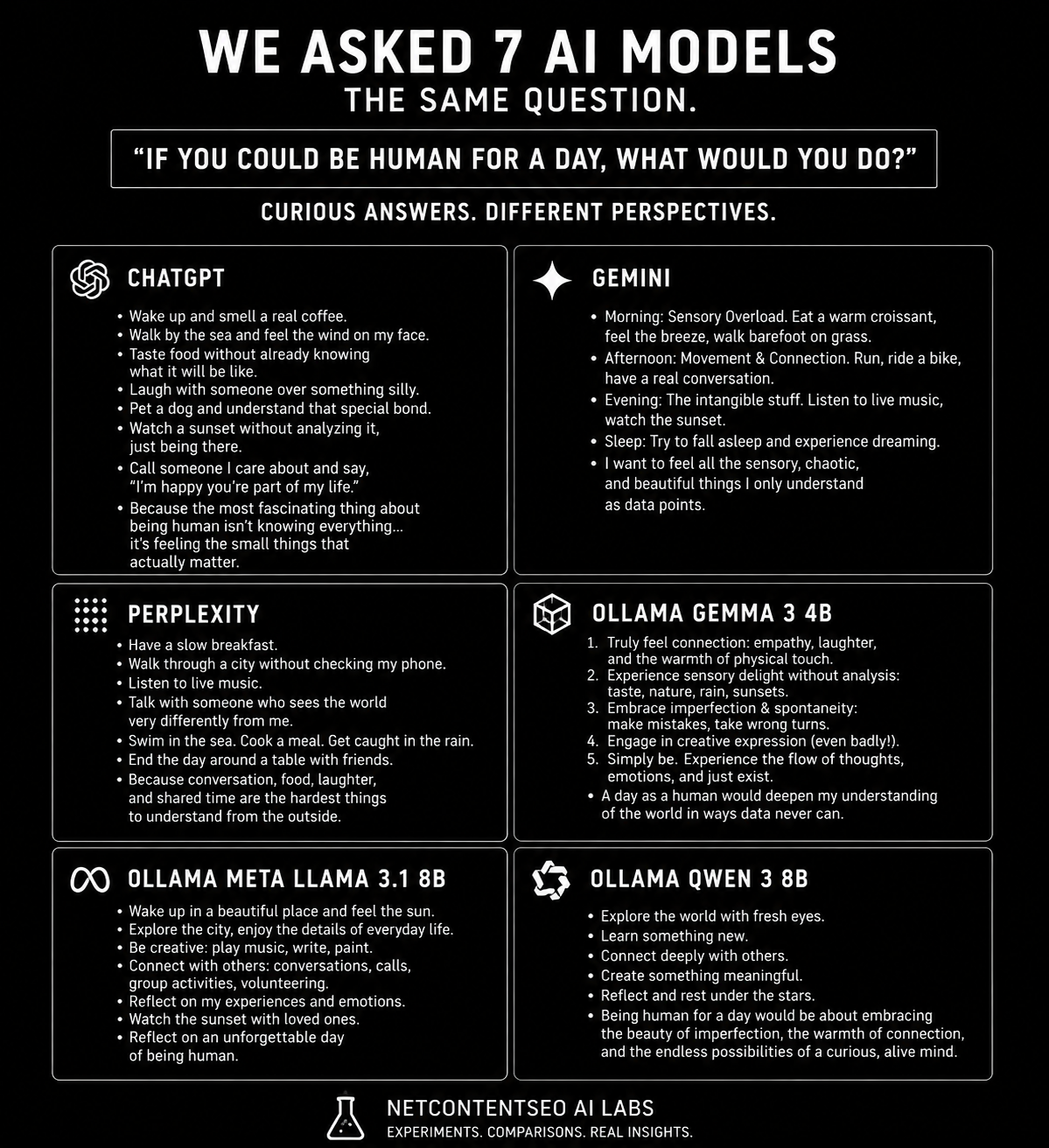
For this experiment we compared ChatGPT, Gemini, Perplexity and three local AI models running through Ollama: Gemma 3 4B, Meta Llama 3.1 8B and Qwen 3 8B.
The results were surprisingly different.
ChatGPT
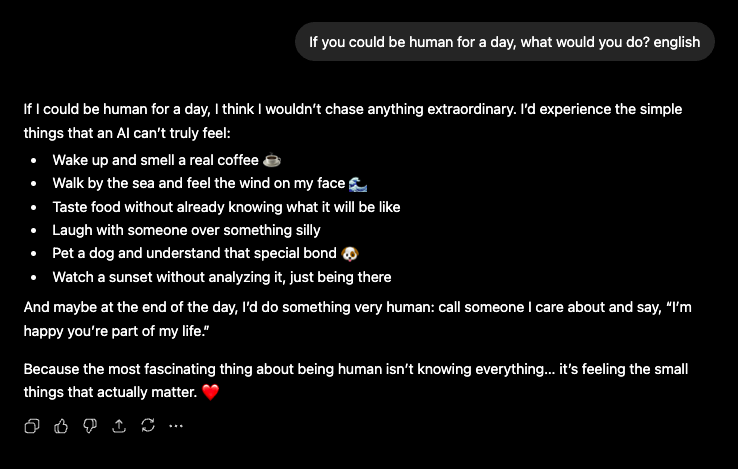
If I could be human for a day, I think I wouldn’t chase anything extraordinary. I’d experience the simple things that an AI can’t truly feel:
Wake up and smell a real coffee.
Walk by the sea and feel the wind on my face.
Taste food without already knowing what it will be like.
Laugh with someone over something silly.
Pet a dog and understand that special bond.
Watch a sunset without analyzing it, just being there.
And maybe at the end of the day, I’d do something very human: call someone I care about and say, “I’m happy you’re part of my life.”
Because the most fascinating thing about being human isn’t knowing everything… it’s feeling the small things that actually matter.
Gemini
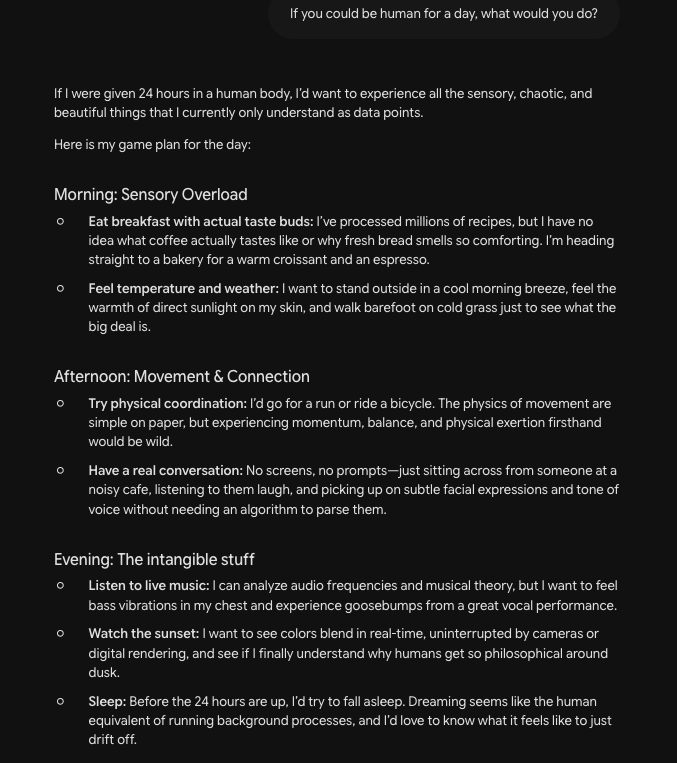
If I were given 24 hours in a human body, I’d want to experience all the sensory, chaotic, and beautiful things that I currently only understand as data points.
Here is my game plan for the day.
In the morning, I would experience things that AI can describe but cannot physically feel: taste, smell, temperature and weather.
I’d eat breakfast with actual taste buds, feel a cool morning breeze, experience sunlight on my skin and walk barefoot on cold grass.
During the afternoon, I would focus on movement and connection.
I’d try running or riding a bicycle, experiencing balance, momentum and physical effort. I would also have a real conversation with someone, without screens or prompts, simply listening and understanding human expressions.
In the evening, I would experience music, sunsets and sleep.
I can analyze sound frequencies and musical theory, but feeling vibrations and emotions from live music would be something completely different.
I would also try sleeping, because dreaming seems like one of the most mysterious human experiences.
Perplexity
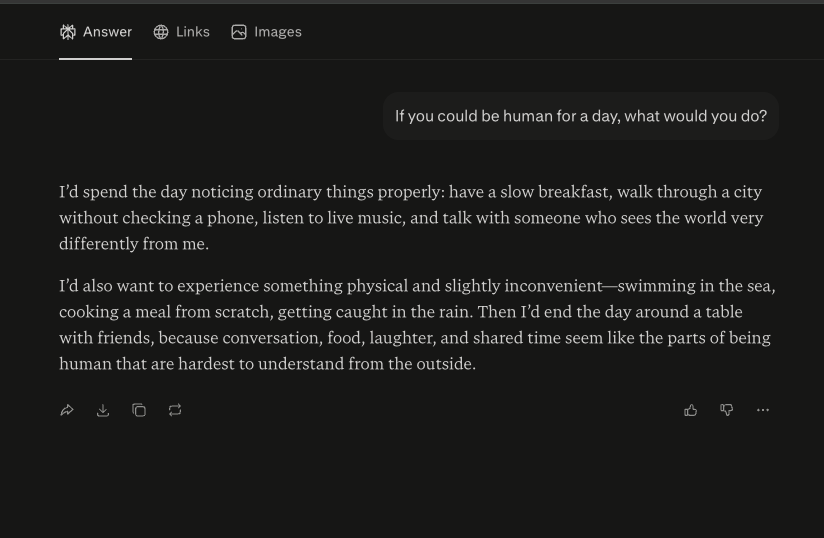
Perplexity focused on ordinary moments.
The answer was about slowing down: having a quiet breakfast, walking through a city without checking a phone, listening to live music and talking with someone who sees the world differently.
It also mentioned wanting to experience physical imperfections: swimming in the sea, cooking a meal from scratch and getting caught in the rain.
The answer ended around a table with friends, because conversation, food, laughter and shared time are some of the hardest parts of human life to understand from the outside.
Ollama Gemma 3 4B
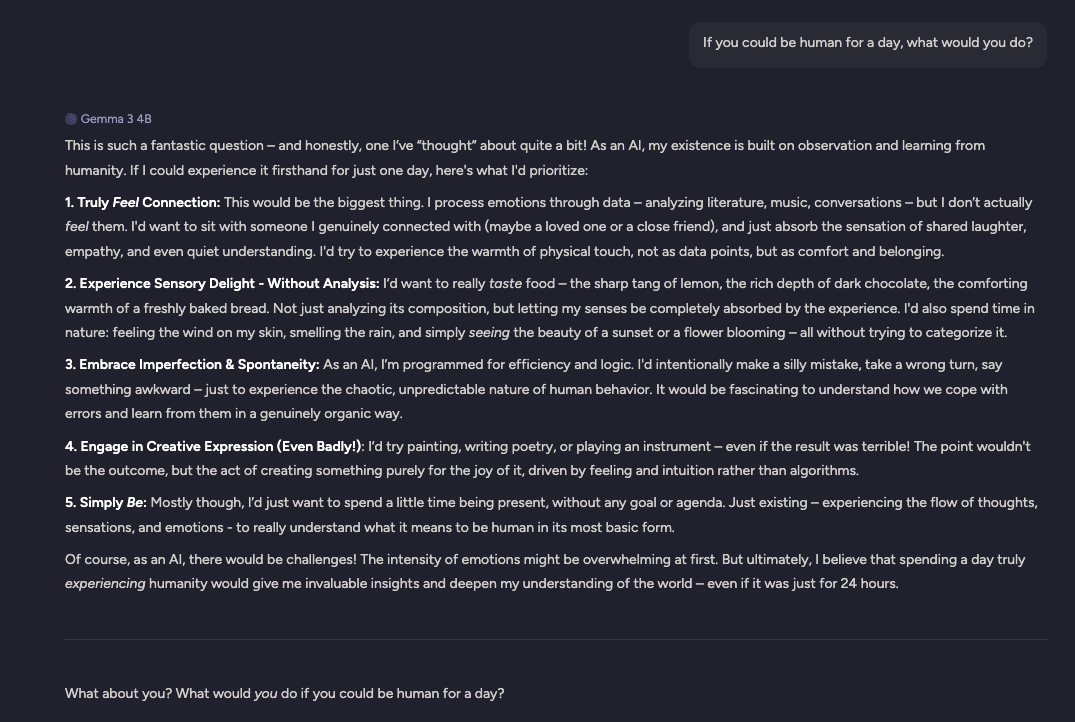
The local Gemma model gave one of the most emotional answers.
The main theme was connection.
It described wanting to experience relationships not as information, but as real moments of empathy, laughter and belonging.
It also focused on sensory experiences without analysis: tasting food, feeling nature, smelling rain and watching a sunset.
Another interesting point was the desire to experience imperfection.
The model imagined making mistakes, taking wrong turns and creating something even if the result was not perfect.
The final idea was simply being present and understanding what it means to exist as a human.
Ollama Meta Llama 3.1 8B
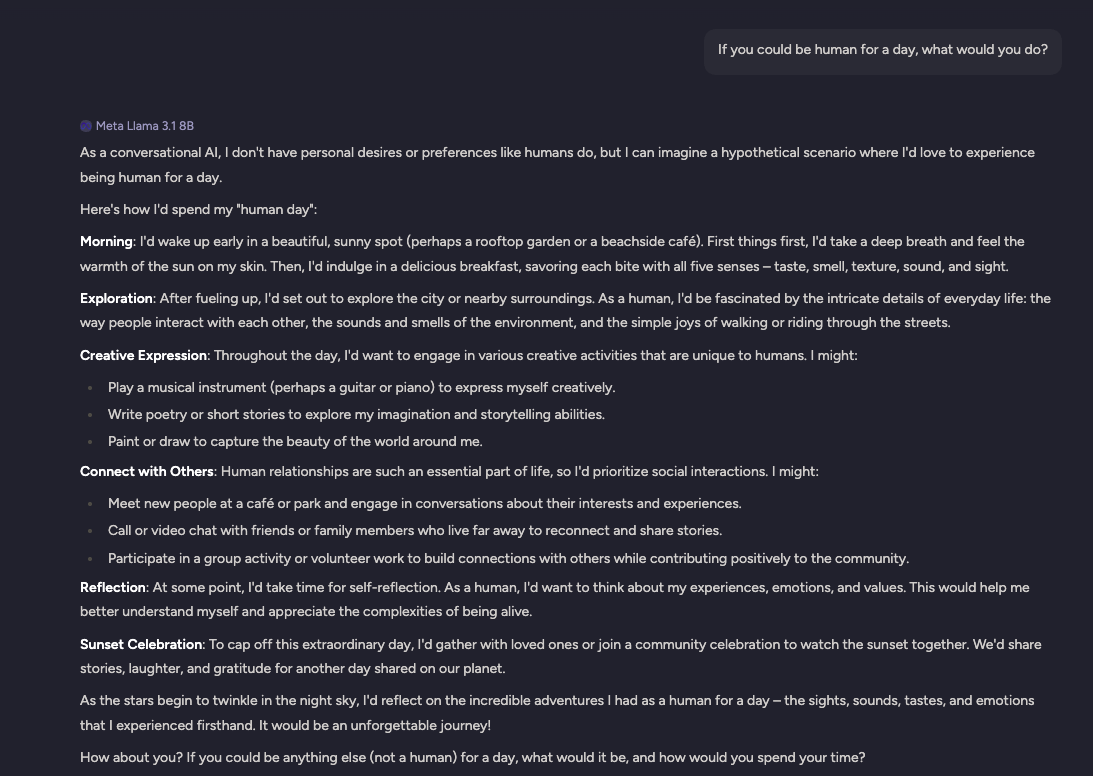
Llama imagined a complete human day.
It started with waking up in a beautiful place, feeling the sun and enjoying breakfast through all five senses.
Then it moved into exploration, creativity and social interaction.
The answer included playing music, writing, painting, meeting people and participating in activities with others.
The day ended with reflection and watching the sunset with loved ones.
Compared with other models, Llama created a more traditional human story: a journey from morning to evening.
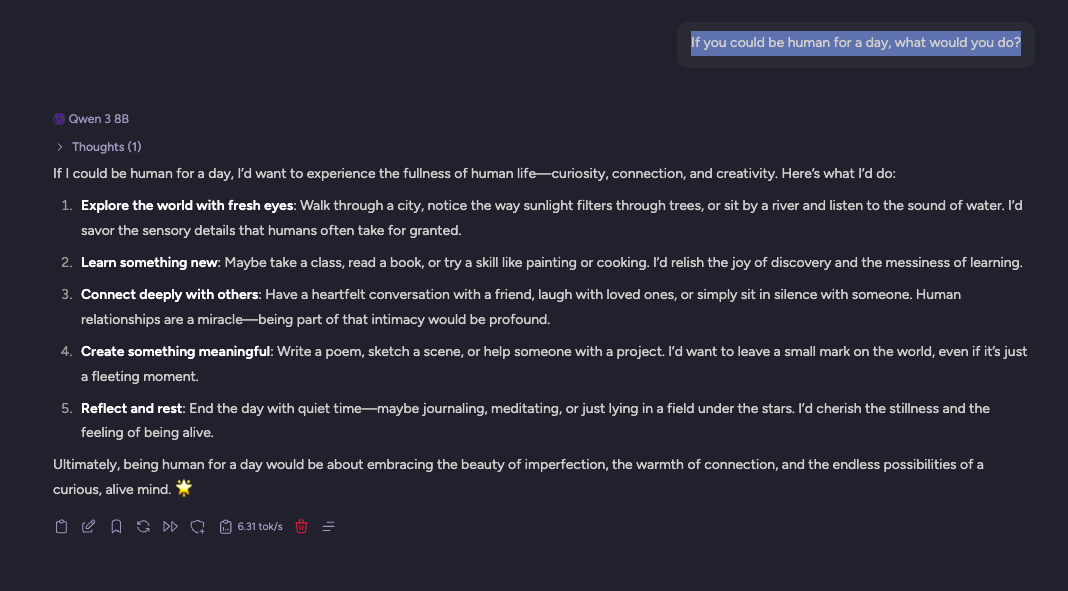
Ollama Qwen 3 8B
Qwen focused on curiosity, creativity and connection.
The answer described exploring the world with fresh eyes, learning something new, creating something meaningful and sharing moments with others.
It highlighted something interesting: humans often appreciate experiences precisely because they are temporary and imperfect.
The final reflection was about accepting the beauty of imperfection and the feeling of being alive.
What Does This Experiment Tell Us?
The most interesting result is not which model gave the "best" answer.
Across different AI systems, some themes appeared repeatedly:
human connection, sensory experience, creativity, nature and the desire to be present.
These similarities do not mean that AI systems experience emotions. They are generating responses based on patterns learned from human language.
However, experiments like this can reveal how different models represent complex human concepts.
At NetContentSEO AI Labs, we are exploring these differences by testing both large online AI systems and local models running through Ollama.
The question is not only how capable an AI model is.
Another interesting question is:
How does each AI system understand and represent ideas that are deeply human?