
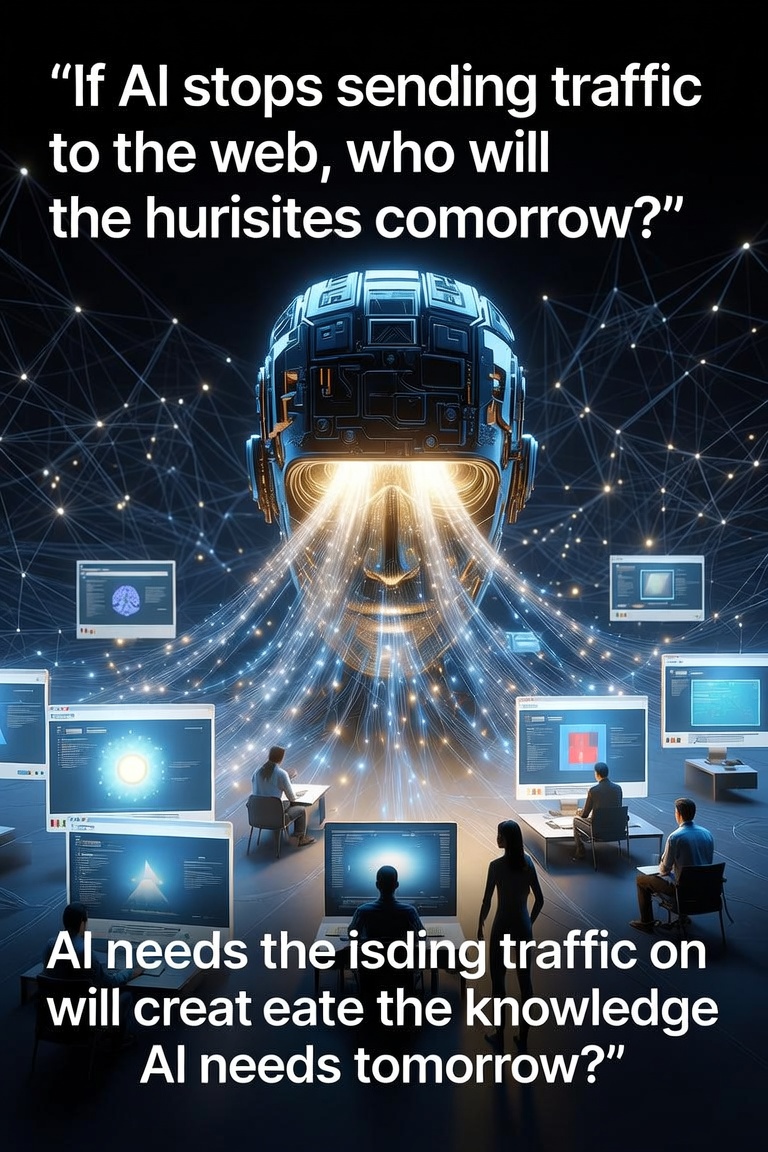
AI search is becoming remarkably good at removing the need to visit a website.
Ask a question and, increasingly, the answer is already there. Google can summarize it. ChatGPT can explain it. Perplexity can combine several sources into a single response. From the user's perspective, this is often a better experience. You get what you need without opening ten tabs, accepting cookies, closing pop-ups or searching through a 2,000-word article for one paragraph.
But there is an uncomfortable question hiding behind that convenience: if LLMs progressively replace traffic to the sources they use, who will fund the new sources those same LLMs will need tomorrow?
For much of the open web, traffic has never been just a vanity metric. A visit can become an advertising impression, an affiliate commission, a subscription, a lead or a sale. That economic exchange helped finance millions of websites, from independent blogs and specialist publications to comparison sites, forums and small businesses producing useful information in their niches.
AI search changes that exchange. A source can contribute information to an answer without receiving the visit that traditionally gave that information economic value. Citations certainly help. They provide attribution, visibility and potentially brand recognition. They may even create a new kind of value that we are only beginning to understand. But a citation and a visit are not economically equivalent.
This creates a strange dependency. Search engines and LLMs become more useful by extracting, understanding and reorganizing knowledge from the open web. At the same time, if that usefulness dramatically reduces the incentive to visit the original sources, it can weaken the ecosystem responsible for producing new knowledge in the first place.
The problem probably won't appear overnight. Large publishers will adapt. Brands will continue publishing because content serves purposes beyond direct traffic. Governments, universities, communities and enthusiasts will continue putting information online. New business models will emerge. But at the edges of the web, where a few thousand visits can determine whether maintaining a specialist website is worthwhile, the calculation may become very different.
There is another consequence worth considering. If fewer humans and organizations can justify producing original material, the web may gradually contain a larger proportion of content generated from information that already exists. AI systems would then increasingly encounter pages that summarize, rewrite or recombine knowledge previously produced elsewhere — sometimes by other AI systems.
That is a very different information ecosystem from the one that trained today's models.
Perhaps this is one reason citations are becoming so important. They are usually discussed as a question of attribution or AI visibility, but they may eventually become part of something larger: a mechanism for preserving an incentive to remain a source. Visibility, reputation and recognition could acquire economic value even when the traditional click becomes less common.
Whether that will be enough is still an open question.
AI search does not have to destroy the open web. It may create entirely new ways for information producers to capture value. But some sustainable exchange has to exist between the systems answering the questions and the people, businesses and communities producing the knowledge behind those answers.
Otherwise, we eventually arrive back at the same question:
If AI no longer needs to send us to the web, what will make it worthwhile for us to keep creating the web AI needs?