
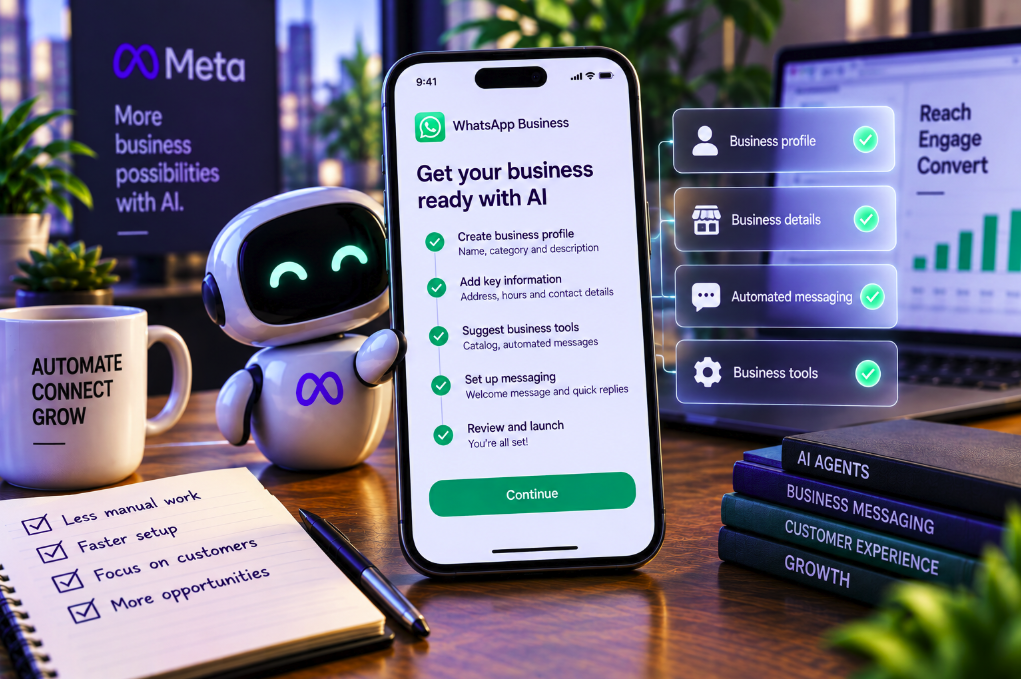
Meta is turning one of the most tedious parts of WhatsApp Business development into a conversation with an AI agent.
According to a September 15 TechCrunch report, Meta has introduced WhatsApp Business Tools MCP, a Model Context Protocol server designed to connect AI coding agents such as Claude, Cursor, Codex and ChatGPT directly to the WhatsApp Business Platform.
The practical change is significant. Instead of moving repeatedly between Meta’s Developer Console, Business Manager, API documentation and a code editor, a developer can describe what needs to be configured and let a compatible agent carry out much of the operational work.
This is not another chatbot for answering customers. It is infrastructure for letting AI agents operate the developer and configuration workflow behind WhatsApp Business messaging.
WhatsApp Business setup is becoming an agentic task
WhatsApp Business Platform onboarding contains several steps that are individually straightforward but collectively time-consuming.
A developer may need to create or configure the relevant business account, add a phone number, verify it, register it for the Cloud API, confirm platform requirements, configure templates and then test whether messages and webhooks behave correctly.
Traditionally, those steps are spread across different Meta interfaces and documentation surfaces.
The new MCP server gives an AI agent a structured way to interact with those tools on the developer’s behalf.
The agent can create and configure core WhatsApp Business resources
TechCrunch reports that Meta’s MCP integration can handle much of the setup busywork, including creating the company’s WhatsApp Business account, adding and verifying its phone number and registering the number for Cloud API access.
The agent can also check whether important account requirements are in order.
That turns natural-language instructions into operational actions rather than merely generating a checklist that the developer must execute manually.
The distinction is central to the current wave of agentic software: the model is no longer limited to telling a user which button to press next.
MCP provides the bridge between the model and Meta’s platform
Model Context Protocol has become a common way to expose external tools and data to AI assistants through standardized interfaces.
Instead of relying on the model to imitate browser actions blindly, an MCP server can present defined capabilities that a compatible agent can invoke as tools.
For WhatsApp Business, that means the agent can be given structured access to platform operations required for onboarding and maintenance.
The developer still communicates with the AI conversationally, but the work behind the conversation can involve real platform actions.
Claude, Cursor, Codex and ChatGPT are among the compatible agents
Meta’s decision to expose the workflow through MCP also avoids tying the experience to one AI assistant.
TechCrunch specifically names Claude, Cursor, Codex and ChatGPT as examples of AI coding agents that can connect to the WhatsApp Business Platform through the new server.
That makes the launch part of a broader shift in developer infrastructure.
Software companies are increasingly designing APIs and operational systems not only for human developers and conventional applications, but also for AI agents that can interpret a goal and orchestrate several tool calls to complete it.
Message templates can be created conversationally
Onboarding is only one use case.
Businesses can reportedly describe the messaging template they want and ask the agent to create it. Existing templates can also be edited through the same workflow.
This is a natural fit for agentic tooling because template creation combines two tasks AI systems already handle well: understanding a business communication requirement and translating that requirement into a structured platform artifact.
The value comes from connecting generation directly to the system where the template is managed rather than stopping at draft text.
The agent can also test messages and webhooks
Configuration problems often emerge after the nominal setup is complete.
A webhook may not fire correctly. A message test may fail. An account dependency may remain incomplete without producing an obvious warning in the developer’s normal workflow.
Meta’s new tooling reportedly lets agents test messages and webhooks, creating the possibility of a conversational debugging loop.
A developer can describe the expected behavior, let the agent inspect or exercise the relevant configuration and then work through the failure without manually switching between several interfaces.
Monitoring quiet configuration failures may be one of the most useful features
TechCrunch says the agent can monitor issues that might otherwise fail quietly, including the state of Terms of Service, payment methods and Business Verification.
This should not be interpreted as the agent bypassing those requirements.
The important capability is visibility: an agent can inspect the workflow and surface which dependency is preventing the configuration from progressing.
For teams supporting many business messaging implementations, reducing the time spent discovering that a payment method or verification state is blocking deployment could be more valuable than automating any single setup form.
AI agents do not eliminate Meta’s platform requirements
The arrival of a conversational setup layer does not mean WhatsApp Business has become permissionless.
Phone verification, business requirements, messaging policies, templates, Cloud API registration and other platform controls still exist.
The agent can automate supported steps and help identify incomplete requirements. It cannot turn a failed verification into an approved one simply because the developer asked conversationally.
This is workflow automation inside Meta’s platform rules, not a mechanism for bypassing them.
Meta is building a broader MCP layer around its developer ecosystem
The WhatsApp launch is not Meta’s first move into MCP.
TechCrunch notes that the company already offers MCP servers for other developer tasks, including advertising and app configuration or monitoring.
The new WhatsApp Business Tools MCP extends that strategy into business messaging onboarding.
This suggests Meta sees AI coding agents as a new interface layer for its developer platform rather than as a one-off experiment attached to WhatsApp.
If that approach continues, developers may increasingly manage Meta infrastructure through an agent while dashboards become the place where humans inspect and approve state rather than manually perform every step.
Meta Social Technologies MCP can work alongside the WhatsApp server
Meta also has another MCP server that can complement the WhatsApp-specific tools.
TechCrunch reports that Meta Social Technologies MCP can help an agent discover API endpoints, search documentation and troubleshoot errors during setup and configuration.
The combination illustrates how agentic developer tooling can be modular.
One server exposes the operational WhatsApp actions. Another helps the model understand Meta’s broader developer environment and documentation.
The agent can potentially move between both toolsets while keeping the developer inside one conversational workflow.
This is different from putting an AI customer-service bot on WhatsApp
The terminology can easily create confusion because Meta, WhatsApp and the broader industry use “AI agent” for several different products.
WhatsApp Business Tools MCP is a developer and operations interface. It lets an AI coding agent configure the infrastructure used by a business.
That is different from an AI system that responds to customers inside WhatsApp conversations.
It is also different from a general-purpose assistant using WhatsApp itself as a distribution channel.
The new launch is about who—or what—does the setup work behind the scenes.
Meta is effectively making natural language a developer interface
The strategic shift is larger than WhatsApp.
Developer platforms have traditionally exposed two primary interfaces: graphical dashboards for humans and APIs for software.
MCP adds a third layer.
An AI agent can understand a high-level instruction, inspect available tools and translate the goal into the sequence of API-backed actions required to complete it.
That can make sophisticated platforms more accessible without removing the underlying technical architecture.
The developer still needs to understand what the agent is changing
Lowering the interface burden creates a new governance problem.
A developer who manually registers a phone number, changes a webhook or edits a template knows exactly which action was performed because they performed it themselves.
An agent can execute several related changes in response to one broad request.
Teams therefore need visibility into tool calls, permissions and resulting configuration state.
Convenience should not turn infrastructure changes into an opaque process.
Scoped credentials become increasingly important
An AI agent capable of modifying business messaging infrastructure needs meaningful permissions.
Those permissions should be no broader than the task requires.
Organizations adopting agentic developer tools should use scoped access, controlled environments and auditable credentials rather than giving a general-purpose assistant unrestricted authority over every business asset.
This is standard security practice, but agentic interfaces make it more important because a model can execute actions faster and across more steps than a human clicking through dashboards.
Human review remains useful for externally visible changes
Some WhatsApp Business actions can directly affect customer communication.
A message template can become part of a campaign. A webhook change can affect production automation. A phone configuration can influence whether customers can reach the business.
For those changes, a sensible workflow is to let the agent prepare, configure and test while preserving human approval before consequential deployment.
The goal is not to keep every manual step. It is to keep accountability at the points where errors become expensive.
The biggest productivity gain may come from eliminating context switching
Meta’s own description of the old workflow, as reported by TechCrunch, emphasizes the number of tools developers had to move between.
That is a classic source of operational friction.
The developer reads documentation in one place, changes configuration in another, checks business settings elsewhere and returns to the editor to test the integration.
An agent connected through MCP can potentially keep the context of the task while operating across those layers.
The benefit is not merely faster clicking. It is reducing the cognitive overhead of remembering where every part of the configuration lives.
The launch does not come with a quantified productivity benchmark
Meta and TechCrunch describe the workflow as easier and less cumbersome, but the report does not provide a controlled study measuring setup time before and after the MCP integration.
There is no published percentage reduction in onboarding time, failure rate or developer effort in the source material reviewed for this article.
Those numbers should not be invented.
The productivity case is structurally plausible because several interfaces are being collapsed into one agentic workflow, but real savings will depend on the complexity of the business account, the quality of the agent’s instructions and the number of exceptions requiring human intervention.
Agentic onboarding could matter most to platforms managing many businesses
A single developer setting up one WhatsApp Business account may save some time.
The economics become more interesting for agencies, SaaS platforms, systems integrators and internal teams that repeatedly onboard business messaging accounts.
Repetitive configuration is exactly where automation compounds.
If an agent can consistently create accounts, register numbers, configure templates, run tests and diagnose incomplete requirements, the workflow can become a reusable operating procedure rather than a sequence of manual dashboard tasks.
The limiting factor will be reliability at scale.
Exceptions will determine whether the workflow is truly production-ready
Happy-path automation is relatively easy to demonstrate.
Real WhatsApp Business deployments can contain unusual account ownership, verification delays, phone-number issues, template restrictions, billing dependencies and webhook behavior that does not match the expected configuration.
An effective agent needs to know when it can solve the problem itself and when it should stop and ask the developer for a decision.
The quality of that escalation behavior may matter more than how quickly the agent completes a perfect setup.
Meta is designing its APIs for an agent-operated future
The broader significance of WhatsApp Business Tools MCP is that Meta is acknowledging AI agents as first-class users of developer infrastructure.
The company is not merely publishing documentation that an LLM might read. It is exposing structured tools specifically so compatible agents can perform supported operations.
That is an architectural change in how software platforms expect developers to work.
The future developer may spend less time memorizing dashboard navigation and more time specifying desired states, reviewing proposed actions and debugging exceptions with an AI operator.
WhatsApp Business setup becomes a conversation—but responsibility does not
The new MCP server can remove substantial mechanical work from WhatsApp Business onboarding.
A developer can ask Claude, Cursor, Codex or ChatGPT to help create and configure business messaging resources, register a phone for Cloud API access, work with templates, test messages and webhooks and inspect configuration blockers.
That is meaningfully different from using AI to generate sample API code.
The agent can participate in the actual operational workflow.
But Meta’s requirements remain in place, and the source material does not establish that every setup can now run autonomously or that human verification is unnecessary.
The strongest interpretation is simpler: Meta is converting a fragmented developer process into an agent-accessible toolchain. The boring parts can increasingly be delegated. The developer still owns the result.