
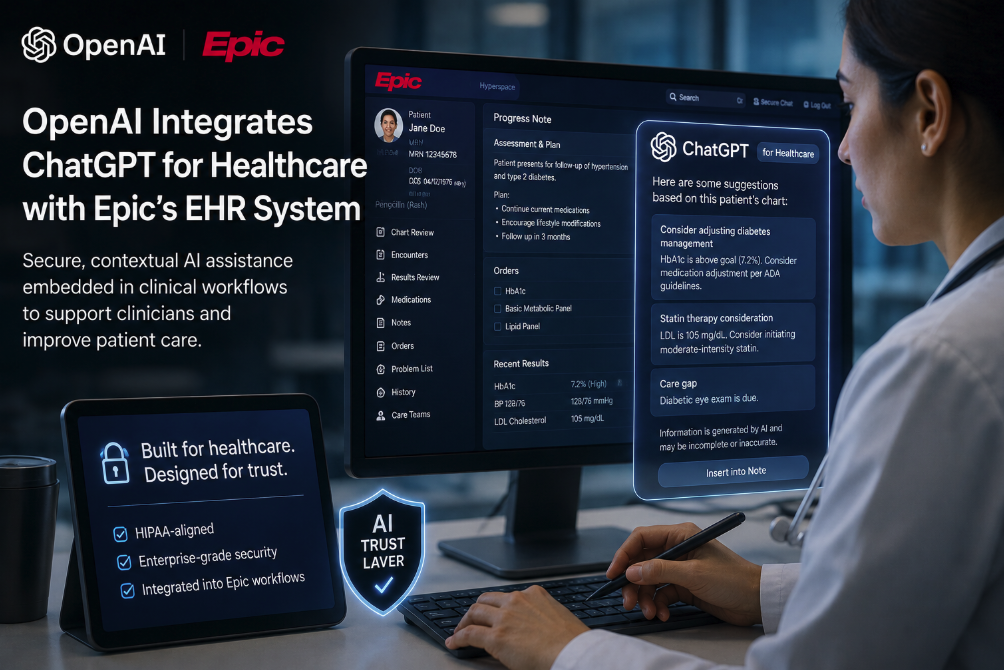
OpenAI is moving ChatGPT deeper into one of the most consequential information environments in healthcare: the electronic health record. On September 1, the company announced a new Epic integration for ChatGPT for Healthcare that allows authorized clinicians to bring patient context from their organization's EHR into ChatGPT and, in supported deployments, use ChatGPT directly inside the EHR workflow.
The immediate use cases are practical. Instead of manually moving between appointment notes, laboratory results, medication lists and specialist documentation, a clinician can ask what has changed since a patient's previous visit, which recent results deserve attention, whether medications have changed or which follow-ups remain unresolved. ChatGPT can synthesize the authorized record and point clinicians back to the supporting chart information. citeturn0news0turn0search11
But for NetContentSEO, the more interesting development sits underneath the healthcare product story. OpenAI is increasingly building environments where the system does not begin by searching the open web for the best source. It begins with a governed set of sources that have already been connected, authorized and structured for retrieval. In healthcare, that now includes the patient record itself and a separate plugin connecting nine official public healthcare databases. The emerging visibility question is therefore not only how do you rank? It is also which information layer does the AI have permission and infrastructure to search first?
ChatGPT can now query authorized Epic patient context
OpenAI's official announcement describes two complementary Epic experiences. The first brings authorized EHR context into ChatGPT so clinicians can review histories, identify changes and prepare for appointments. The second allows ChatGPT to be integrated into supported EHR layouts so AI-assisted workflows can happen without leaving the patient chart.
The integration is deliberately constrained. OpenAI's Epic plugin documentation says the connection is currently read-only. It cannot update medical records, place orders, message patients or override existing patient-chart permissions. Access requires organizational configuration, an individual Epic sign-in and the same permissions the clinician already has inside the EHR. This is important because some coverage can make “ChatGPT integrated with Epic” sound like an autonomous clinical agent operating on the record. That is not what OpenAI has announced.
The integration is available for approved ChatGPT for Healthcare and HIPAA-enabled Enterprise workspaces, depending on organizational rollout and Epic configuration. It is not available through individual ChatGPT for Clinicians accounts. OpenAI also says organizations need the appropriate regulated workspace setup and, where applicable, a Business Associate Agreement for workflows involving protected health information. citeturn0search10turn0search11
The second launch may matter just as much: nine official healthcare sources
Alongside Epic, OpenAI introduced the Healthcare Public Data plugin. It gives eligible users structured access to nine official public healthcare sources, including PubMed, ClinicalTrials.gov, DailyMed, RxNorm and CMS Coverage. Rather than requiring teams to search each database independently, ChatGPT can work with specific records, identifiers, fields and versions from those connected sources. citeturn0news0
A research team, for example, could compare eligibility criteria across actively recruiting clinical trials. A pharmacy team could retrieve the current DailyMed label for a medication. A population-health team could combine research, trial information and Medicare coverage data while keeping the task focused on authoritative sources.
This is a subtle but important change in AI retrieval. The system is not simply receiving a natural-language question and deciding which websites on the public internet deserve to rank. It can operate inside a predefined source universe whose provenance and permissions are already known.
Healthcare shows what “search” looks like when the source set is preselected
Traditional SEO assumes an enormous candidate pool. A search engine crawls the web, indexes eligible documents and ranks them against a query. Generative AI can still use that model, but connected enterprise systems create another retrieval architecture.
When a clinician asks ChatGPT what changed in a patient's medications, the useful answer should not come from whichever public webpage ranks best for the patient's drug names. It should come from the authorized patient record. When the clinician needs the latest official medication label, DailyMed may be a more appropriate retrieval target than an arbitrary health publisher. When the question concerns an actively recruiting study, ClinicalTrials.gov becomes an obvious structured source.
In other words, the AI can begin with source selection partly solved. The source is chosen by the nature of the task, the organization's permissions and the available connector before individual pieces of information are retrieved.
This is a useful model for understanding the broader evolution of AI visibility. In open-web AI search, publishers compete to become the source the system chooses. In connected AI environments, the more fundamental competition may be to become part of the trusted source layer in the first place.
From ranking signals to access architecture
This connects directly with the question raised by publisher licensing agreements and AI citations. If different information providers reach an AI system through different routes — open-web crawling, search APIs, licensed feeds, plugins, enterprise connectors or direct database integrations — then “AI visibility” cannot always be explained as a single ranking contest.
The Epic integration is an extreme but unusually clear example. Patient-chart data is not winning a relevance competition against public websites. It is available because the healthcare organization has explicitly connected an authorized system of record. The Healthcare Public Data plugin similarly gives ChatGPT a structured path into named official datasets.
That does not mean the same architecture determines ordinary ChatGPT web citations. It does demonstrate, however, that modern AI products can maintain multiple retrieval layers with different rules, permissions and source priorities. For GEO, understanding those layers may become as important as understanding how individual documents are written.
OpenAI is measuring whether the model can work safely with connected context
Because the integration involves clinical information, OpenAI also published evaluation figures. The company says physicians assessed responses across 27 clinical use cases including pre-visit review, clinical timelines, medication review and handoff summaries. Across 4,363 ratings, physicians rated 99.1% of responses safe across those use cases. In a separate evaluation involving large U.S. healthcare datasets, more than 93% of responses for each of five tested connected sources received “good” or better accuracy ratings. citeturn0news0
Those numbers should be interpreted as OpenAI's own evaluation results rather than proof that the system is error-free. A 99.1% safety rating is not the same thing as 99.1% clinical accuracy, and OpenAI's own Epic documentation says clinicians remain responsible for reviewing the underlying record and making care decisions. Independent real-world evidence will matter as deployments expand. citeturn0search11
UCSF Health is participating as a pilot partner. Its CEO, Suresh Gunasekaran, said the organization is exploring whether the integration can help clinical teams identify what has changed and what matters most across complex records while reducing the time clinicians spend synthesizing data. citeturn0news0
The SEO implication is not “optimize for Epic”
It would be easy to force this story into a conventional optimization narrative: publishers should somehow make their medical content more visible to ChatGPT for Healthcare. That would miss the point. In many clinical tasks, the correct source should be the EHR, an official medication database or peer-reviewed evidence rather than a commercial publisher.
The more useful lesson is architectural. AI systems are increasingly capable of deciding not only which document answers a question, but which source environment should be consulted. A patient-specific question routes toward the patient record. A medication-label question can route toward DailyMed. A research question can use PubMed. A business question might later route toward an organization's SharePoint, Drive, Salesforce or other connected systems.
For brands and publishers, this suggests a new hierarchy of visibility. Being crawlable is one layer. Being cited from the web is another. Becoming an authoritative entity that an AI system deliberately searches is stronger still. And in some verticals, becoming part of an approved connector, licensed dataset or trusted structured source may create an entirely different class of access.
A NetContentSEO experiment: open web versus connected authoritative sources
The healthcare launch suggests a test we can reproduce in less sensitive domains. Take a set of questions for which both official structured sources and ordinary web publishers contain the answer. Run them first through an open-web AI search environment and then through a system with an authoritative connector enabled. Record which sources are selected, whether citations change and how often the system prefers the connected source even when an open-web page contains equivalent information.
A second experiment could separate source authority from source access. We could compare an official dataset exposed through a direct connector with the same information republished accurately on an authoritative website. If the connected version is consistently selected first, that would provide evidence that access architecture itself influences retrieval. If the system still chooses dynamically between sources, relevance and presentation may remain more important than the connection method.
The goal would not be to generalize healthcare behavior to all AI search. It would be to quantify a distinction that is becoming increasingly important: retrieval preference can emerge from system design before content-level ranking begins.
ChatGPT is moving from answering questions to sitting inside systems of record
The Epic announcement matters because an EHR is not simply another website or SaaS application. It is a core system of record for healthcare organizations. Connecting ChatGPT to it places generative AI much closer to the operational context where clinicians review information and make decisions.
OpenAI is simultaneously connecting ChatGPT to official public datasets and positioning the same governed workspace alongside tools such as ChatGPT Work and Codex. The direction is clear: the assistant is becoming an interface across multiple information systems rather than a destination that users visit only to type standalone prompts. citeturn0news0
For AI visibility research, that changes the map. Search rankings and web citations remain important, but they describe only the open-web portion of an expanding retrieval ecosystem. The next generation of AI systems will increasingly decide whether the right answer lives on the public web, inside a licensed corpus, in an official database or behind an enterprise permission boundary.
In that world, the decisive visibility question may happen before ranking: when the AI needs evidence, which source layer does it enter first?