
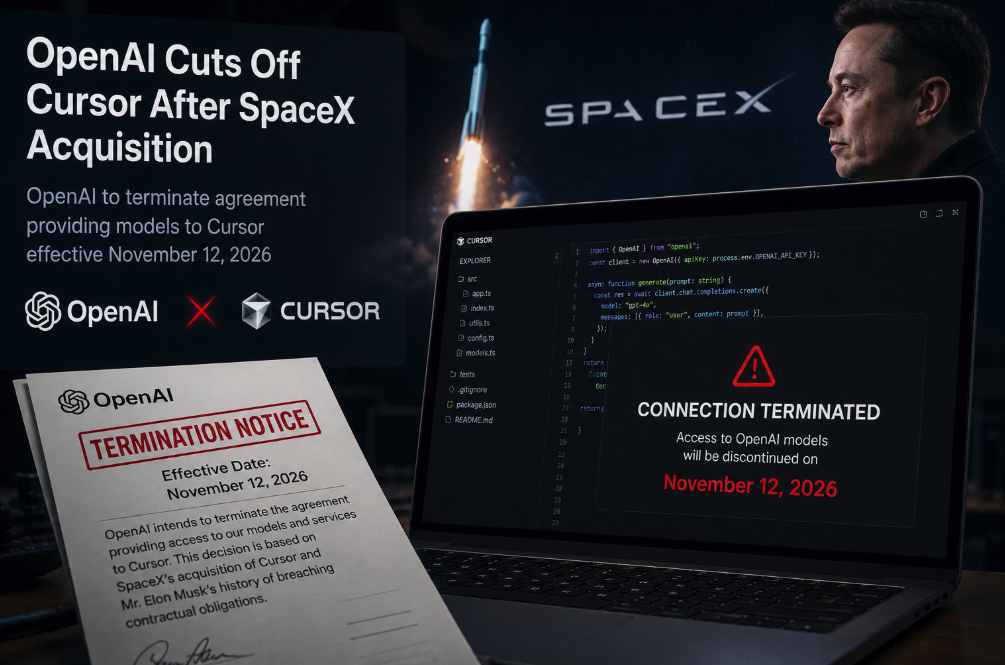
OpenAI is moving to end the agreement that supplies its models to Cursor after the AI coding company was acquired by SpaceX, explicitly citing its history with companies controlled by Elon Musk and saying it cannot be confident that SpaceX will use OpenAI technology within its terms. The company has proposed November 12, 2026 as the shutoff date, giving developers a transition window before direct model access through Cursor’s existing commercial integration is expected to end.
The decision was announced by OpenAI on August 28 in an unusually direct company statement. OpenAI said its custom agreement with Cursor contains a limited cancellation window following a change of control, and that SpaceX’s acquisition triggered the opportunity to exercise that provision. Cursor confirmed on August 14 that it had officially become part of SpaceX.
What makes the announcement notable is not simply that an AI supplier is leaving a distribution partner after an acquisition. OpenAI publicly tied the decision to its assessment of Musk-controlled companies’ past contractual behavior, turning a commercial termination into another major front in the increasingly complicated relationship between the two AI camps.
OpenAI says the issue is whether SpaceX will follow its terms
OpenAI said it normally relies on custom contracts when supplying models to a large partner such as SpaceX, both to enforce its terms of service and to provide safety controls at scale. The company argued that its previous dealings with Musk’s businesses give it insufficient confidence that those obligations would be respected under Cursor’s new ownership.
In its statement, OpenAI pointed to its previous contract with Twitter, now part of SpaceX, saying the company broke the agreement after Musk acquired the social network. OpenAI also cited sworn testimony from Musk earlier this year in which, according to the company, he acknowledged that xAI had violated OpenAI’s terms of service. Those are OpenAI’s stated reasons for invoking the change-of-control provision; they do not amount to an allegation that Cursor itself breached its agreement before the acquisition.
That distinction matters. OpenAI praised Cursor’s team and said it had worked with the company for nearly four years. The cancellation is being framed as a response to the ownership change and OpenAI’s assessment of the new parent company, rather than as punishment for Cursor’s prior conduct.
November 12 is proposed, but the final date is not yet locked
The headline date requires some precision. OpenAI’s announcement describes November 12, 2026 as a proposed shutoff date, not an already finalized termination date. The company’s newly updated support documentation for Cursor users says OpenAI plans to continue providing the models Cursor currently uses during the transition period, but Cursor may choose to end that access sooner. OpenAI says it will publish the official termination date once it is confirmed between the companies.
OpenAI says it deliberately selected the latest date permitted by the contract so developers have as much time as possible to retain access. However, the company has drawn a line around future models: it says it will not provide upcoming models to Cursor during the wind-down.
That includes Astra, which OpenAI specifically referenced in explaining its decision. The company said advancing model capabilities create a higher level of responsibility to ensure that future systems are used according to its terms. In other words, the dispute is not only about an existing commercial relationship; it is also about who gets access to OpenAI’s next generation of technology.
Cursor users will still have routes to OpenAI models
The termination does not mean developers will necessarily be unable to use OpenAI models while working inside Cursor. OpenAI’s support page outlines several alternatives, including bringing a developer’s own OpenAI API key for supported local Chat and Agent functionality, using OpenAI’s Codex IDE extension directly inside Cursor, or connecting through a compatible AI gateway provider.
This makes the practical impact more nuanced than a complete technical blockade. OpenAI is winding down the contract under which Cursor itself provides access to OpenAI models, but it is simultaneously telling developers how they can maintain a direct relationship with OpenAI while continuing to use the Cursor application.
The distinction is strategically important. OpenAI can stop supplying models as a platform partner without necessarily preventing individual developers from choosing OpenAI through their own accounts. That reduces the disruption for users while weakening Cursor’s ability to package OpenAI access as part of its own multi-model service.
The SpaceX acquisition changed Cursor’s strategic position
Cursor’s acquisition by SpaceX makes the supplier relationship much more sensitive because Cursor is no longer simply an independent coding startup buying access to external foundation models. In its acquisition announcement, Cursor said joining SpaceX would give it access to enormous GPU capacity and help it develop stronger, more economical models of its own. The company highlighted Grok 4.6 as an early example of what the combined organization could build.
SpaceX had already described its collaboration with Cursor in regulatory materials as part of a broader strategy to vertically integrate compute infrastructure, AI models and applications. Its June 2026 prospectus said the companies intended to collaborate on improving existing models, including Grok, and potentially develop AI models together. That creates an obvious competitive dimension to OpenAI’s decision: Cursor is now embedded inside an organization developing models that compete directly with OpenAI’s.
OpenAI’s public rationale remains contractual compliance and safety rather than competitive exclusion. Still, the result is the same at a strategic level: one of the most important AI coding interfaces will no longer receive OpenAI’s future models through the commercial arrangement it previously relied on, just as its new owner is investing heavily in its own competing model stack.
The dispute exposes a weakness in the multi-model AI ecosystem
Cursor became influential partly because it allowed developers to work with multiple frontier models through a single coding environment. That model assumes that AI labs are willing to distribute their most capable systems through third-party applications even when those applications can switch users among competing providers. The SpaceX acquisition shows how quickly that assumption can break when the application layer itself becomes part of a rival AI organization.
For developers, this creates a new kind of platform risk. Choosing an AI coding environment is no longer only a question of interface quality or model benchmarks. Ownership structures, supplier agreements and competitive relationships between AI labs can determine which models remain available inside a product and on what terms.
According to reporting from Reuters, the move further escalates the long-running conflict between Musk and OpenAI leadership. The Information reported that OpenAI models represent only a small share of Cursor’s traffic, which would limit the immediate operational damage if that figure accurately reflects current usage. But the symbolic significance is larger: a major model provider is explicitly declining to extend future access to a leading developer platform because of who now owns it.
A commercial contract becomes part of the AI power struggle
There is an irony in how the AI developer ecosystem has evolved. Frontier model companies spent years encouraging software startups to build products on top of their APIs, creating an application layer in which developers could mix models from different labs. As consolidation accelerates, some of those applications are becoming strategic assets of the same companies competing to build the underlying models and compute infrastructure.
Cursor’s move into SpaceX therefore changes the incentives on both sides. SpaceX gains a major AI-native developer interface, model-training expertise and a direct distribution surface for its own systems. OpenAI, meanwhile, must decide whether supplying increasingly capable models to that interface remains compatible with its contractual, safety and competitive obligations.
OpenAI has now made its choice. Barring a change during the transition negotiations, the direct model-supply relationship with Cursor is heading toward termination, with November 12 as the proposed cutoff and future models such as Astra already excluded. Developers may have alternative routes to OpenAI inside Cursor, but the broader message is difficult to miss: in the next phase of the AI industry, access to frontier models will depend not only on technical compatibility and price, but increasingly on ownership, trust and the contracts connecting rival ecosystems.